
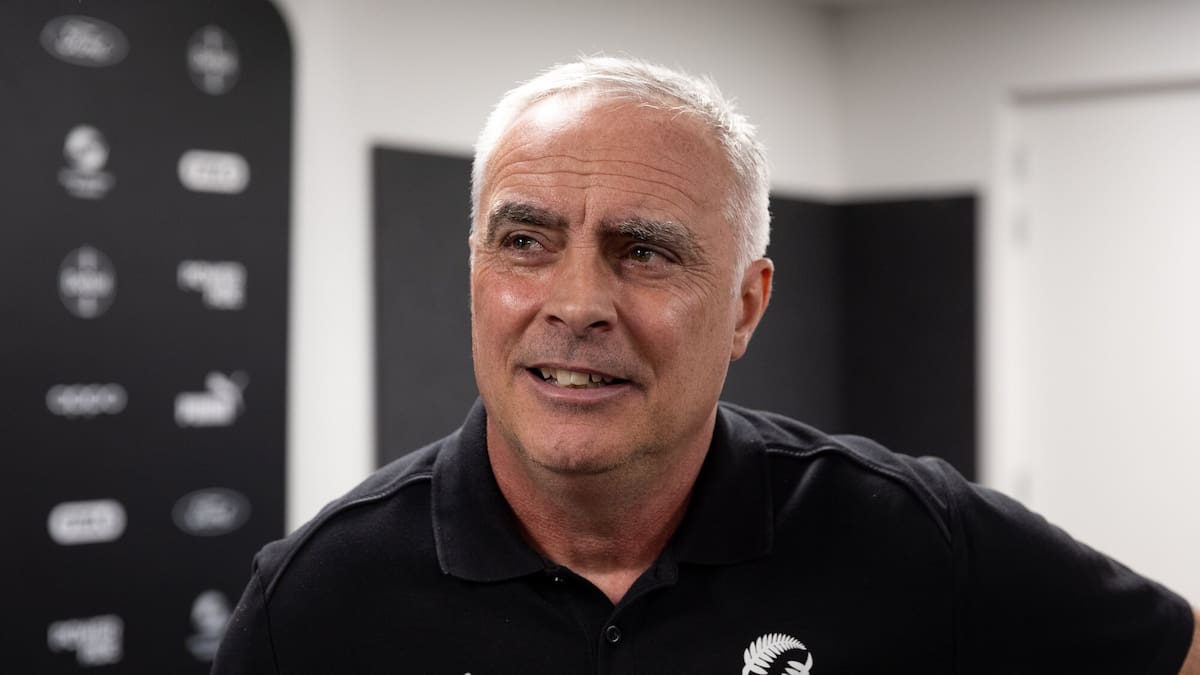
Bazeley says he didn’t see it coming. Even a week later – as he sits down to talk to the Herald – he is still coming to terms with the reality. He accepts the decision. But he certainly doesn’t agree with it.
“I think we were headed in the right direction,” Bazeley says. “There were so many things you can point to over the last few years and how we have progressed. I still think I was the best person for the job.”
The decision from Pragnell and NZF came four months after the end of the All Whites’ World Cup campaign, with the 5-1 defeat to Belgium on June 27 in Vancouver. It was a bitter way to finish, after the highs of the opening game, when they twice held the lead against Iran in the 2-2 draw, then the stunning first half against Egypt, when they led the powerful African nation 1-0, before conceding three goals after the break.
At that stage, Bazeley’s fate was uncertain, though precarious. Contracted until December, as time stretched on without any word, he was more hopeful of a renewal. Then there were the recent games in China and Japan, with a brilliant win over China, an impressive draw with Panama and being edged by Japan, in front of more than 70,000 in the Kirin Cup final.
“That match felt like a World Cup game,” Bazeley says.
He was already planning for next year when the news came.
New Zealand head coach Darren Bazeley with his team. Photo / Photosport
‘Results are key’
Pragnell told the Herald the decision was about results. Specifically, the World Cup games but also in the preceding 12 months, along with the general “trajectory”. There was a desire, Pragnell added, to take the team to the next level. Bazeley accepts the rationale – but questions the need for change at this time.
“I know results are key – but results have been building and it takes time for those results to come,” Bazeley says. “I genuinely feel like the trajectory of the team is in a good place. The environment’s great, the culture’s great, the players are performing, we’re scoring goals, we’re playing possession football.
“Yes, we need to be better in certain moments, tidy up our transition, tidy up some defensive moments but everything is heading in the right direction. We know we need to be better. Does it need wholesale change? No. Is it me that’s the problem? Time will tell.”
Bazeley is particularly proud of the last 18 months, pointing to some impressive performances. One of the highlights was a 1-0 win over Ivory Coast – then the African champions – in Toronto in June last year. They drew 1-1 with Norway in Oslo – “they were on a big winning streak” and lost 1-0 to a strong Polish side in Warsaw.
One of the best displays was against Colombia, then ranked 13th in the world, last November, in front of more than 25,000 passionate Colombian fans in Florida.
“That was a great team, they had everybody playing and we equalised in the 80th minute,” Bazeley recalled. “I remember we had a conversation on the sideline, ‘What shall we do?’ And we decided we could win it and made another attacking change.”
Ultimately New Zealand were punished, conceding a “sucker punch” goal in the dying stages, but for Bazeley, the point had been made in the 2-1 defeat.
“For us to be in that position, that was great strides.”
Another big moment was the 4-1 win over Chile in March, as New Zealand claimed their first victory against a South American nation in 20 attempts.
“That showed what we could do,” Bazeley says.
There were disappointments too, particularly the 2025 series against Australia, with the 1-0 loss in Canberra – after a dominant display – then the humbling 3-1 defeat in Auckland, where the Socceroos tore New Zealand apart and could have scored a few more.
The All Whites celebrate a goal against Chile. Photo / Photosport
A killer blow
But everything came down to the World Cup. The All Whites turned heads and produced some brilliant passages of play at that rarefied level. They took the lead twice against Iran – with the Iranians’ second equaliser a killer blow, in the 64th minute – while the New Zealand men also held a 1-0 advantage against Egypt early in the second half, before the Pharaohs, inspired by Mohammed Salah, came back to win 3-1.
“People talk about the fact that we conceded leads three times,” Bazeley says. “Why don’t we also talk about that we took the lead three times at a World Cup, which is very rare for a New Zealand team? Against Egypt, Callum McCowatt has a chance at 1-nil where the keeper makes a great save. If we go 2-nil up, that’s a different game. And we had other chances against Iran as well.”
There were many Sliding Doors moments, from key midfielder Matt Garbett’s injury on the eve of the tournament to the defensive lapse for Iran’s second goal to the refereeing blunder at 1-1 in the Egypt match, which led to their go-ahead strike.
There were also some big selection calls and tough, debatable decisions around substitutions.
Eli Just scores for the All Whites against Iran at the World Cup. Photo / Photosport
Overall, Bazeley was proud of the performances but took the exit hard, as he digested what might have been. Upon his return to New Zealand, he didn’t leave home for two weeks, sitting in his study, going over every aspect of the campaign.
“I didn’t want to go out,” he says. “I didn’t really want to talk to people. I felt disappointed that we didn’t achieve our goal. It wasn’t until I came out and I started talking to people on my walks that the pain around football started to change. I realised that a lot of people weren’t feeling like that. I felt the hurt and the disappointment because we didn’t achieve our internal goal. But other people didn’t have the same goal. They were proud of the players and had loved watching them play.”
NZF’s widely publicised aim before the World Cup was to win a match and get out of the group. Bazeley signed on for that – and still believed it was possible – but argued it was also an “ambitious, lofty goal”.
“We were playing against big football nations,” Bazeley says. “Nobody expected us to win and we pushed them to the limit. Imagine how Egypt felt at halftime, they have Salah and [Omar] Marmoush, some of the best players in the world and they are losing to a team ranked 85. Iran are a good team – they drew with Egypt and Belgium. Egypt almost beat Argentina [Round of 16] and Belgium reached the quarter-finals.”
Finn Surman celebrates his World Cup goal against Egypt. Photo / Photosport
Overall, there are different ways to assess Bazeley’s tenure. He wasn’t the first pick for the role and had never been a head coach at club level – a rare situation – but grew into the job. He inherited a strong base from Danny Hay, then developed further talent, with 17 players given their debuts. There were impressive performances but wins over non-Oceania opposition were often hard to come by, as they always are for New Zealand. The All Whites played a stack of games – with more opportunities and resources than ever – though also faced an unprecedented number of top-50 teams.
Bazeley had a golden generation of talent, who produced some wonderful football under his watch and enjoyed special moments but lacked the ruthless edge of the 2010 team, especially defensively. And it was undoubtedly a tough scenario at the World Cup, especially with several key players lacking full fitness, but Group G was seen as accessible and less foreboding than many others.
A life in football
Bazeley’s entire life has been football. It started back in 1988, as a 16-year-old apprentice at Watford. He was paid £28 a week, along with a bus pass to get to and from training.
“I was in digs, so all the meals were provided as well,” Bazeley says. “I was living, breathing football. It was brilliant.”
It was also a different world, as they had to clean the changing rooms and baths and were each allocated the boots of three first-team players. At one stage, the apprentices helped paint the terraces. He still remembers his senior debut away to Hull – coming on and setting up a goal with his first touch, along with the £150 win bonus.
“That felt like so much money,” Bazeley laughs.
Bazeley was a confident teenager and one day “nutmegged” one of their star players at training, who had previously won the European Cup in the early 1980s at another club.
“He grabbed me later, turned around and said ‘if you do that again, I’ll kill you’,” Bazeley laughs. “I was probably a bit cocky.”
Darren Bazeley (right) with former All Whites coach Anthony Hudson. Photo / Photosport
Bazeley spent 16 years in the professional game in England – with Watford, Wolves and Walsall – before coming here to play for the New Zealand Knights in 2005. And he has never left, aside from spells as an assistant at the Colorado Rapids (under Anthony Hudson) and the Newcastle Jets.
His first New Zealand role was as an assistant with the Under-17 team at their 2009 World Cup and he has been on the sidelines for more than 150 international matches since then, from age group to senior, either as head coach or assistant.
“For me this doesn’t feel like just the end to a three-year job,” Bazeley explains. “It’s like the end to a 15-year journey. I had Joe Bell and Alex Rufer in the Under-17s in 2012, Tim Payne at the 2011 Under-17 World Cup. I scouted Callum McCowatt when he was 11. I had the Under-20s, the Olympics, the All Whites under Neil [Emblem], under Anthony, under Danny [Hay]. So much of my life.”
‘I want to stay in football’
Bazeley will be in charge for the final time next month, when the All Whites take on India in Auckland (November 12) and Christchurch (November 15). When asked by Pragnell and Hansen if he wanted to continue – despite the news – he didn’t hesitate.
“I jumped at it,” Bazeley says.
He doesn’t know what’s next but is resigned to moving overseas, at least for a period.
“I want to stay in football,” he says. “That’s all I’ve known since I was 16 and I’m 54 now. But the thing about football is, roles are rarely advertised. You wait until something comes up.
“I haven’t really explored too much. I’m not one of those people that have been hedging my bets, thinking, ‘Okay if need to leave, I can go there’. I’ve only ever thought about this job. Even the last few months, I had already planned for next year and the next cycle, what changes are we going to make, who are we going to bring in to help.
“I’ve been working on that rather than making sure that I’ve got a plan B. Maybe it’s a little bit naïve. But I was fully focused on this job. I love these guys, I love this team. I’ll miss working with them so much. I really hope they go on to fulfil their potential and it’s just disappointing that I won’t be involved.”
Michael Burgess has been a Sports Journalist for the New Zealand Herald since 2005, covering the Olympics, Fifa World Cups, and America’s Cup campaigns. He is a co-host of the Big League podcast.