
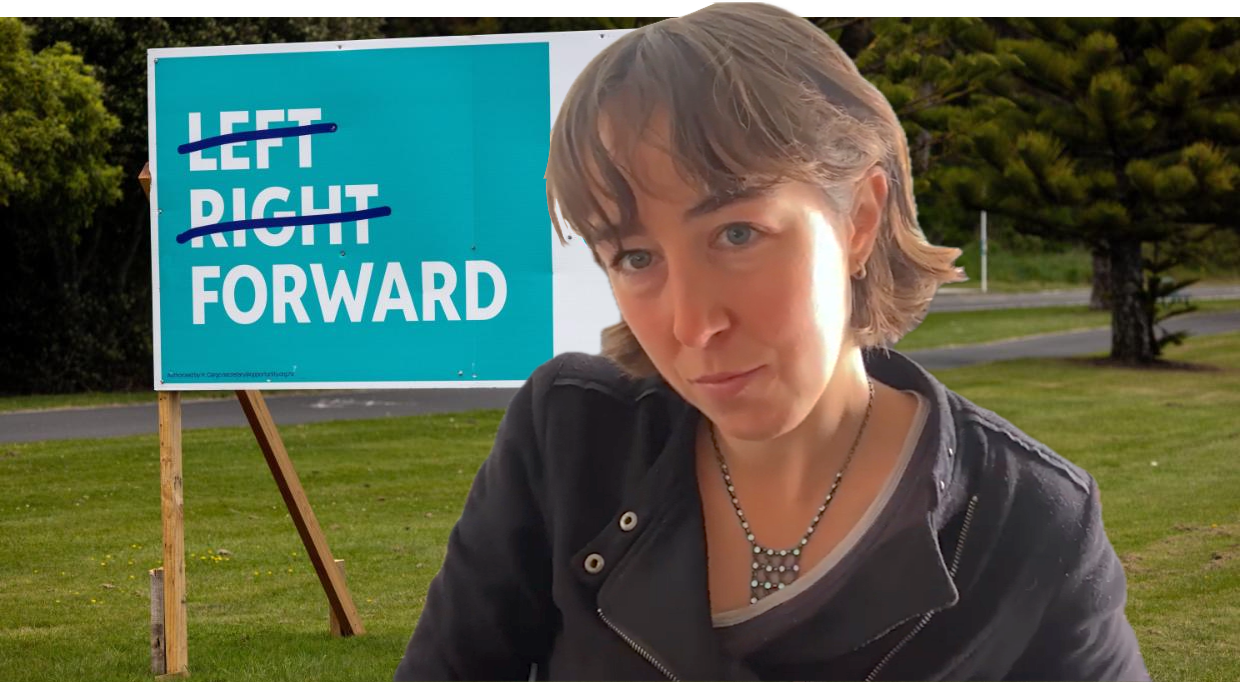
Tayla Forward laughs. She’s found herself unexpectedly at the centre of this election campaign, every time she passes an Opportunity billboard. “The Opportunity Party wants to run me so bad. All of their signs say not left, not right, but ‘forward’. I will never go into politics, but I’ve got the name for the signs!”
This week she finds herself at the centre of the campaign in a more meaningful way. The political economist has published a report – an extension of Inland Revenue’s big High-wealth Individuals Research Project in 2023 – that shows how much more untaxed wealth has concentrated in the hip pockets of NZ’s wealthiest people.
Now, the very wealthy in New Zealand pay just an 8.1 percent effective tax rate on their comprehensive income – less than half the 17.4 percent effective tax rate paid by middle New Zealand. Yet it’s middle New Zealand who will vote, and pay, to maintain this seemingly unfair status quo.
If the top 1 percent of wealthy New Zealanders had paid the same share of tax as middle New Zealand, then it would have generated an additional $7 billion a year in tax revenue from 2021 to 2024, the report says. That’s enough to pay for all NZ’s state highway network improvements over three years, or the entire Auckland Airport rebuild.
After-tax returns rise with wealth. The tax system permits this. Reinvested, the top 1 percent’s wealth doubles in about six years; the middle’s, concentrated in the family home, takes around 11 years. Perhaps longer now, as house prices plateau.
Since data collection closed for Inland Revenue’s project, Parliament has reintroduced a top 39 cents rate for all taxable income over $180,000 per year – but it’s only hit high salary earners. NZ’s wealthiest people – the top 1 percent – have simply avoided the higher income tax by reducing the salaries and dividends they take out of their companies, and taking cash loans instead. Loans they need never repay.
Inland Revenue spotted the use of this loophole and, late last year, began consulting on closing it. Officials wanted to follow the lead of other jurisdictions like the UK by treating such loans – if not repaid within 12 months – as dividends, and taxing them accordingly. But the Government put the kibosh on the proposal.
‘Tayla Forward demonstrates how unequal New Zealand really is … A must-read.’
Professor Thomas Piketty, Paris School of Economics
And so here we are at another election, with another report showing New Zealand’s most wealthy individuals and families paying an even smaller share of tax, relative to their wealth, than ever before.

Want to stay across stories like this? Start your day with Newsroom’s top stories and analysis in your inbox.
Surveys show many New Zealanders support new taxes – so long as it’s not them paying the tax. A bed tax on tourists, yes. A digital services tax on rapacious tech companies, yes. A wealth tax on New Zealand’s most affluent, yes yes yes.
Yet also, National’s war cry of ‘No New Taxes’ seems to resonate. According to tax consultant Terry Baucher, messaging from the likes of Act and the Taxpayers’ Union has successfully created a disconnect between the taxes we pay, and the services those taxes fund.
So we want more teachers and better hospital services, but we don’t want to pay for them through taxes; we want our rubbish collected every week but we don’t want to pay for it through increased council rates.
‘She was imagining a Persian prince kind of scenario – like, tigers on gold leashes, palace jewels – and then she came back to Tai Tokerau! She went, excuse me, and promptly moved to Parnell.’
Tayla Forward, Ngāpuhi
Paris School of Economics’ renowned Professor Thomas Piketty, co-director of the World Inequality Lab, has acknowledged the rigour of the report by his former student. “Tayla Forward demonstrates how unequal New Zealand really is,” Piketty says. “According to her latest estimates, the bottom 50 percent of the population barely owns 3.5 percent of aggregate net private wealth, while the top 10 percent owns 68 percent of the total.”
This is not the only endorsement for Tayla Forward’s work. She’s regarded as somewhat of a prodigious talent. Baucher has also worked with her and acknowledges her smarts.
Forward studied her undergrad at Auckland University and Sciences Po, the Paris Institute of Political Studies, chopping and changing between pure maths, applied maths, statistics and computer science, before eventually settling on maths and economics. “Yeah, mathematicians are freaks, and I love them dearly.”
She went straight into the New Zealand Treasury graduate programme and was suddenly modelling the Covid wage subsidy scheme and residual support payments. “By a few contingencies and mistakes of circumstances, I ended up a little bit more central to the Covid response than a 22-year-old maybe should be!”
‘The rest of the world has these taxes, and the world hasn’t ended for them. I was astonished when the PM was saying that capital gains taxes restrict investment. Australia’s had a capital gains tax for 40 years; they’re wealthy.’
Terry Baucher, tax consultant
Through it all, her Ngāpuhi whakapapa has contributed. Wellington may be Economics Central, but she bases herself in Auckland – in part, so she can occasionally get back to her marae, Parawhenua and Parahaki in the Mangakāhia Valley west of Whangārei.
This part of the country knows better than most the stark contrasts that can emerge, over generations – so much natural wealth and yet so much material poverty. And that resonates in her work.
“If you’re a curious person, you’ll try and find a way to understand that. And yeah, I happen to be good at maths, so I do maths to try to understand some of the tensions and contradictions and dynamics going on, with regard to disparities.”
One of her tūpuna was the young chief Kamariera Te Hau Takiri Wharepapa, who boarded a boat to London in 1863 in the hope of meeting Queen Victoria.
He brought home an English bride. “She was imagining a Persian prince kind of scenario – like, tigers on gold leashes, palace jewels – and then she came back to Tai Tokerau! She went, excuse me, and promptly moved to Parnell. The north is abundant, of course, but perhaps not in the way she imagined.”
That’s an early reflection of the wealth disparities emerging in the region, and they’ve been perpetuated and compounded over generations. As Forward’s report points out, the wealth of the top 1 percent now doubles in about six years; it’s starkly different for those on middle and low incomes.
Now, 29-year-old Forward is watching the impact of today’s report on the election. Greens co-leader Chlöe Swarbrick called a media conference at 11am Friday to discuss it. “There’s a reason the Greens’ wealth tax has the support of two-thirds of New Zealanders,” she said. “People feel every single day how hard things are, and how rigged the system is.”
The report was commissioned by the lobby group Better Taxes for a Better Future. Campaign manager Kate Stone says successive governments have made choices about NZ’s tax system that have increased wealth inequality and forfeited billions in much-needed revenue. “This is not inevitable. The question is whether the political will to do so can be assembled before the costs of inaction become even harder to address.”
National Party campaign chair Simeon Brown retorts, “the Greens want to get the wealth tax through the door first, then lower the threshold so it captures more New Zealanders”. The Taxpayers’ Union’s Austin Ellingham-Banks says, “these new taxes are always just the thin end of the wedge”.
Personally, Forward backs a wealth tax as the best way to broaden the tax bases. Tinkering with the existing system doesn’t work, she says, as shown by the way the top 1 percent avoided the impact of the 39 cents income tax band by keeping their money in their companies on the lower company tax rate, instead.
Baucher is agnostic about the wealth tax. In its favour, it broadens the tax base as a more reliable alternative to other taxes; the downsides are expecting people to find the cash flow to pay it, and the difficulties valuing people’s assets and capital.
“Yes, there is a risk of capital flight, but there is some interesting data from what happened in Norway, which says that might not be as much as people say. And one of the things about wealth taxes is that the political economy is dominated very much by those who are most affected, so they make a lot of noise.”
If he were finance minister, he says, his first priority would be to install a comprehensive capital gains tax – one that covered realised gains on all real estate as well as company assets, shares and equities and crypto gains. He says his clients often expect to pay tax when they make a gain; they’re surprised to discover they don’t have to.
But there’s no party proposing a broad, comprehensive capital gains tax this election. Labour’s proposed 28 percent capital gains tax would apply only to commercial property and residential investment property, excluding the primary home.
Baucher thinks the big parties should step up. “The rest of the world has these taxes, and the world hasn’t ended for them. I was astonished when the Prime Minister was saying that capital gains taxes restrict investment. Australia’s had a capital gains tax for 40 years; they’re wealthy.”
Tayla Forward’s report doesn’t reach any emphatic conclusion on the best way forward – but it does make it clear that the status quo is not sustainable.
“A tax system that applies formally progressive rates while leaving most of the income of its wealthiest households outside the base is progressive in form but not in substance. Closing that gap – through a comprehensive capital gains tax, or a tax on wealth – requires confronting the design of the base, not the calibration of the rates.
“The question is whether the political will to do so can be assembled before the fiscal and distributional costs of inaction become harder still to absorb.”
This analysis was first published in the Newsroom Pro subscriber newsletter. If you’re interested in seeing more content like this, you can subscribe here.