
 Prostock-Studio/Getty Images
There was a fantastic lecture on hair loss in women at the 2026 Menopause Society annual meeting, given by Dr. Paradi Mirmirani. The lecture was about the three common types of hair loss for women: female pattern hair loss, telogen effluvium, and scarring alopecia, with a specific emphasis on female pattern hair loss.
I was glad to see this addressed at a national meeting, because this is a common concern, it can be very distressing for many women, and there are so many influencers and companies capitalizing on this with bold claims. Throughout the lecture, I was thinking about the immortal words of Fleabag, “Hair is everything, Anthony!”

Here are my twelve takeaways from the talk, with some expanded content:
Hair loss is a common concern. A slide from the talk suggests it affects about 47% of women ages 45 to 59 years and 68% of women ages 60 to 79 years.
The most common cause in menopause is female pattern hair loss, which is a miniaturization of hair follicles. The hair produced by the follicles gradually becomes thinner and smaller, eventually resembling vellus hair, which is the fine baby hair that we have on our bodies. Female pattern hair loss is characterized by thinning that is typically most pronounced over the top and front of the scalp. It does not cause baldness, so if the hair is completely absent in areas, another cause should be suspected. A thinner ponytail is also another way that women may describe female pattern hair loss.
Telogen effluvium is another cause of hair loss, and this is due to disruption of the hair’s “grow-sleep” cycle. Normally, hair has a growing phase (anagen), a short transition or regression phase (catagen), and a resting phase (telogen), at the end of which the hair is shed and a new hair begins to grow. With telogen effluvium, a trigger such as illness, surgery, or childbirth pushes many follicles into telogen early and all at once, so about two to four months later there is what is often described as a mass shedding. Telogen effluvium and female pattern hair loss may both be present.
Scarring alopecia was the third type of hair loss discussed. This includes frontal fibrosing alopecia (FFA), where hair recedes at the hairline, and central centrifugal cicatricial alopecia (CCCA), which disproportionately affects women of African ancestry. Scarring alopecia happens in part because hair follicles lose their protection from the immune system, and consequently there is inflammation and damage to the hair follicle, leading to scarring, and hair loss. Because it can cause irreversible damage to the follicles, early referral to a dermatologist is important to start the therapy to prevent further damage and irreversible hair loss.
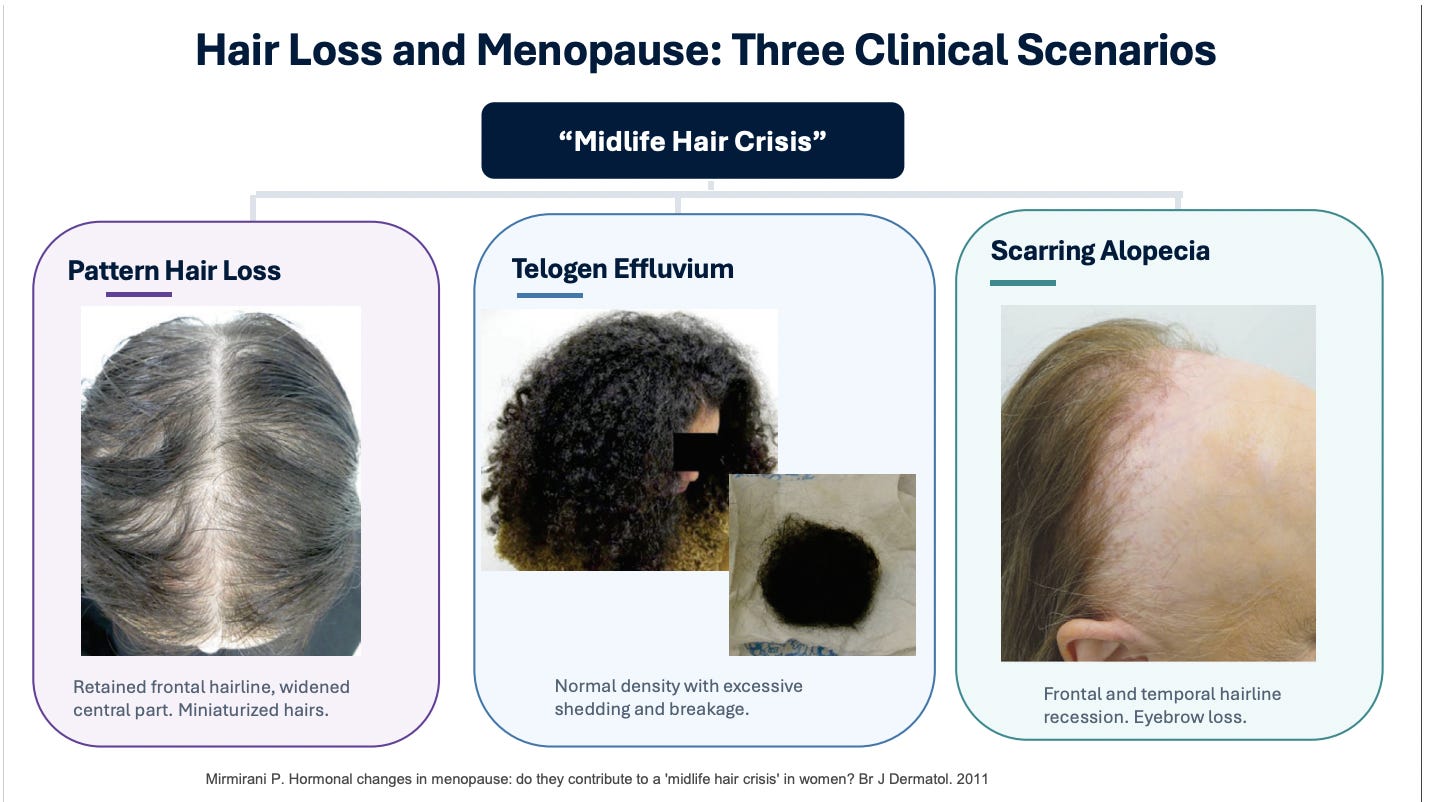
Source: Dr. Paradi Mirmirani, lecture, 2026 Menopause Society Annual Conference
How much of female pattern hair loss is menopause and how much is aging? The literature can’t disentangle the two because of substantial overlap with aging, and no study has been designed to separate them. In addition, many of the studies are conflicting. There are definitely ways that menopause could contribute to hair loss. For example, with decreased estrogen, women have relative androgen excess, and androgens can cause hair follicles to miniaturize. However, women with androgen insensitivity syndrome, whose bodies can’t respond to testosterone, can still get female pattern hair loss, suggesting factors other than androgens are likely involved.
A decrease in estrogen may have an impact as hair has estrogen receptors. Estrogen is likely part of the signaling that helps protect the hair follicle from the immune system. Changes in estrogen can also affect metabolic health, which could have an impact. However, female pattern hair loss can start in the twenties, when women have higher estrogen levels. In short, there are many complex ways that changes in estrogen could be involved, but there is no long-term study characterizing hair changes over the reproductive life span and no studies suggesting that menopause hormone therapy is recommended as a treatment. A recent review of female pattern hair loss in the New England Journal of Medicine did not mention menopause hormone therapy as treatment for hair loss and neither did the speaker.
If a patient is on testosterone, could spironolactone be added to counter hair loss? This was a question that was asked at the end of the talk. In this case, usually the