
Elon Musk, whose Tesla is building a line of humanoids called Optimus, has said he expects the machines to become so affordable that each household will get one or two. Sam Altman’s OpenAI will build humanoids too. “Everyone should have a personal robot,” he said in a recent interview.
Elon Musk’s Tesla shows off its humanoid robot Optimus Gen 3 at an event in Shanghai, China. Photo / Getty Images
China has an early lead in the market. The country accounted for 97% of the humanoid shipments in the first half of 2026, according to data from Smart Analytics Global. Shanghai-based Agibot and Hangzhou-based Unitree Robotics led the field with volumes far ahead of top Western companies such as Tesla, Figure AI and Agility Robotics. While the US has truckloads more capital and the most successful entrepreneurs in the world, China controls the robotics supply chain and has an emerging class of founders who have begun to show they can compete with the best of Silicon Valley.
Huo studied computer science at Tsinghua University, the prestigious school where founders of prominent AI start-ups such as Moonshot, Z.AI and Robot Era got their training. She also worked at Tsinghua Skyworks, a group at the university that collaborates with industry on AI and robotics. She joined Dreame when it was a small start-up and has spent six years devising AI algorithms for smart devices that work inside homes. She’s one of a small group of women working at the forefront of Chinese AI.
At Dreame’s headquarters in Suzhou, Huo’s teams are working to incorporate new artificial intelligence models and customised training data to prepare the next generation of home machines. The company’s robot vacuums are already a high-volume product, with 1.5 million machines shipped in the first quarter, and they’re built with core AI that will be developed for a broad range of future tasks. Huo said she believes the potential for these machines is almost limitless.
”Home robotics is now at an important turning point,” said Huo. “It’s gradually moving from concept demonstrations toward real-world deployment.”
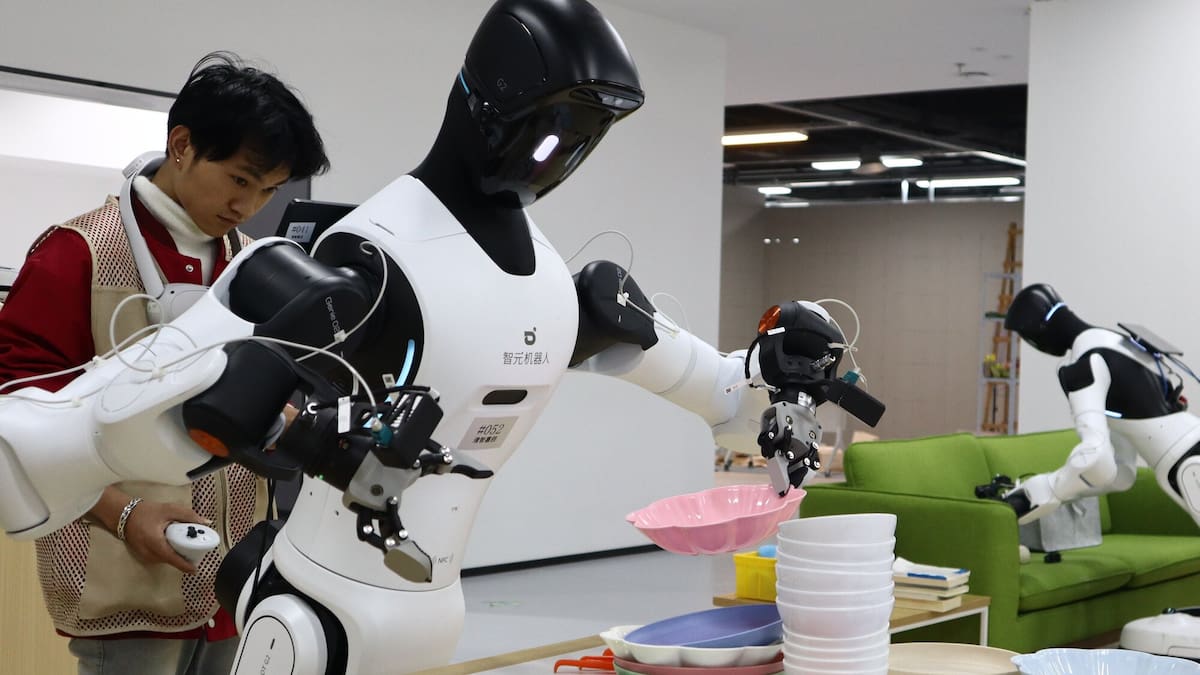
In September, the company debuted a wheeled robot called Echo S1 at a trade show in Berlin, an early experiment in handling laundry for the family. The one-armed machine, which takes voice commands, sorts garments by fabric and colour, selects the right wash routine and then loads and unloads the washer. The S1 then puts away the clothes. Dreame unveiled the Echo P1 at the same event to demonstrate basic home chores such as moving objects and monitoring the household.
Huo’s next key introduction is coming in the new year. The company plans to unveil a dual-arm, above-table-height droid that can clean, organise table tops and – eventually – operate appliances like the dishwasher, oven and air fryer. The company wouldn’t share commercial launch timing or pricing.
Sanjay Sarma, a professor of mechanical engineering at Massachusetts Institute of Technology, believes it’s more difficult to create home robots than factory machines because they need a higher level of dexterity and sensitivity, and they need to adapt to ever-changing scenarios, unlike a standardised manufacturing plant.
“Heavy work, hazardous tasks have long been the focus of automation,” he said. “Robots seem to be following an evolutionary path – the finer the motor or cognitive skills required, the harder to automate.”
Home robots usually need a higher level of dexterity and sensitivity than those used in factory settings. Photo / Getty Images
Huo and her colleagues have been working on these problems for years, and she says they’ve developed three core technology foundations that will help Dreame crack the code. First, there’s a perception system that gives the robot the capability to sense their surroundings. Then an AI world model – an increasingly important effort in the tech industry to create something like ChatGPT for the physical world – to understand how the home works. Finally, Dreame has created an intelligent control system that brings all the technology together so the robot body can execute tasks.
“The complexity of a household environment is much higher than that of the simplest processes in a factory,” she said. “The home is never a single, isolated use case. It is a complex physical environment shaped by the interaction of hundreds of tasks, objects and relationships.”
She figures that large-scale deployment of humanoids in homes is still more than two to three years away, in part because costs have to come down to make them affordable.
In her vision, the robot will become something more than just another household appliance. Rather than controlling dozens of connected devices individually, home owners would interact with a single robot capable of co-ordinating other appliances and even manage grocery orders. The hope is that robots’ household penetration can eventually exceed 70%.
“My ultimate dream is a bit like The Matrix,” said Huo. “Machines supporting or taking care of humans so people no longer have to do anything.”
©2026 Bloomberg L.P.
Sign up to Herald Premium Editor’s Picks, delivered straight to your inbox every Friday. Editor-in-Chief Murray Kirkness picks the week’s best features, interviews and investigations. Sign up for Herald Premium here.
Tags:
- adrenalinefuelled
- AUGUST
- Beijing
- Breathing
- Business
- competitions
- day
- every
- flocked
- future
- games
- generation
- high
- homehelp
- humanoid
- important
- into
- jump
- Life
- mankind
- more
- mundane
- New Zealand
- NewZealand
- next
- NZ
- people
- perhaps
- records
- robot
- robots
- soaring
- spectators
- speeds
- Sports
- sprinting
- subdued
- superhuman
- tasks
- the
- this
- training
- woman
- world