
You don’t get buried if you die up here. There’s no dirt. If you wanted dirt, back in the coal-heady days of the early 1900s, it had to be winched up a formidable incline, pulled up by the counterweight coal headed down. Only then could you plant a measly garden, one where the carrots hit bedrock and shunt sideways, as if they, too, were digging for treasure.
Instead, the bodies of the men and women who died up here were sent down the very same incline, taking one final ride alongside the fruits of their labour.
Childbirth, injury, illness or accidents punched tickets for this ride, but for others, shallow mine ceilings and heavy rains fashioned private tombs. The area is punctuated with sinkholes, the craterscape of a forgotten bombardment. If you’re buried on the Denniston Plateau, it’s not on purpose.
The plateau is thrust up behind Westport, hidden behind the lip of a ridgeline, where it rambles down towards another ledge and the Buller River. It is nigh impossible to see for anyone taking a conventional route through this remote corner of the country, except by aeroplane. The whole area is the Buller plateau, subdivided into areas like Denniston and the neighbouring Stockton.
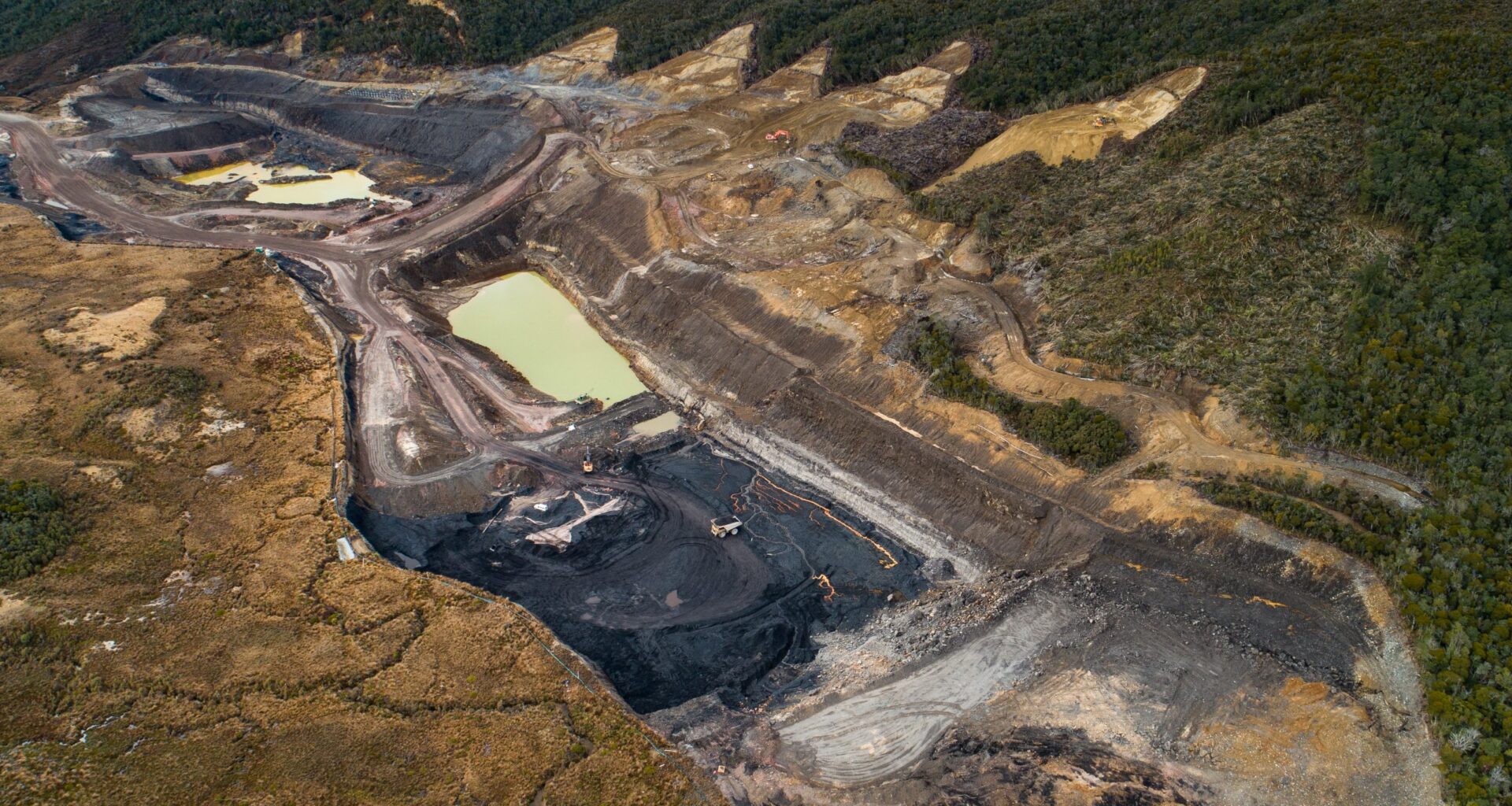
Stockton, the country’s largest opencast mine, is hidden here as well, on a restricted carve-out of public conservation land. A faint toe of the mine’s footprint can be seen extending from Happy Valley, one of many sites of former protest action, now stripped of vegetation. Elsewhere, powerpoles and muddy roads stretch across the landscape, hinting at the bustling but mostly invisible industry.
BT Mining, a joint venture between Australian-owned Bathurst and Talley’s Energy (linked to the Motueka-based food group of the same name), took over operations on Stockton in 2017 after the price of coal collapsed and state-owned Solid Energy folded. Its target is a seam of high-grade coking coal, blasted in overseas furnaces to fuse iron and carbon into steel.
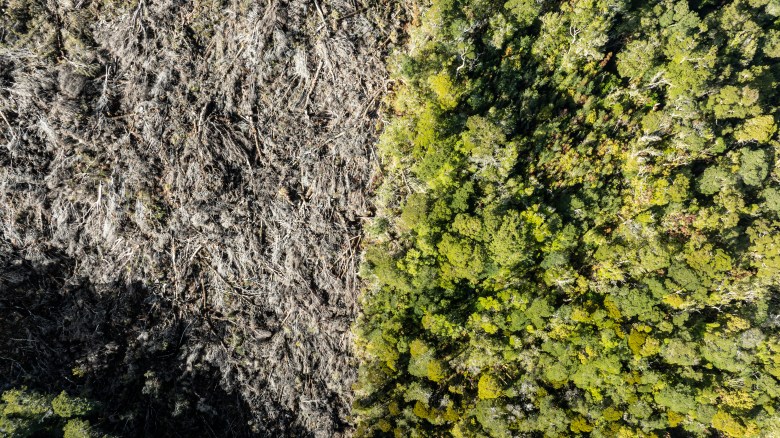 Felled old-growth forest in Happy Valley. Photo: Neil Silverwood
Many of its consents are due to expire in 2027, threatening hundreds of jobs, mostly in Westport. It’s applied under the fast-track to expand and continue operations, extending mining on Stockton by 16 years – 25 years including remediation – resuming operations on the nearby Escarpment mine and opening pits on the Mount Frederick South site, which conservationists adamantly oppose. Bathurst did not respond to questions for this article.
As the nation debates the role of mining in an advanced economy, how much mining companies ought to pay in royalties and who gets to decide what happens on state land, Bathurst finds itself with just days to go before the election. With its application still under revision, Bathurst’s fast-track bid is now to be judged under a new government, one perhaps less friendly to the sector than the current coalition.
What’s on the table
In August 2026, more than a year after its initial target, Bathurst submitted its substantive application to the fast-track panel. It was returned in September as incomplete, with two specifications: access arrangements for a managed reserve and a wildlife permit.
The permit in question is Bathurst’s management programme for native lizards, which planned to recover less than 1 percent of the animals. The Department of Conservation’s target threshold is 80 percent, but the application states “this cannot feasibly be achieved”.
Fast-track panellists are tasked with assessing economic benefits and weighing them against costs; an approach its critics say is weighted against the environment.
Labour and the Greens promise to amend the fast-track if they win the election, prompting Resources Minister Shane Jones to encourage miners to get their applications in as soon as possible. The Greens went further, vowing to revoke “the most damaging” mining licences granted under the scheme.
Labour’s environment spokesperson Rachel Brooking says if her party returns to power then projects already going through the fast-track won’t be cancelled, but may have their conditions reviewed based on environmental impact. New applications would go through an updated fast-track process, which will place a higher value on the environment and local input than economic impact.
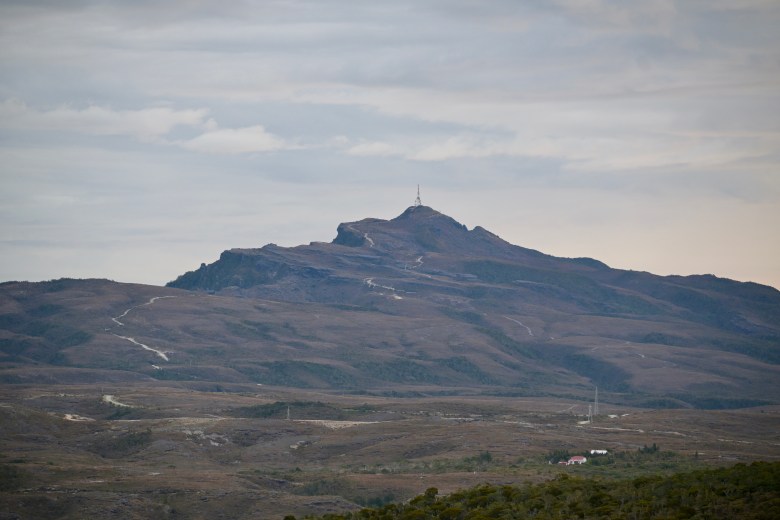 Looking south from Mount Frederick, across where the road meets the plateau, towards Mount Rochfort. Photo: Fox Meyer
Under the current settings, the economic benefits (provided by a report by Aigis and assessed by Bathurst’s expert reviewer Greg Akehurst) are a total value of between $661 million and $956m over the life of the mine – with up to $224m in regional benefits; the retention of 388 jobs; and an extended off-ramp to prepare Westport for the mine’s departure. In short: an “economic anchor” for the West Coast, even if only for another 25 years.
However, the accounting Akehurst assessed omits costs of the project. Factors including long-term water treatment and biome destruction are assessed by other specialists, so they are excluded from the impact assessment “to avoid double-counting”; the economics are a gross estimate, not a net estimate.
The Environmental Protection Authority, in charge of the fast-track, made the same conclusion in an earlier assessment: “We have been unable to find a direct statement of the direct net economic and other benefits of the proposed activities.”
For Westport’s mining supporters, any benefit is better than the alternative.
No middle ground
Outdoorsman and photographer Neil Silverwood says to be discreet about a visit to the plateau. It’s public land, but pro-mine locals have not been friendly to those they see as opposition. Logs and chains have been laid across the access road, tyres have been slashed, and vehicles burned. Protesters have been arrested, including a handful who climbed into Bathurst’s coal bucket gondola and stayed put overnight. Silverwood says there’s no middle ground in this debate, only diehard supporters and ardent opponents.
Silverwood grew up at the foot of the mine. His father lives near where the road from the hills meets the coast, and for decades has filled his home furnace with coal he’s scooped from a bluff up the road.
On this trip Silverwood is joined by Suzanne Hills, the chair of the West Coast Branch of Forest & Bird. They’ve never brought a journalist to spend a night on the plateau; Hills says you can’t get a true feeling for it with a quick visit.
Unlike modern miners, the old-timers didn’t break the sandstone bedrock. Their kilometres of tunnelling are not obvious to the naked eye. It’s a far more expensive process, yielding lower returns, but Silverwood says he’d be open to this approach if Bathurst took it. Hills disagrees. She thinks the emissions from burning the coal, even if the plateau could somehow escape unscathed, are still a deal-breaker.
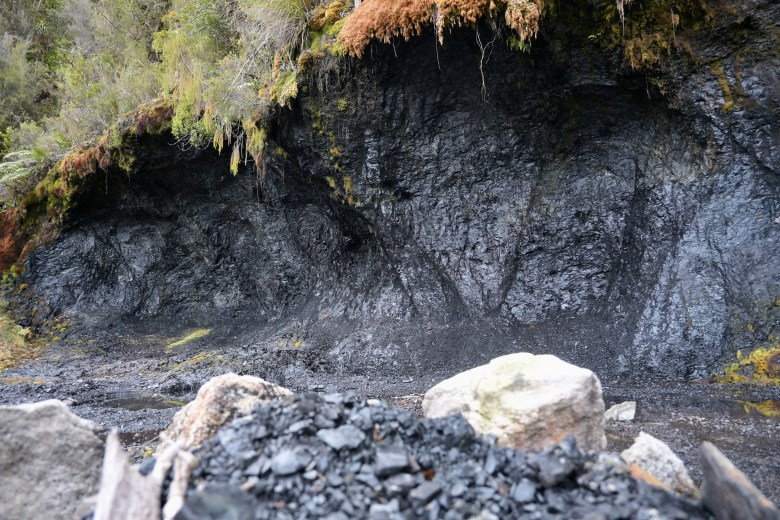 A seam of coal scraped for use in home furnaces. Photo: Fox Meyer
Opponents of the mine fall roughly into two camps: the climate-focused, younger activists of 350 Aotearoa, who are willing to break the law to make a statement, and the more established groups such as Forest & Bird, who have tried to keep their engagements and resistance in the professional arena. The two overlap, but don’t always get along.
Both are dubious of Bathurst’s track record. In Canterbury, at the Coalgate mine, Bathurst received multiple fines for repeatedly breaching its water runoff consents and was notified of this 27 times in 2017. Five years later, its attempt to shutter the mine was rejected. Hearing commissioners said the proposed rehabilitation was “inadequate next to the environmental impact of their mining activity”.
The rehabilitation plan for Stockton and the Denniston Plateau includes a practice called Vegetation Direct Transfer, which amounts to picking up what’s there, moving it, and then returning it at a later date. At a candidates debate in Westport, local candidates from National (Katie Milne) and Act (Janelle Hocking) both praised these modern methods for their efficacy. Hocking suggested the recently discovered Avatar moth could fly down the road.
Bathurst’s ecology reviewer Roger MacGibbon also recommends the method, but notes its efficacy is capped at just 15 percent of the disturbed area: “It is not possible to fully offset or compensate for all ecological effects.”
What’s at stake
Sandstone slabs have pancaked in above the disused Burning Mine, which Silverwood suspects has finally stopped burning. From the carpark here, down the rockface and across the river is an old tramline, and winding up the forested hillside are the withered iron tendrils it left behind. An old-timer parked his minecart here and it stands to this day, fused to the tracks.
Silverwood opts for what he remembers as a shortcut through an old mining tunnel, with walls and ceiling of black coal. The mineshaft is cut on a gentle slope with right-angle corners. Halfway through, Silverwood admits he’s only been here once before but reckons he knows the way.
Rotted logs crumble under foot and the tunnels narrow at times where the ceiling has shedded plates of sandstone. The tramway is like a string through the labyrinth, and weaves past a dark room with a pool of bone-coloured foam and another where moss like spiderwebs drapes from ceiling to floor.
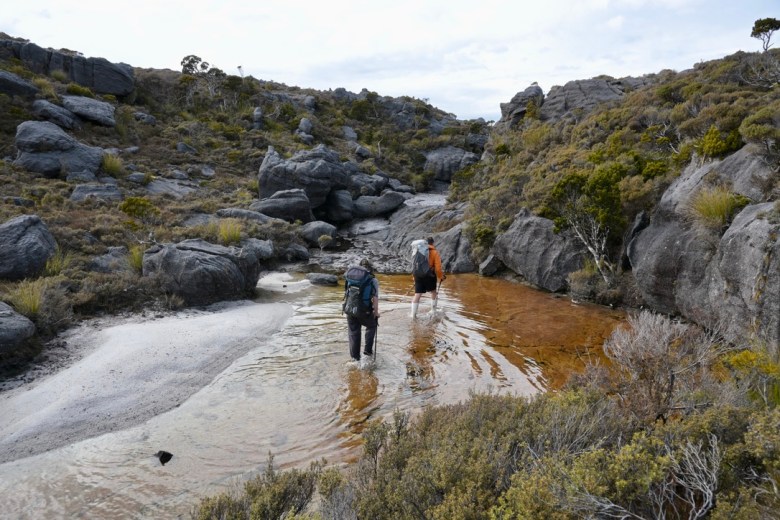 Water on the South Frederick mining block is still drinkable. Photo: Fox Meyer
From the exit the track carves its way through a hill and bursts out onto the sandstone pavement the plateau is known for. At the top is the brick foundation of an unrecognisable building, and strewn all around it in the branches of tiny trees are pieces of wilted and corroded metal.
Silverwood says to lose these relics is part of the conservation debate, just like the plants and animals. It’s part of our heritage, he says. He wants to see a Great Walk up here, connecting to the Old Ghost Road, and thinks money can be made without sacrificing the landscape – not that he thinks the money being advertised will come back to New Zealand in an equitable way.
Who pays, who gets paid
Most of the value of this coal does not remain in New Zealand. The coal is exported, mostly to Asian factories, and offshore shareholders account for most of the value not dispersed in the community or the Government’s take – though Bathurst claims 44 percent of shareholder value is retained in New Zealand.
But private shareholders are only one side of the equation. Across 2024, the most recent published results, the Government’s total earnings from coal royalties was $1.78m. This is half as much as it collected in 2023, a drop the Government attributes to lower coal prices and a rail tunnel collapse in Reefton, which slowed Stockton’s exports.
But royalties are not the full picture, and Deloitte’s recent report on New Zealand’s royalty scheme found it to be – after considering taxes and other fees – fairly standard.
That is not to say the system is working as intended. For New Zealand’s largest (tier 1) mines, after royalty rate changes in 2013, the Government is meant to take in 2 percent of a miner’s net revenue or 10 percent of accounting profit – whichever is higher. Of all the tier 1 mines, only one is paying this rate. Bathurst is not.
Many mines have consents grandfathered in with older, lower rates, including those set in 1996, which are half the 2013 totals. In 2025 a full 97 percent of New Zealand’s mining royalties came from these discounted legacy regimes, meaning the Government is earning potentially only half as much as it could.
Multiple political parties are promising to do something about this if elected. The Green Party’s 2025 Budget wanted to double the 2013 rates and enforce them; New Zealand First wants to send half of what’s collected back to the region that hosts the mine; Labour wants to be even more specific and send it back to the community.
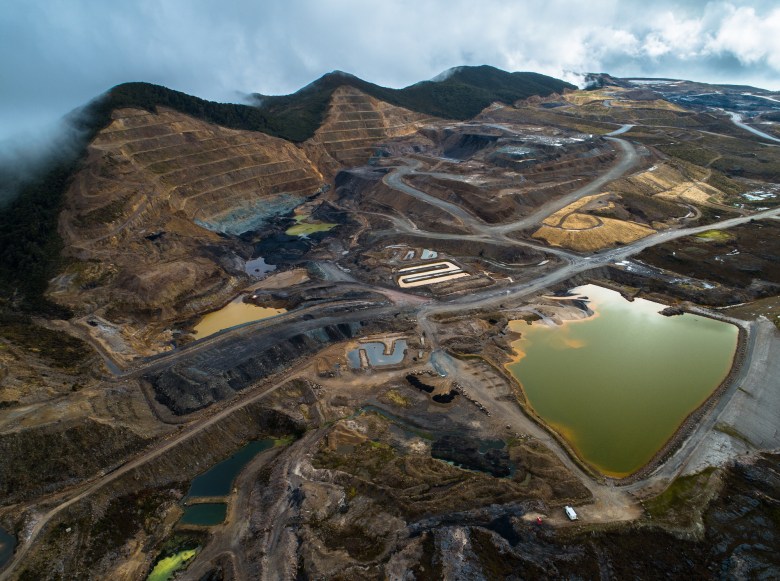 Stockton is New Zealand’s largest coal mine, and is looking to expand under the fast-track. Photo: Neil Silverwood
There are also costs to the Government for these activities, chief among them the legacy costs of acid mine drainage from historical Stockton mining.
When it took over the Stockton mine, Bathurst also took responsibility for treating the historical damages. The rock here is naturally acidic, and the chemicals it leeches have rendered some streams acidic enough to dissolve metal. Treating this costs the Government about $2m-$3m a year, which is more than its usual earnings from coal royalties nationwide.
Failure to properly manage this risk, according to a 2025 Cabinet paper, is “almost certain to have immediate and harmful environmental impacts and likely significant human health, financial and reputational consequences”.
The paper also notes that although Bathurst has expanded treatment efforts since it took over, acid mine drainage is still escaping, and a “base case” approach for the future – doing exactly what Bathurst is doing now – would not meet the bar for ecosystem health or regulatory requirements.
The same Cabinet paper lists a previous estimate of $89.9m for the total cost of cleaning up historical acid mine drainage at Stockton using current methods, but a business case prepared in 2024 by Treasury raises the total to $256m, including management costs (a responsibility recently passed to Land Information New Zealand).
Currently, Bathurst is reimbursed by the Crown for this work for as long as mining continues in the area; after this point and after remediation, Bathurst may exit the agreement, pay a termination sum, and leave the rest of the work to the Crown, which currently benefits from not having to cart in its own workforce and equipment to do the job. Consenting the expansion would mean 25 more years of Bathurst, and 25 more years for the Government to prepare to take over.
It would not have much time to get moving; Bathurst’s general manager of export operations Ian Harvey says the nearby Ngākawau River would become severely acidic in less than a week if his company’s two treatment plants shut down.
350 Aotearoa campaign manager Adam Currie – one of the protesters who climbed into Bathurst’s buckets – says this is tantamount to “holding our waterways hostage, saying ‘give us another coal mine or we’ll turn your river to acid’”.
Currie thinks, in another 20 years, Bathurst will make the same arguments unless it’s allowed to expand even further. Silverwood also suspects further expansion, pointing out the exploration drill holes that dot the landscape, even the areas Bathurst has said it will leave aside. Bathurst did not answer questions about these plans.
A town that’s been here before
A 25-year extension will also be a relief to Westport, a town where one in 10 workers depend directly on mining. Infometrics’ principal economist Nick Brunsdon prepared a report on the consequences of Stockton’s closure, and presented the report to Westport locals in September.
He says “the room went pretty quiet when I went through the slides on economic impact”. Brunsdon estimates the loss of 466 jobs and the departure of nearly 3 percent of the population – including nearly 10 percent of its under-15s. There is some discrepancy over job losses; Bathurst says about 390, and its economic impact report estimates 388.
Much of Brunsdon’s estimate is based on what happened the last time Bathurst closed a mine.
Bathurst fought hard to get the consents for the Escarpment mine, also on the plateau, consents that came with a warning when granted by the Buller District Council: “It is abundantly clear that large-scale mining is poised to invade the entire Denniston Plateau coal reserves, which, if unchecked, will totally destroy the ecosystems which are present.”
The company purchased the rights to the mine for $70m in 2010, with a further $70m payment contingent on export volumes. But in 2016, just two years after it got up and running, the price of coal collapsed and Bathurst mothballed the mine. The same crash pushed Solid Energy over the edge, at the time in charge of Stockton, spelling crisis for Westport and the wider region.
The coal downturn coincided with a 25 percent drop in employment across the Buller District from 2013 to 2018: a total of 1370 jobs. The region lost 7.5 percent of its population, and one in five of its under-15s.
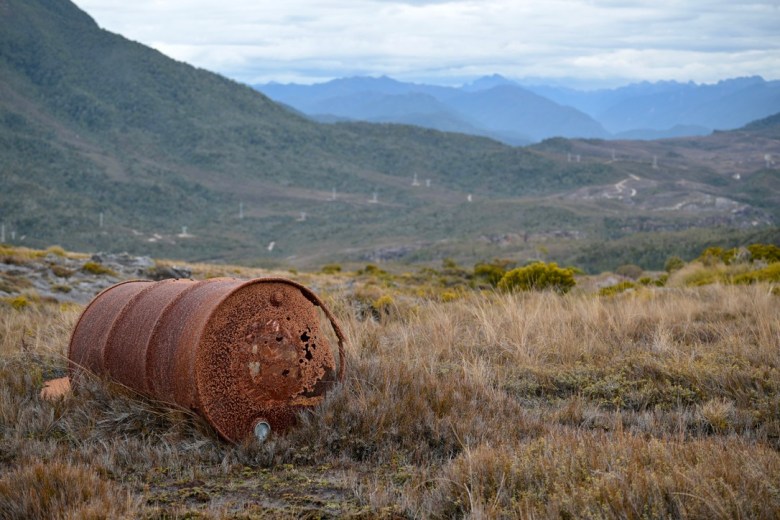 The ‘untouched’ Denniston plateau still hosts relics from last century’s miners. Photo: Fox Meyer
Brunsdon thinks some workers stayed behind because they suspected a private company – BT Mining, in the end – would buy out Solid Energy, and they were right. But if Bathurst itself pulls out, Brunsdon doesn’t think people would be as tempted to stay and wait it out, especially because Talley’s (the ‘T’ in BT Mining) and Westland Mineral Sands cut a total of 132 jobs in the area in recent years, nearly 3 percent of the Buller District’s total.
Now, with this fast-track bid, Bathurst is repeating many of the promises it made in the 2010s: prosperity for Westport, opening the Escarpment mine and a future for the community.
But these are all underpinned by the assumption that coal will keep its value in a market Bathurst’s own economic analysis notes for its “substantial volatility”; according to Bathurst’s 2025 annual report, it fetched $297 for a tonne of coal in 2024, but only $242 in 2025.
BT Mining has internal strife as well; the two partner companies are locked in a legal battle, with Talley’s suing Bathurst over prejudicing shareholder claims. Because Talley’s has the ability to veto cash distribution, about $257m of Bathurst’s funding is locked away while the battle proceeds: money that could otherwise be used to invest in the project.
A territorial claim
The nature here is “hands and knees” wilderness, as the scientists call it. Soil, where present at all, is acidic and nutrient-poor, stunting the vegetation into a permanent bonsai configuration. Century-old trees come to your knees, and the beasts that roam this forest are similarly minuscule.
To the botanists and ecologists, these are treasures – members of a unique ecosystem, many of their ensemble still undescribed. The strangeness of the land is only revealed on closer inspection.
Beds of white sand pocket the landscape like little pools of Golden Bay. What appears to be remnants of a cobblestone pathway are natural features of this sandstone pavement biome, and the black soils crunching underfoot are in fact a layer of crumbling and stygian coal. In the night, blue crayfish crawl through their miniature jungles, along blue highways secreted by giant snails. Nothing here is quite what it seems.
 Rare ferbirds hop around the plateau, which at night is dominated by the screech of kiwis. Photo: Fox Meyer
It’s a similar experience for the miners, who look below the bizarre landscape and see an opportunity long tapped by their predecessors. This coal whisked the HMS Calliope from a gale that sank 19 others, and burned in the furnaces that brought Captain Scott to Antarctica.
These are the only two reasons people have ever had to venture up here: what’s on the ground, and what’s under it. On the pristine scrublands, evidence of the multi-million dollar operation is limited to a few flags of tape, some rubbish, and the decaying fragments of bygone industry.
Instead, it is heard. At night on the plateau there are only two sounds: great spotted kiwis screaming their nightly territorials, and the low drone of heavy diesel spilling over the ridgeline, two very different beasts staking claim to their land.
A world away in Wellington, a decision is about to be made on which voice will continue to echo over the sandstone spines of Denniston.