
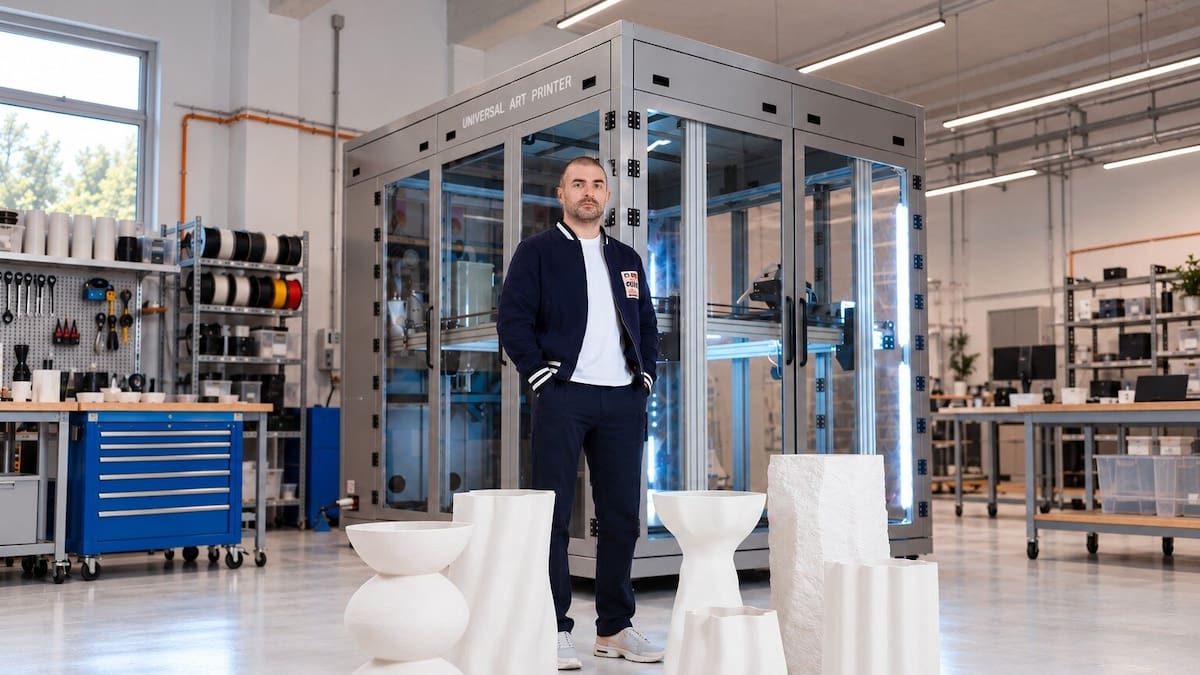
The main goal of the business is to disrupt supply chains rather than manufacturing. We’re using advanced manufacturing techniques, including large-format additive manufacturing or 3D printing, to create products for in-house and commercial spaces.
What inspired you to start the business?
The inspiration for the business really came from the frustration and the complexity of supply chains.
I had a business before this called Sound Switch, which was a hardware and software product for the DJ industry. We sold that to a multinational company, and we ended up designing products in New Zealand, manufacturing them in China, then shipping them to the United States before shipping them to customers.
Zooming out from that supply chain, it just made me think it was both amazing and insane. I thought to myself, what happens if this doesn’t work, and how could a business in a country like New Zealand profit from that?
I started researching manufacturing techniques, and I knew automation was going to be a big part of it. Then it was deciding what material to use for certain products, and I looked at ceramics and timber, but they didn’t meet my needs. I settled on polymers, which eventually led me to 3D printing, and the benefits of putting it all together really shone through.
Special Studio creates a wide range of living and homewares, from coffee tables to chairs, all made with recycled materials.
What materials do you use, and where do you source them from?
One of the biggest problems is that the supply chain for recycled materials is not nearly as mature as it needs to be. Originally, all of our materials were processed and sourced from the Netherlands, but the supplier went under. Luckily, our New Zealand supplier had just started to work with recycled materials, which made the switch relatively easy.
The raw material we get comes mostly from three sources. The first is our own recycled products, so our own failed prints. The second is called PETG (Polyethylene Terephthalate Glycol), which is similar to what is used in Coke bottles, but slightly more workable. This comes from Australia, and we get that processed at a plant in Tokoroa.
The third is PLA (Polylactic Acid), which is a biopolymer we get largely from Asia.
How do you balance price with sustainable practices?
In terms of value, for us it comes a lot from the physical scale, as our products can get quite large. When most people think of 3D printing, they think of a desktop-sized box printing small components, whereas we can print things roughly a metre and a half cubed.
Things that are larger are inherently more expensive, so we can play into that even though we don’t necessarily have those distribution costs.
But there is a lot of time spent on the finish. We’re always trying to increase the weight of our products, whereas typically people are trying to make 3D prints as light as possible. We want things that are strong, look great and function well.
Being made locally is another factor, alongside recycled materials.
Special Studio also works with commercial clients, including BNZ Bank, which has a large recycled material counter in its office.
What are your plans for growth?
From the business perspective, we’re always hiring staff and growing. We’re moving into a new factory at the moment, which is twice the size of what we are currently in, and we’ll be able to have possibly more than 20 machines.
Originally, we built all of our own hardware and mid-size printers, but now we’ve shifted to a great machine supplier who has massively increased the output. Not only are we doubling our physical number of printers, but those printers can produce almost three times as fast as our old ones.
From a revenue perspective, we’re targeting over $1 million in the next 12 months. We’re growing so fast at the moment that it’s become a real headache. A lot of that is in exports, which is now 40% to 60% of our business.
What would be your advice to a budding entrepreneur wanting to start a business?
I would constantly check and reinforce your assumptions, and probably try to keep it as much of a side project as you can before you dive in headfirst. Once you have to start relying on your business to survive, it’s a massive motivator, but it’s also incredibly difficult.
Also, don’t be afraid to talk to people about your ideas. A lot of people are afraid that someone’s going to steal their idea, and I think that really holds a lot of people back. People are going to see what you’re doing, and if what you’re doing is as valuable as you think it is, then people are going to want to do it as well.
Tom Raynel is a multimedia business journalist for the Herald, covering small business, retail and tourism.
Stay ahead with the latest market moves, corporate updates, and economic insights by subscribing to our Business newsletter – your essential weekly round-up of all the business news you need.