
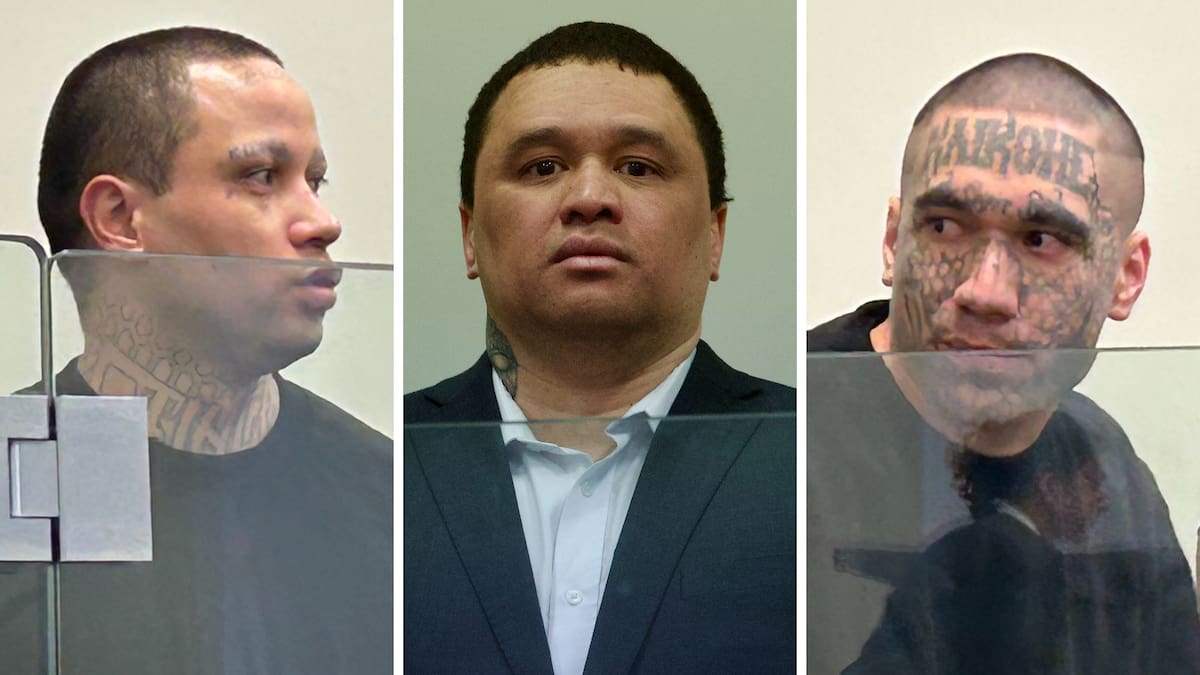
The day served as a grim reminder as to why the Paremoremo-based prison, which also houses gang leaders and the Christchurch terrorist, is the nation’s highest security facility.
The most serious charge before the judge was the near-murder case, involving all three defendants, that took place in the prison’s concrete exercise yard in August last year.
“The violence was extreme and left the victim with lifelong serious injuries,” the judge repeated during each hearing.
CCTV cameras indicate the victim did nothing to provoke or confront the defendants in the hour before the attack. The victim even disengaged and walked away after Teina instigated what was described in court documents as a “unilateral play fight”, pretending to strike him and placing him in headlocks.
An hour after the “play fight” at 9.40am, Teina approached the man again and began choking him in a no-longer-playful headlock. Marsden walked up and tapped his co-defendant twice on the shoulder, at which point Teina released the victim, who fell to the ground.
Kavae Teina led the exercise yard attack on a fellow Auckland Prison inmate so brutal that police initially prepared for a potential murder investigation. Photo / Jason Dorday
The victim twice tried to stand up but was struck down as Teina delivered repeated blows to his head. All three men then encircled him, each pummelling him.
“At this point, the complainant was fully incapacitated as he lay on his side unable to defend himself,” court documents state. “Messrs Teina, Marsden and Hepi then took turns stomping on the complainant’s head in quick succession with their shoes.
“Messrs Marsden and Hepi lifted their knees to their chest to increase the force of their stomping. All stomps were delivered to the complainant’s head, and with enough force to cause his body to move and his head to rebound on the concrete.”
Teina then walked away to dispose of a shank – an improvised prison knife that had not been used – into a nearby toilet as the other two continued to administer blows. When he returned moments later, he punched the victim in the face so hard it caused the man’s body to move.
“All three defendants then moved to the back of the yard where they made gang signs and shared congratulatory hand gestures until they were secured and removed by Corrections staff,” documents state.
The attack, which lasted just under a minute, resulted in victim Stead Nuku spending three months recovering in hospital with a brain bleed and numerous other injuries.
“Medical staff initially believed he would die from his injuries, or at the very least require 24-hour bedside nursing care for an indefinite period,” authorities noted in the agreed facts. “The complainant has since substantially recovered, however, his long-term prognosis is unknown.”
Like his attackers, Nuku has also been associated with the Killer Beez in the past and was no stranger to violence. In 2019, while an inmate at the same prison, he used a shank to stab another man more than 20 times – including a gash to the back of his neck.
Nuku claimed it was retaliation for the death of a family member after she was raped by the Mongrel Mob. He was handed an additional sentence of 14 years, but it was later reduced to 10 years on appeal.
‘Spat the chunk of ear out’
In October 2024, 10 months before the attack on Nuku, Teina and Marsden had turned their aggression towards a guard at the facility.
Both pleaded guilty to wounding with intent to injure, which would have carried a maximum possible sentence of seven years’ imprisonment had they been sentenced for that alone.
The two were again in the prison exercise yard that afternoon and were set to return to their cells, a process in which each inmate is handcuffed and escorted by multiple guards.
Inmate Charles Marsden (centre) appears for sentencing on charges resulting from two vicious attacks at Auckland Prison – hospitalising a fellow inmate and knocking a guard unconscious. Photo / Craig Kapitan
When Teina “became obstructive and wedged himself in the door frame”, an officer sensed something was amiss and attempted to push the inmate back into the yard to close the door. Marsden and a third inmate then got behind Teina and helped to force the door open.
They rushed Corrections officers, throwing punches, documents state. The third inmate was able to pull one of the officers to the ground and continued to punch him until other officers restrained him.
Marsden then kicked the officer in the head, rendering him unconscious. He suffered multiple facial fractures.
The third attack, this time on jewellery store robber Jason Flavell, occurred in July this year – again in an exercise yard.
Hepi, with two other inmates who have pleaded guilty but not yet been sentenced, punched, kicked and stomped the other inmate as they pulled him to the ground.
“Mr Hepi then held Mr Flavell’s head to the ground, so the left side of his head was facing upward,” court documents state. “Mr Hepi leaned down and bit Mr Flavell’s left ear while pulling upwards, ripping a large part of his ear off.
Former prison escapee Zane Hepi appears in North Shore District Court after pleading guilty to attacks on two inmates at Auckland Prison in Paremoremo. Photo / Craig Kapitan
“[The other two] continued to kick Mr Flavell on the ground all over his body as Mr Hepi bit off the large portion of his ear. Mr Hepi spat the chunk of ear out on the concrete floor.”
Corrections officers doused Hepi with pepper spray in an attempt to stop the attack. One of his co-defendants “picked up the discarded ear and put it in the toilet in the yard”.
Hepi was initially charged with disfiguring with intent to cause grievous bodily harm, punishable by up to 14 years’ imprisonment, but he pleaded guilty instead to a lesser charge of wounding with intent to injure.
Nationwide manhunt, cash van heist
The ear-biting incident is not the first time Hepi’s law-breaking has attracted media attention.
In February 2023, he and two other inmates were the subject of a high-profile manhunt when they escaped a Corrections van on an Auckland motorway, allegedly fleeing on foot with grins on their faces before stealing an SUV.
Police released this mugshot of Zane Hepi during the manhunt that followed his 2023 escape.
He had 18 months added to his sentence for that charge. Another term of four years and eight months was added in April 2024, after Hepi was found guilty of foiling his electronic ankle bracelet and committing an aggravated robbery while absconding from a drug rehab facility.
“There is a need to protect the community from you,” Judge Brooke Gibson told the defendant as he appeared in Auckland District Court for that charge.
Teina, meanwhile, was sentenced in February 2021 after a retrial in which he and other Killer Beez members were accused of armed robberies. The heists included the 2018 targeting of a cash transit van in which the bandits made off with $110,000.
Teina was initially sentenced to 11 years and eight months’ imprisonment, but it was reduced to 10 years and nine months on appeal.
Marsden has also spent a significant amount of time in prison already. His sentence was increased in 2024 by two years and 10 months for an attack on prison guards similar to the current offending.
He and four other Killer Beez members had been inmates at the Auckland South Corrections Facility when they executed a “concerted and deliberate” attack on three Corrections officers in which about 100 blows were delivered in less than a minute and a half.
The group yelled gang slogans as the victims were struck from multiple angles, including the back of their heads and kidneys. They celebrated, giving high-fives to other prisoners, after one of the officers was able to stop the attack by using pepper spray.
‘Particularly savage act’
In court last month, defence lawyer Annabel Cresswell sought sentence reductions for Teina’s institutionalisation, as well as his background and remorse. Although her client had a shank, it was not used in the attack, she said.
“Mr Teina comes from a background of significant hardship and abuse – not only in his family but in state care,” Cresswell said, noting her client has learned from counselling.
“He has a real understanding of how his diagnosis of PTSD and how his institutionalisation have all affected his behaviour. He knows he needs to address that going forward.”
Kavae Teina already had a history of prison violence when he attacked a guard and a fellow inmate. Photo / Jason Dorday
But Crown prosecutor Isabella Joe noted it was Teina’s third conviction for prison violence. Denunciation and deterrence had to play a major role in the new sentence, she said.
The judge ordered a sentence of four years and seven months’ imprisonment without the possibility of parole, noting that Teina has been assessed as a very high risk of reoffending and has refused to engage in a special treatment programme for violent offenders.
He had already been serving combined sentences of 11 years and 10 months, with a release date not slated until February 2030. The latest sentence won’t begin until those sentences end.
His lawyer had argued that a non-parole order, normally required because it was his second strike, would be manifestly unjust. The judge disagreed.
“You are already highly unlikely to be released on parole,” Judge Fitzgibbon said. “Your offending is perhaps the most dangerous kind, involving serious levels of violence.
Judge Anna Fitzgibbon. Photo / Jason Dorday
“There is also nothing to currently suggest you are on a path of rehabilitation.”
Marsden, who joined Teina on the Corrections officer attack, was already serving a sentence of three years and eight months, with a release date slated for next April. The judge ordered his imprisonment to be extended by six years, also without parole because it was his second strike.
Lawyer Hannah Johnson had argued against the non-parole period, pointing to her client’s similarly difficult childhood and institutionalisation.
The judge noted that Marsden was observed as having shown no empathy for his victims.
Charles Marsden participated in the beating of a fellow Auckland Prison inmate that left the victim hospitalised for three months. Photo / Craig Kapitan
“You explain to the report writer this is because you didn’t grow up knowing empathy,” Judge Fitzgibbon said.
Hepi, who was involved in the ear-biting incident, was already serving sentences amounting to seven years and eight months that weren’t slated to end until November 2029. The judge ordered three years and 11 months to be tacked on.
Defence lawyer Claire Robertson noted Hepi’s background of deprivation included family involvement in gangs, the murder of his father and placement in state care at age 12. She also emphasised her client’s “very low cognitive ability” based on ADHD and a likely diagnosis of fetal alcohol spectrum disorder, which she argued significantly reduced his culpability.
“There’s certainly a willingness to change,” she said, adding of her client’s remorse: “He’s made some quite insightful, profound comments.”
Unlike Hepi’s co-defendants, he didn’t have a lengthy prior history of serious violent offending, Robertson said.
The Crown noted, however, that the trajectory did not seem to be going in the right direction. The ear-biting incident, described as “a particularly savage act”, happened three months prior.
Auckland Prison inmate Zane Hepi has had his sentence extended for two exercise yard attacks on fellow prisoners. Photo / Craig Kapitan
Despite being assessed as a high risk of reoffending, the defence asked for sentence reductions of 55%, arguing that the usual 40% cap would be manifestly unjust. The judge agreed, pointing out that Hepi had never before received a discount for his low cognitive functioning.
“This is an exceptional case, and the injustice is clear,” Judge Fitzgibbon said.
Craig Kapitan is an Auckland-based journalist covering courts and justice. He joined the Herald in 2021 and has reported on courts since 2002 in three newsrooms in the US and New Zealand.