
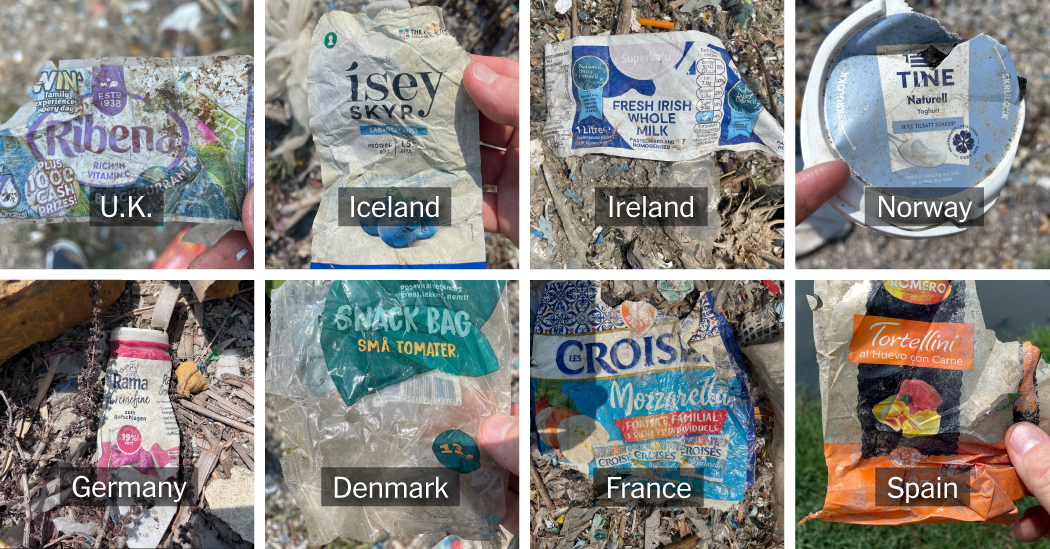
Walking along canals and beaches around Adana, in southern Turkey, we found discarded packaging for mozzarella from France, wet wipes from Holland, tortellini from Spain and fertilizer from Germany. Ice cream tubs from Britain exhorted consumers to recycle.
The piles of refuse were part of the plastic waste imports that Turkey receives each year. Last year, the plastic waste sent by European countries exceeded 700,000 tons — a record, according to trade data. All of it was destined for Turkey’s recycling industry.
Much of it was recycled — into plastic bags, irrigation pipes and plastic pellets that manufacturers use to make new products. But a lot of it ended up in the environment alongside great quantities of Turkish trash, both contributing to the very pollution that recycling is supposed to prevent.
Unlike the simple circularity suggested by the recycling symbol, recycling is messy and generates waste. Local officials, scientists, activists and recyclers told us that Turkey’s environmental regulations often failed to prevent that extra waste from being burned, dumped or discharged with wastewater.
We drove from Adana’s recycling factories along canals flowing south, and saw the flow of plastic runoff all the way to the Mediterranean Sea.
Scientists told us that plastic shredded during the recycling process had washed up as far away as Antalya, 250 miles west, where Turkey is hosting COP31, the United Nations climate summit, which began on Monday. The experts cautioned, however, that the farther waste travels, the harder it is to pinpoint its source.
At the summit, Turkey is highlighting its “Zero Waste” initiative, seeking to promote global waste reduction and inviting conference delegates to visit a Zero Waste Museum, with exhibits about the resources that can be saved when glass, metals and plastic are recycled.
The Zero Waste program is championed by Emine Erdogan, the wife of President Recep Tayyip Erdogan.
Ms. Erdogan told attendees at an environmental conference in June that waste reduction was critical to the Earth’s environmental future.
“While there are many ways to fight climate change, zero waste is a bridge that connects them all,” she said. “In fact, it is the most transformative force in the climate struggle.”
We recently asked Turkey’s environment minister, Murat Kurum, about the European trash we saw on Adana’s beaches. He said that it had been imported illegally, and that the companies that brought it in had been penalized or shut down. He did not name the companies.
He sought to distinguish between discarded materials that recyclers could use to make new products, and mere garbage.
“We don’t import trash,” he said.
Officials and residents said the rise in imported waste had worsened air, land and water pollution around Adana, where plastic, both imported and domestic, plugged irrigation canals, taxed the water treatment facility and often caught fire, filling neighborhoods with noxious fumes.
“This neighborhood is just covered in trash,” said Burhan Kurt, a local official in Onur, a part of Adana with many recycling facilities. “Why is Adana the place for Europe’s trash?”
The Waste Capital
Adana, a city of 1.9 million known for hot weather and spicy kebabs, sits on a fertile plain extending to the Mediterranean Sea. Recycling factories line its roads. Piles of trash, both imported and domestic, teeter in the backs of trucks, near the factories and in cavernous hangars where laborers, many of them Syrian refugees, sort the refuse.
Scientists are studying how microplastics, plastic particles smaller than five millimeters across, affect human health. Some research has suggested links between microplastics in the body and strokes, heart attacks and other health disorders.
Two Turkish scientists recently found that water flowing through Adana canals contained more microplastics after passing by recycling facilities.
Downstream water in one canal contained 21 times more than upstream water, they wrote. The downstream level in another canal was 132 times higher.
The study called Adana’s recyclers “a significant and active point source of microplastic pollution.”
Other studies also have documented plastic seeping from Adana’s recyclers into the environment.
In an interview, Kemal Deniz, the overseer of a complex housing dozens of recycling businesses, said his recyclers followed all government regulations, and he accused unidentified scofflaws of causing pollution.
“Some people dump stuff on the beaches,” he said. “It is the state’s job to find out who. How would I know?”
Part of the problem is that plastic is hard to recycle, and the process itself generates waste. That is because what we call plastic includes a variety of compounds, often with added chemicals to enhance flexibility, strength or other properties. It must be sorted, cleaned and shredded for recycling, which creates debris.
Removing added chemicals requires more complex processes that also generate refuse.
And plastic degrades each time it is recycled, reducing its value, unlike glass and steel, which maintain their integrity.
Also, many imported waste shipments include a portion of material that recyclers can’t use. Recyclers can legally send this to cement factories for incineration, often for a fee.
Some instead get rid of it illegally, recycling workers told us.
“They dump it in the blind spots of the city, burn it or dump it in the sea,” said Kursat Karaca, a recycler who opposes waste imports because he thinks Turkey should focus on its own trash.
Some recycling facilities lack the specialized equipment needed to remove plastic from their wastewater, said Deda Buyukozturk, the head of an environmental office for Adana Province. So it often ends up in canals or at the water treatment plant, which was not designed to handle large quantities of plastic.
“We are the city that suffers the most from this plastic waste,” he added.
He said banning waste imports was the only solution, echoing calls made by Turkish environmentalists.
Around Adana, we found mounds of waste illegally dumped along roadsides, near farmland and along canals, some containing European packaging. We saw plastic shards in canals near recycling factories.
In an interview, Sedat Gundogdu, a co-author of the report about Adana’s canals, called Europe’s waste exports a kind of “colonialism,” which allowed more developed countries to pass the environmental and health costs of their refuse to less developed ones.
“This is not recycling,” said Dr. Gundogdu, a marine biologist at Cukurova University in Adana. “This is pollution transfer.”
A spokeswoman for the European Commission said, “The E.U. is not exporting its waste problem to third countries.”
South of Adana, we saw a steady stream of small pieces of colored plastic, which experts identified as recycling runoff, flowing down Adana’s main drainage canal. That canal merges into the Seyhan River before entering the Mediterranean.
In places, the waste gathered under bridges, creating large plastic islands.
In Karacercili, a village on the canal, we found a farmer, Cumali Ucaroglu, 40, unclogging his irrigation pump.
“The motor is full of shredded plastic,” he said. “It all comes from the plastic recycling factories.”
In Baharli, a village near the sea, a fisherman, Tufan Tuna, said marine animals ate the plastic.
“We find plastic inside the fish,” he said.
Sun and Plastic
In 2022, Olgac Guven, an ocean scientist at Akdeniz University in Antalya, investigated shredded plastic trash that had begun washing up on beaches south of Adana, he said.
He traced the waste’s source to canals from Adana and reported his findings to Turkey’s environment ministry, he said. He doesn’t know whether his report prompted any action.
The ministry did not respond to a request for comment.
Then, during the last two summers, similar plastic showed up in Antalya, the site of the climate summit, whose gleaming beaches are a pillar of Turkey’s tourism industry, he said. This waste, too, had been mechanically sliced, which Dr. Guven said pointed to Adana’s recyclers.
“The gates of hell opened,” he said, recalling fear that polluted beaches would deter tourists.
“What we are selling here is sun and sea,” he said. “So if you have a polluted sea, you don’t have anything to sell.”
Recycling runoff has also tarred beaches in Mersin, the province between Adana and Antalya, said Emre Uresin, the Mersin representative for Turkey’s Chamber of Chemical Engineers.
“When summer comes, we get huge numbers of complaints,” he said.
The spokeswoman for the European Commission said that strict rules govern E.U. waste exports, and that the commission monitors whether importing countries can handle the refuse in “an environmentally sound manner.”
An E.U. assessment in September said Turkey had tightened its environmental regulations but that more information was needed to determine how well it was handling imported waste.
A spokeswoman for the U.K. Department for Environment, Food and Rural Affairs said British law required exporters to ensure that waste was handled properly in the countries where it ends up.
The president’s wife, Ms. Erdogan, did not respond to questions sent to her office.
In August, her Zero Waste Foundation published a report calling for new measures to reduce waste generation and to prevent refuse from entering the sea. It held a workshop this year in Adana about plastic waste, but people involved in recycling told us the foundation was not heavily involved in the industry.
Mr. Kurum, the environment minister, told journalists last month that Turkey’s recyclers needed to supplement domestic waste with imported waste to be able to meet the demands of plastics manufacturers, so more had to be imported. As the domestic recycling rate goes up, he said, waste imports will decrease.
Turkey’s powerful tourism industry, which earned $65 billion last year, is pushing for a cleanup.
At a separate event about plastic waste organized by Ms. Erdogan’s foundation in Istanbul this summer, the governor of Antalya, Hulusi Sahin, said reports of dirty beaches led to canceled vacations, costing the country hundreds of millions of dollars.
Turkey’s recycling sector could not replace that revenue, he said.
“We have a responsibility to protect this heavenly geography,” Mr. Hulusi said. “This may be more valuable than money.”