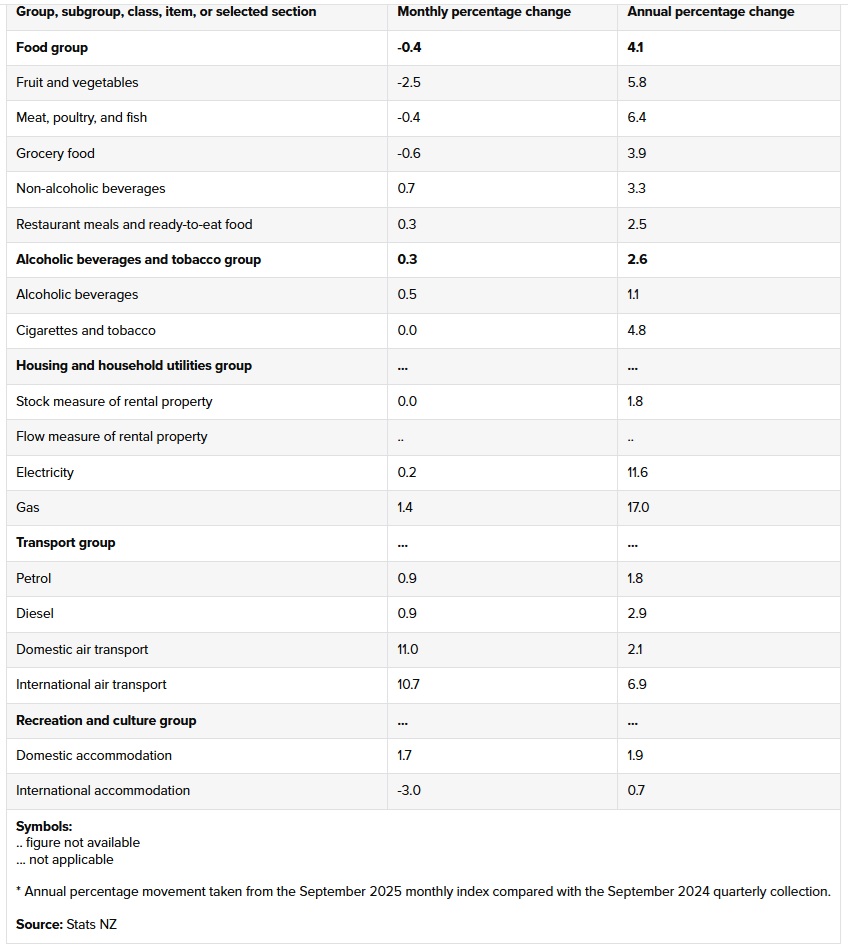
A surprise monthly fall in food prices and the lowest annual increase in rents for well over 14 years are suggesting that inflation figures for the September quarter out next week might not hit the 3.0% expected.
Statistics NZ’s latest Selected Prices Indexes (SPI) information shows that food prices fell 0.4% in September, the first monthly fall since February – while annually prices increased 4.1%.
And while the latter figure might sound like a big increase – it is well down on the 5.0% annual food price increase recorded in both August and July and is in fact the lowest annual increase since April. Economists had expected the annual increase to remain at about 5.0% in September too.
Rents increased by 1.8% in the 12 months to September, which is the lowest annual rate of increase since early 2011.
Since food and rents collectively make up well over a quarter of the Consumers’ Price Index (CPI), these latest figures do suggest that annual inflation figures for the September quarter due to be released on Monday, October 20, might be somewhat lower than expected.
The Reserve Bank (RBNZ), which is charged with maintaining inflation within a 1% to 3% range is expecting that CPI inflation for the September quarter will have hit 3.0%. These figures suggest possibly not – although I should qualify that by saying that two economists CPI previews issued shortly after these figures came out suggest the figure will have hit 3.0% and indeed the ANZ economists forecast 3.1%.
The SPI is a monthly series that now features 47% of the contributors to the quarterly CPI, the accepted measure of inflation. So, they are a good early guide to what inflation’s doing.
While food and rents were easing during September, the ever volatile airfare prices were, well, taking off again in time for the school holidays.
Domestic airfares rose 11.0% during the month, while international airfares nearly matched that with a 10.7% gain.
On an annual basis domestic fares were up 2.1%, while international fares rose 6.9%.
“This is the largest annual increase in airfares, in a September month, since 2021,” Stats NZ’s prices and deflators spokesperson Nicola Growden said.
“The increases for both domestic and international airfares means travellers experienced higher prices during the school holidays.”
Back on the food prices, in September vegetables and chocolate contributed most to the monthly fall. Highlights for September included that the average prices for:
cucumber was $10.98 per 1 kilogram, a 34.1% decrease
chocolate (bars, blocks, excluding drinking) was $5.15, a 9.0% decrease
capsicums were $18.68 per 1 kilogram, a 23.4% decrease
chocolate (boxed, loose) was $10.13 each, a 16.2% decrease.
In terms of annual price changes, these were some of the stand-outs:
milk was $4.72 per 2 litres, up 15.1% annually
cheese was $12.81 per 1 kilogram block, up 31.4% annually
beef mince was $23.11 per 1 kilogram, up 17.7% annually
butter was $8.53 per 500 grams, up 28.9% annually
eggs were $10.14 per dozen, up 14.4% annually
bread (white) was $2.08 per loaf, up 49.6% annually.
Additionally, From September 2024 to September 2025, the weighted average price of cabbage has increased from $2.97 to $5.85 per kilogram (97 percent annually). “This is the highest price for cabbage in nearly three years,” Growden said.
And lettuce now costs 55% more than a year ago, with the price in September 2025 at $6.75 per kilogram compared with $4.35 per kilogram in September 2024.
Here is the detailed SPI information for September as supplied by Stats NZ: