
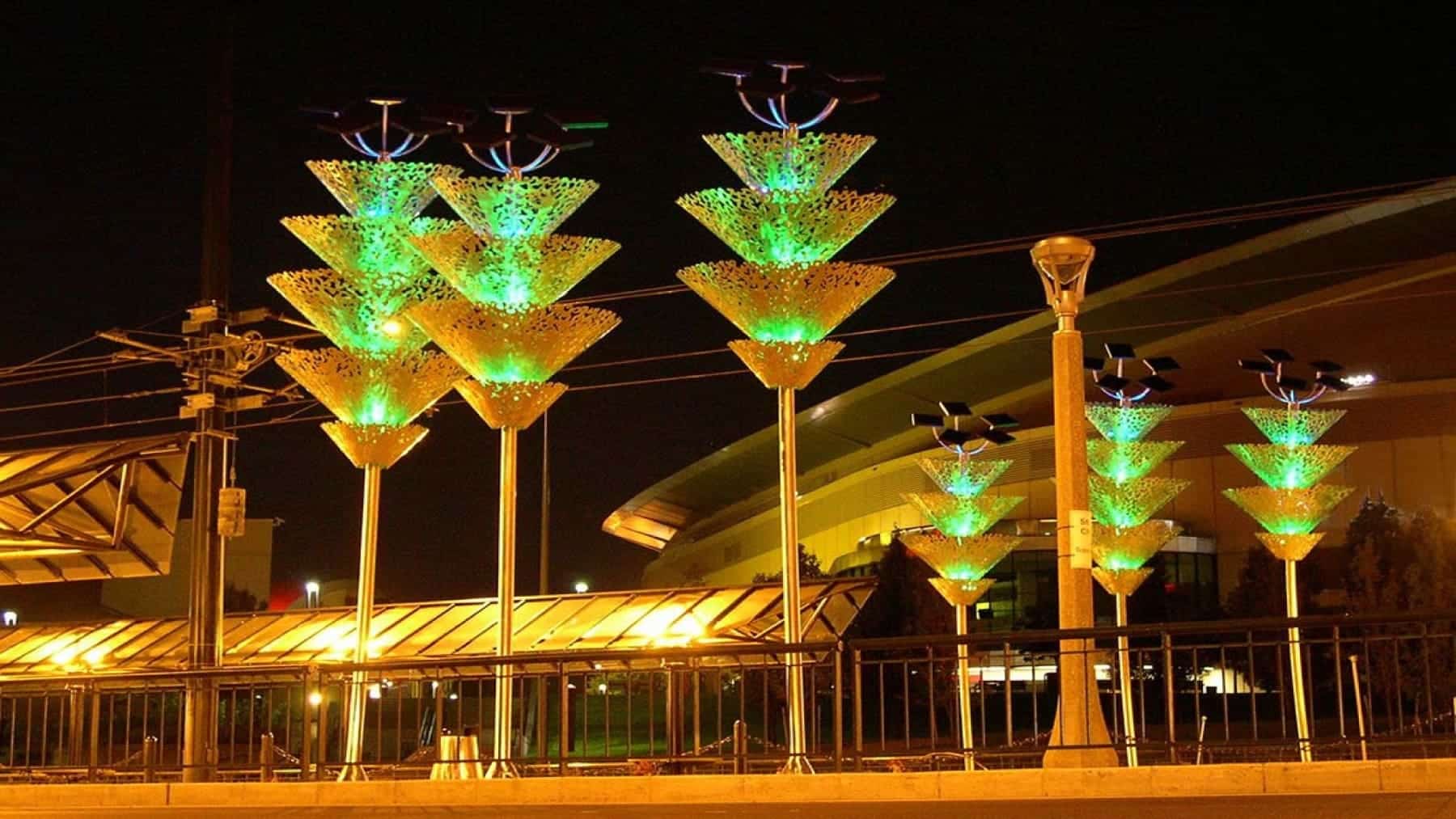
It’s dubbed the “forest that never sleeps,” a new type of urban icon. As darkness falls, steel trees come to life with light, glowing gently against the backdrop of the skyline. People pause to watch when in between intrigue and disbelief. You can almost feel the pulse of the city through the planted wires and roots of steel of the Silicon Forest.
Where steel meets sunlight, innovation finds its brightest reflection
Portland, Oregon, has a reputation for its towering trees, rainy weather, and creative vibes. Close to the Interstate and Rose Quarter MAX station in the Lloyd District, you will find a different kind of forest, one not made of bark and branches. This one is made of stainless steel and silicon.
Here are six flashy sculptures, each one about 22 to 24 feet high. They create a grove unlike any you’ve seen, powered solely by the sun! Silicon Forest, produced by Portland artist Brian Borello in 2013, hoped to bring about a design that melded art, technology, and ecology in a glowing vision.
Throughout the day, the Silicon Forest wide “leaves” store solar energy through photovoltaic panels that act like a canopy of artificial trees. As evening arrives, concealed LEDs come on to transform the energy saved during the day into a slow pulse of illumination that ripples across the station.
Uncovering the secret of the light that could change everything
Every tree made by Borrello speaks a soft story of displacement and return to the forests reborn through the intervention of humans in nature’s setting. Portland’s Lloyd District was once forest; the Silicon Forest is remaking that memory through artwork activated by solar energy.
Borrello characterizes the process as “photosynthesis in silicon,” whereby sunlight is absorbed, held, and released in a spectacular show. Even the seating in the installation resembles tree stumps, representing renewal. What was cut down now provides a place to rest, and what previously needed sunlight can still find a way to shine, just like this groundbreaking Solar Ark, powering innovations.
When light becomes a gathering place and innovation honors nature
During the daytime, the sculptures come off as industrial and even austere. By night, they change. Their crowns sparkle in blues and ambers; the central plaza serves as a virtual campfire, where the nightly ritual of commuters convenes. They are drawn to the light, almost instinctively. There is no sound, no heat, simply light, silence, and contemplation.
But behind the Silicon Forest’s radiant exterior is a softer message: nature and science do not need to be in conflict. In this forest, technology does not supplant nature; it celebrates it, learning from the rhythms and forms, and inspiring aspects of life through steel and light in a homage.
Messages carried quietly in the glow of a technological forest
Stroll through the Silicon Forest, and it won’t take long for you to see the tension between what is visible and what is obscured. At the roots of the calm lights are batteries storing the energy produced during the day. At the base of each tree are wires humming quietly, alive but not visible. It is a fragile ecosystem, one made of code, current, and craft.
For residents, Silicon Forest is not just art, it’s proof of potential. Its solar-panel trees power the city while its glowing trees inspire, representing regeneration, sustainability, and the capacity of creativity to re-enchant urban life, one decade post-commissioning.
As night falls in Portland, the Silicon Forest shines back into being, a reassurance that the future could be both bright and rooted. Metal mimics life, sunlight weaves into poetry, just like the Arch of Time, transforming parks into power. As you drive past the Rose Quarter Station, you might catch a glimpse of the past and the future together, a forest reborn with glowing steel leaves.