

Fri, 17th Oct 2025
The fragile US-China trade truce has ended. On October 10th the US president, Donald Trump, announced on social media that, starting from November 1st, he would impose additional 100% tariffs on China; restrict US exports of critical software to China; and consider cancelling a potential meeting with the Chinese president, Xi Jinping, during the APEC summit in early November. The latest developments mark the “third round” of the US-China economic war, following the first (February-April, focused on tariffs) and second (May-June, focused on export controls) rounds of tensions earlier in 2025.
Mr Trump’s announcement was in response to China’s recent series of actions targeting the US. These included a substantial expansion of export control of rare-earth materials and technologies; the listing of several US defence firms as “unreliable entities”; an antitrust investigation into an acquisition involving the US chipmaker, Qualcomm; customs checks on imported Nvidia H20 and RTX Pro 6000D chips; and port fees on US ships docking at Chinese ports. The Chinese actions are, in turn, retaliation for new US actions following bilateral talks in Madrid in September.
EIU is unsurprised by the end of the relative stability in US-China relations since mid-2025. We have long cautioned that continued US provocations, including sanctions against individual Chinese companies and increasing pressure on third countries to levy tariffs on China (including in regard to transshipments), could cross the latter’s threshold of tolerance. We interpret China’s measures, which were enacted immediately after the country’s eight-day National Day holidays, as retaliation to these earlier US actions.
What is more surprising is China’s shift towards bolder tactics. In its previous economic conflicts with the US, China limited itself to reacting to the US’s moves, with its countermeasures largely matching the US actions in scale. The latest manoeuvres suggest a more pre-emptive approach. Its new export control regulations, for example, effectively resemble the US’s foreign direct product rule; they essentially require foreign firms to obtain Chinese approval before they can export any goods that contain rare-earth materials sourced from China or are produced using Chinese technologies. These rules have the potential to bring a wide range of global industries—spanning semiconductors, automotives and advanced weaponry—to a sudden halt, at the whim of the Chinese government.
We still see China’s escalation as tactical, rather than strategic. Its latest moves have a dual purpose: they seek to bring bilateral negotiations back on track, while also emphasising that the current US strategy (which involves engaging with China while concurrently tightening economic pressure) is unacceptable to the Chinese leadership. We believe that China is open to de-escalation, and will consider rolling back some of its measures if it deems the US as fulfilling its demands.
The US has also already hinted at its willingness to defuse the current spike in tensions. On October 12th Mr Trump struck a more conciliatory tone towards China on Truth Social, his preferred social media platform, following a sharp sell-off in US equity markets and a steep decline in US Treasury yields following his tariff announcement. These factors match our view that the US president’s sensitivity to financial market movements often acts as a brake on his more radical policy threats.
Our baseline view still assumes a relatively quick resolution of tensions by the end of October, although the risk of new US tariffs materialising on China is very high (over 40% probability). Expected de-escalation will lay the foundation for the Xi-Trump summit to take place as scheduled, which is likely to yield another (brief) period of stability in US-China ties. We expect China to be willing to roll back some of its measures as part of any détente. It will, however, abstain from fully dismantling its upgraded rare-earth export control scheme, which it will retain as a bargaining tool. This will pose a long-term threat to US industrial security.
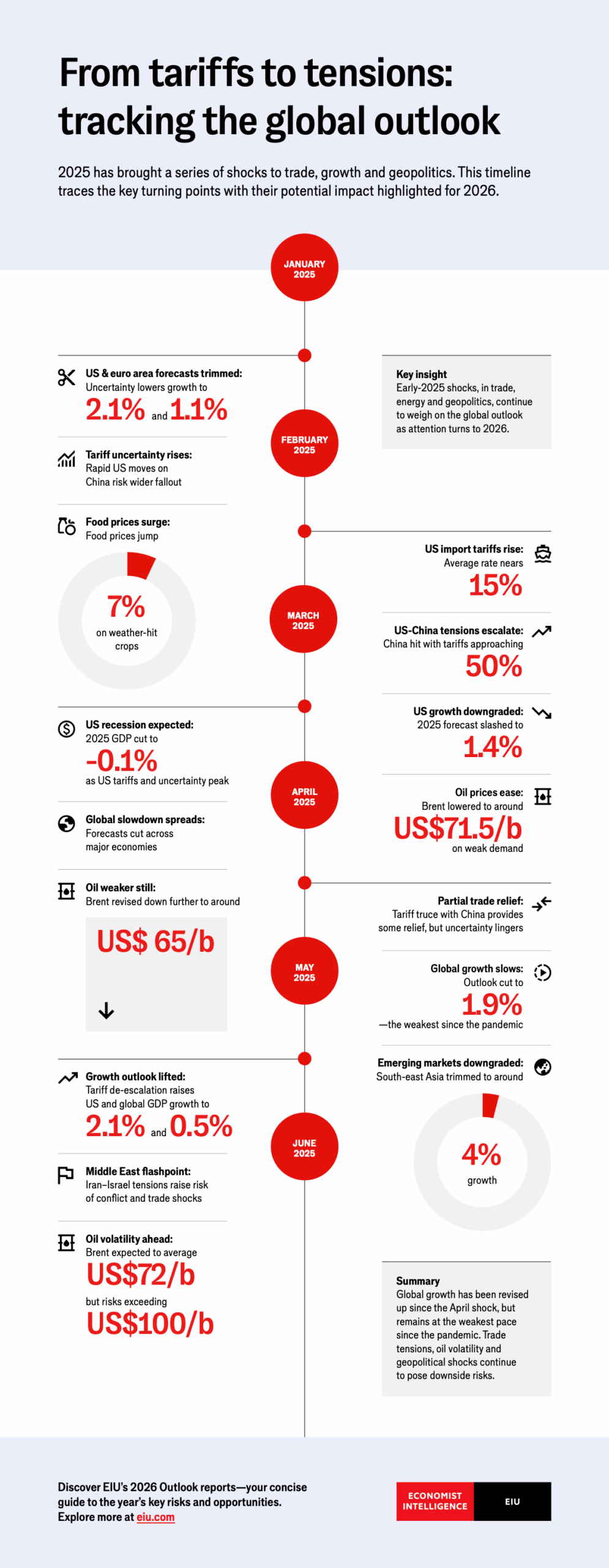
Looking back at 2025’s key turning points and how they will impact North America’s 2026 outlook.
North America 2026 Outlook
North America faces a challenging year ahead as the impact of new US tariffs, slowing growth, and rising policy uncertainty reshape the region’s economic outlook. Decision-makers across government, finance, and business will need to navigate an increasingly complex policy and investment landscape. EIU’s North America Outlook 2026 explores how trade disruption, USMCA renegotiations, and monetary policy independence will shape strategic decisions—and where opportunities like AI investment could offer resilience amid volatility.
Download the summary report today to access our latest analysis and forecasts on the risks and opportunities redefining North America’s economy in 2026. Download the report.
Join us on November 13th for our live event, where EIU experts will examine what to watch in 2026—from tariff and trade policy shifts to growth dynamics, market implications, and strategic responses for policymakers, investors, and corporate leaders. Save your seat.