
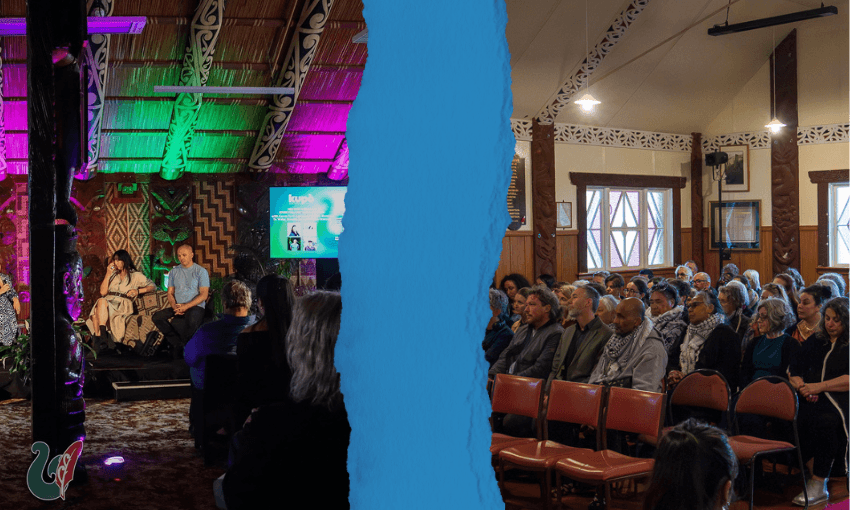
Two writers report back from two different festivals on two islands over the same weekend.
It is with the plan of killing two birds with one stone (or rather, to mate e rua ngā manu with kotahi whatu) that I steer my waka to the Kupu Festival in Rotorua where I’m looking to upskill my reo because for the first time ever, they are offering the first day of their two-day schedule completely in reo Māori only.
As an akunga houhare – a diligent disciple of the reo, it is day one that I am here for the most: to sit in a wharenui with these mātanga Māori – experts in the reo. And what a line-up! Kupu’s directors have gathered skilled experts like Hēmi Kelly, Hona Black, and publishing sensations including Atua Wāhine author Hana Tapiata. Their kupu whakanikoninko – embellished speech – is an inspiration and a motivation for those of us who want to speak like that too one day.
Kupu is unrivalled in terms of the beauty of its location. The venue on day one is the breathtakingly beautiful Te Papaiouru Marae. On the shore of Lake Rotorua, a stone’s throw from downtown, it’s the home of the six hapu of Ngāti Whakaue. The wharenui, Tamatekapoa, is a stunner, with spectacular whakairo and matching stained glass windows, and across the atea, perched right on the water there’s an even greater beauty, the Anglican marae church, St Faiths, which has a sort of mock-tudor-meets-Māori facade and an intricate tukutuku interior that is so outrageously gorgeous I might give up my devout atheism if this were my tūrangawaewae.
The church is the final location of the day, where we sit as the sun begins to set and poet Matariki Bennett recites her work standing beside the tomb of her tupuna. The stained glass around her is all magnificent but the real corker is the modernist window which cunningly depicts Jesus floating over the lake outside as if he is literally walking on the water.
 Matariki Bennett speaking at Kupu Festival. (Photo: Kararaina Pene).
Meanwhile, doing a pretty good impression of Jesus at his best, knocking out the loaves and fishes trick, is festival organiser Ruakiri Fairhall and his offsider Jemma Moreira. The Kupu team effortlessly pull together a schedule that manages to be both super-chill tikanga Māori vibe but also miraculously run on time. Fairhall tells me he’s got big plans too to build further on the reo-only day next year with headsets provided that translate the speakers. Now that’s some top level UN shit! This festival is nothing if not ambitious.
Day two dawns with a pōwhiri at stunning location number two: Whakarewarewa. The crowd is possibly a little larger than the day before and once again the venue is a wharenui. There’s something about making authors leave their shoes at the door that makes them leave their pretentions there too and lots of the writers who speak today are honest about their struggles with language acquisition, and with writing. Mike McRoberts tears up several times as he talks about his journey.
“I had nothing,” he says of growing up in Christchurch and never speaking Māori. “Willie Jackson called me out, inferring I wasn’t a real Māori.”
“Anyone in this room who hasn’t been called out by Willie Jackon?” MC and TVNZ political editor Maiki Sherman laughs.
In his session Airana Ngarewa says that it’s not the reo that is his greatest struggle so much as writing in english. He suspects he might be profoundly dyslexic. To combat this, his writing technique involves him prowling around the room and then almost sneaking up on a sentence by expressing it out loud before he scurries back to his desk to write it down. It sounds frankly exhausting.
Actually a lot of the authors’ techniques that they speak of leave me feeling faint or perplexed. JP Pomare who shares the stage with Airana Ngarewa talks about the importance of not knowing what is going to happen next when he writes. “If you want a predictable book then plan it,” he says dismissively. Uh – hard disagree. But I like JP and he’s sold a lot of books and crime writers are different to the rest of us so what would I know?
He speaks too about his difficulties reconciling himself to a life of crime. He wanted to be literary. Instead, I guess he will just have to cry himself to sleep on his giant bed of money. Two of his books have now been adapted to screen and his writing is very, very good and his fan base reflects that. He has been in Melbourne for 17 years now but he’s still a Rotorua boy at heart. His dad is a racehorse trainer and he grew up in Ngongotahā. “Probably half of this room has bought a fridge from Pomare Electrical.”
JP Pomare (left) and Airana Ngawera (right). (Photo: Kararaina Pene).
There is a film session where writers Tim Worrall, Ramon Te Wake, Hamish Bennett and Karen Te O Kahurangi Waaka talk about the craft. Karen says something profound about decolonising the writing process. Ramon, who wrote The Boy, The Queen and Everything In Between, brings a showgirl quality to the line-up. “I literally came out of my mother with jazz hands”. If I have one gripe (and I really don’t) about the festival it is that sometimes the panels mean I don’t get to hear more from fabulous people who have much knowledge to impart.
Ultimately, I came away with a profound respect for the tikanga of this special festival. Is there any other hui ahurei in Aotearoa right now with more heart, more verve, more ambition than this one? I doubt it.
The theme of this year’s festival was Ahi Kā: keeping the home fires burning. Dunedin for me is a home and I love going back there to huddle in its hilly embrace. The festival’s warmth, manaakitanga and vibrancy stoked my love of this stunning city and the community of writers and readers it holds.
The opening event and pōwhiri at the gorgeous Ōtākou marae on the Peninsula was a highlight. The kai! Tītī, boil up, a pot of cockle chowder large enough to bathe in, salads Ottolenghi would envy. And the post-kai kōrero in the wharenui, Tamatea! Megan Pōtiki – stunning; Apirana Taylor – electrifying; Tāme Iti – mesmerising; Nadine Hura – hilarious; Victor Rodger – heartwarming; Jeanette Wikaira – seismic; Rob Tuwhare – moving; Talia Marshall – sensational; Tina Makereti – gentle; Ati Teepa – stirring; Waiariki Parata-Taiapa – joyful.
From left to right: Jeanette Wikaira (chair of Dunedin Writers & Readers Festival board), Apirana Taylor, Rob Tuwhare, Megan Pōtiki and Tāme Iti. At the Ahi Kā opening event at Ōtākou Marae. (Photo: Kaiwhakaahua Studio.)
After that satiating start, the weekend unfolded like a dream with the Dunedin Centre teeming with festival-goers over two days of back-to-back events in two separate theatre spaces. Becky Manawatu, Talia Marshall and Victor Rodger were first up on Saturday and were an inspired holy trinity – their conversation, built on their mutual love of Fleetwood Mac, was funny and surprising. Some insights: Marshall said that Maurice Gee’s Halfmen of O books are her most sacred NZ texts. Manawatu said she likes to have a truth in her fiction – as small as an object or as a big as a relationship – to build a narrative from there; and when Marshall offered that the fiction was a way of hiding, Manawatu agreed. Marshall said that when she writes she often has a song in her mind and that while she’s working the whole world glows with it, and then once finished, it’s gone. Manawatu said that when rats washed up on the beach in Westport she thought it was a tohu for her and that she was in trouble for Auē and so, at one point, she was trying to use the sequel, Kataraina, to erase everything that had happened in the first book. At question time Marshall elegantly handled a clunky, but curious, inquiry about whether she lumped her readers in to Pākehā and Māori. Marshall responded generously, explaining she has an ideal reader (her son’s Aunty).
Nadine Hura speaks to her book, Slowing the Sun. (Photo: Kaiwhakaahua Studio.)
Nadine Hura drew a large crowd for a conversation based on her essay collection on climate change, Slowing the Sun. It was an extraordinary hour, beautifully chaired by Metiria Turei Stanton. I’ve never heard so many collective “mmmm”s. Hura’s kaupapa for finding a te ao Māori lens for climate conversations feels at once bone logical and revolutionary. Te reo Māori contains within it how to see ourselves in relationship to the planet and withdraw from this colonial, extractive madness we’re living: it’s all there in the kupu. Like “whenua” and its multiplicity of meanings: land and placenta. “You wouldn’t attack the organ that sustains a baby? That’s dumb? So why attack the land?” Hura said the best feedback she’s had on the book so far is that librarians don’t know whether to categorise her book into science or literature.
On Saturday night, legendary watering hole WOOF! came alive with the sound of poetry to the theme of “Go tell your racist jokes to someone else”, a line from Tuwhare himself. The format was inspired: a line-up of seven poets would do one poem each, interspersed with a bell commandeered by former Dunedin mayor Aaron Hawkins, that signalled when the crowd could get back to chatting and drinking, and then would tinkle again to hush us for the start of another poem, and so on for three rounds. Energising, community-building, rousing and fun.
Laurence Fearnley (left) and Louise Wallace (right). (Photo: Kaiwhakaahua Studio.)
My last event was with the brilliant, and in my opinion sorely under-appreciated, writer of 13 novels Laurence Fearnley and the equally brilliant Louise Wallace, discussing the elemental threads between their two books, The Grand Glacier Hotel, and Ash. Fearnley is charming, and went off piste a couple of times, letting us in on a harrowing antenatal experience in Germany. Wallace is incredibly astute (as you’ll know if you’ve read Ash) and read from a particularly funny part of her novel before explaining that she always writes from an emotional centre and is always trying to use the page to evoke a particular feeling in the reader. Fearnley spoke movingly about her passion for the wild landscapes in Aotearoa, some of which we are losing: “it’s a vandalism”. She also spoke about her love of the slow nature of the novel: the excitement of sitting down and wondering what was going to happen in the world of the book that day.
All in all an absolutely wonderful time at a wonderful festival where the organisers worked incredibly hard for a smooth, joy-filled time of connection and care.