
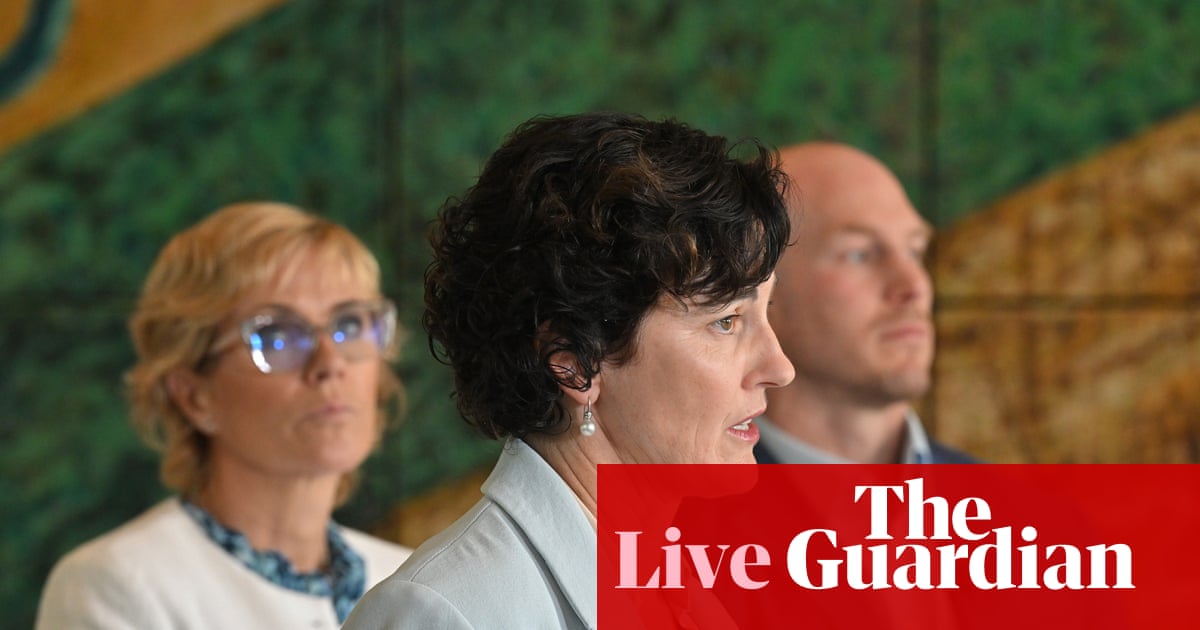
Current environment laws ‘are broken’, Albanese tells parliament
Anthony Albanese is speaking in the lower house now about the proposed nature laws.
The prime minister said:
Australia doesn’t have to choose between a strong economy or a healthy environment. We don’t have to choose between creating jobs and cutting emissions. We can do both. Indeed, we must do both, because each one depends on the other.
The current laws are broken. They were written by the Howard government for a very different Australia, and they haven’t just become obsolete. They’ve become an obstacle. They’re not working for the environment and they’re not delivering for business. They are a barrier to jobs and investment across our nation, and in many cases, they overlap or duplicate state and local government processes.
Updated at 19.47 EST
Key events
Show key events only
Please turn on JavaScript to use this feature
 Dan Jervis-Bardy
Teal independents are set to oppose Labor’s re-write of environment protection laws when it’s put to a vote in the lower house in coming days.
Zali Steggall, Sophie Scamps, Kate Chaney, Nicolette Boele, Monique Ryan and Allegra Spender confirmed they could not support the almost 1500-page bill without major amendments to better protect nature.
Chaney, the MP for Curtin, told reporters in Parliament House:
My community really wants to see reform in this area. We need to do better at protecting nature and also making processes work faster for business. But when it comes to this package, the process sucks and the substance is questionable.
Chaney and the fellow crossbenchers have drafted a raft of amendments, including to redesign the proposed “offsets” fund, prevent the minister from using a new “national interest” exemption to approve fossil fuel projects and insert climate as an object of the Act.
The bill includes a requirement for high polluting projects to disclose their emissions as part of the application process but does include not a “climate trigger” that could block their approval.
Boele said climate change was “turbo-charging Australia’s extinction crisis”.
How can we expect to help the Glossy black cockatoos, our wonderful tall forests, or even our wonderful and diverse reefs, if we’re not dealing with the threats that they face?
Scamps – who will move an amendment to remove an exemption for native forest logging – said the laws were riddled with “enormous loopholes”.
We’ve got one set of environment laws to protect our nature, and they have utterly failed us for the last 25 years, we now have 19 ecosystems on the brink of collapse, but the changes that the government has proposed do not guarantee that our nature will be better protected.
Sydney peace prize ‘disappointed’ Wong declined meeting with laureate
The Sydney peace prize has said it’s “disappointed” foreign minister Penny Wong would not meet with former UN high commissioner for human rights, Navi Pillay, the prize laureate who addressed the National Press Club on Tuesday.
Pillay was the first non-white judge in South Africa’s high court, served as a judge of the international criminal court, and is a former chair of the UN’s Commission of Inquiry on the Occupied Territory of Palestine and Israel.
Director of the Sydney peace prize, Melanie Morrison, told Guardian Australia they had reached out to Wong’s office in August to arrange a meeting. They said that after several follow ups, Wong’s office said the minister was unavailable. Morrison said:
As a matter of course, given the calibre of this years’ laureate, it’s disappointing the meeting was declined by the foreign minister’s office.
Instead, Pillay met with the assistant foreign minister, Matt Thistlethwaite, the government confirmed, with an adviser from Wong’s office present.
Morrison said Pillay also had a meeting with the department of foreign affairs and the ambassador for gender equality on Monday.
Navi Pillay addresses the National Press Club in Canberra. Photograph: Lukas Coch/AAPShare
Updated at 20.24 EST
Opposition accuses Labor of ‘rushing’ nature legislation
Liberal MP Julian Leeser is now responding to the prime minister on the nature laws. He said:
This bill doesn’t make small changes or amendments. It’s almost 1,500 pages of legislation and explanatory materials that reaches into every corner of the economy that builds, digs, grows and manufactures.
He accused the government of rushing the bill, saying “the Senate has already had to step in and refer it to an inquiry”. He continued:
This matters because rushing this legislation will have real consequences for Australians.
Minister Plibersek attempted to make these reforms in the last parliament, they were withdrawn under internal pressure. Labor promised an Environment Protection Agency at two elections, and four years on, it hasn’t delivered what it promised.
Julian Leeser. Photograph: Lukas Coch/AAPShare
Updated at 20.05 EST
Staying with Albanese for a moment, who is speaking now about the nature laws in the lower house.
He said a littler earlier:
This bill is about driving better, clearer and speedier decision making, making it easier to get an answer from government sooner, a quicker yes or a quicker no. Providing that certainty is the key to encourage investment in our economy. And every bit as important as encouraging investment in our economy is ensuring there’s a better system of protections for Australia’s precious and unique natural environment.
He later said:
They can talk about the problem, or they can vote for the solution. That is the choice that will be before the senate.
I say this to the opposition and to the Greens political party. This is good for jobs, good for industry, but it’s also good for the environment.
Updated at 19.55 EST
Current environment laws ‘are broken’, Albanese tells parliament
Anthony Albanese is speaking in the lower house now about the proposed nature laws.
The prime minister said:
Australia doesn’t have to choose between a strong economy or a healthy environment. We don’t have to choose between creating jobs and cutting emissions. We can do both. Indeed, we must do both, because each one depends on the other.
The current laws are broken. They were written by the Howard government for a very different Australia, and they haven’t just become obsolete. They’ve become an obstacle. They’re not working for the environment and they’re not delivering for business. They are a barrier to jobs and investment across our nation, and in many cases, they overlap or duplicate state and local government processes.
Updated at 19.47 EST
Here’s a video of federal communications minister, Anika Wells, talking about the under-16s social media ban a short time ago.
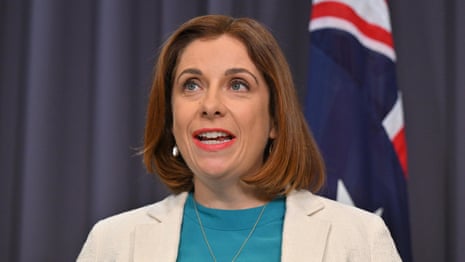 Australian government adds Reddit and Kick to under-16s social media ban – videoShare
Could Roblox be added to the social media ban for under 16s?
Jumping back to that press conference with Anika Wells and eSafety commissioner Julie Inman Grant, while Roblox has not yet been added to the list of banned platforms, Inman Grant said it’s “on the line”.
As we brought to you earlier, the eSafety commissioner said the list of platforms is “dynamic” while Wells said this morning the legislation isn’t “set and forget”.
Inman Grant also brought up a few elements of the Roblox platform that are of concern to her.
[The list] will always change and we’ve told companies, so for instance Roblox, as was just mentioned, some of these companies when we did the assessment were very much, what I would say, on the line. So we had to put our minds to what is the sole and significant purpose – online gaming, right? But there’s chat functionality in the US, they’ve launched a program called Moments, which is very much like stories, which is online social interaction.
We will be watching as well and if they start rolling out features that look more like they’re becoming a social media company than an online gaming company, then we will seek to capture them.
Anika Wells (left) and eSafety commissioner Julie Inman Grant speak to the media at Parliament House on Wednesday morning. Photograph: Hilary Wardhaugh/Getty ImagesShare
Updated at 19.10 EST
Cook defends WA’s GST take
WA, which has declared itself as having the strongest economy in the nation, also gets a phenomenally generous take of the GST carve-up between states and territories.
Economists such as Saul Eslake have been advocating to change the Morrison-era deal that put a floor under WA’s GST take and will give the state an extra $60bn in tax revenue over the next decade.
Roger Cook tells ABC RN Breakfast that while his state only represents 11% of the nation, it contributes 45% of the nation’s exports, and is the “biggest contributor to the nation’s GDP.”
Prior to the actual deal that was done to preserve our 75% floor of the GST share, we saw Western Australia’s contribution to the other states reach almost 90%. That is, we just retained 11% of our GST. Now in WA we utilise that revenue to ensure that we can develop the economic infrastructure, create the sort of frameworks and the regulation for the industry which ultimately pays significant resources to the commonwealth and other states through company tax and other measures.
Host Sally Sara pushes back, saying Eslake argues that private industry provides a lot of that infrastructure, but Cook says the state government provides the roads, water and port infrastructure.
Updated at 19.06 EST
WA premier says Coalition ‘failing the big moral challenge of our time’
Western Australian premier Roger Cook is in town this week as the government tries to gain support for its environment protection reforms (that political followers will know the WA government was not a fan of last time around).
It’s part of the reason why Murray Watt made WA his first visit as a newly sworn in environment minister to get the state on side.
Cook spoke to ABC RN Breakfast a little earlier this morning and said he “commend[s]”
Watt’s work.
I believe we can do this. We have obviously met with environmental groups and with our big resource companies and other members of our industry in Western Australia all the time. They’re encouraged by the progress that’s been made. Obviously, there’s still elements of the legislation that they want to see addressed, but I think there’s a great sense of consensus and collaboration at the moment to see if we can find that space, which creates the balance, the balance between encouraging industry but also protecting the environment.
Asked to weigh in on the other big issue of the week – net zero – Cook says the Coalition are “failing the big moral challenge of our time”, and would be “very concerned” if the Libs go down the same path as the Nats on scrapping net zero altogether.
They’re quite frankly just starting to retreat to the extremes of the political spectrum. They need to come back to the centre … And I think we should all get round the joint and global consensus position of reaching net zero emissions by 2050.
Premier of Western Australia, Roger Cook speaks to the media at Parliament House in Canberra on Wednesday morning. Photograph: Hilary Wardhaugh/Getty ImagesShare
Updated at 19.04 EST
FoI bill returns to house for debate after government ‘sees the light’, says Coalition
After the opposition kicked up a stink yesterday on the government’s attempt to move the controversial freedom of information bill to the smaller federation chamber, the government has brought back the debate to the house.
Talk about a procedure-heavy day today!
The chief opposition whip, Aaron Violi, who yesterday tried to table a list of 16 opposition speakers who were going to miss out on being able to debate the bill in the house, is the first to speak today (his tabling request was rejected FYI).
It’s nice that this bill has returned to the house today, the manager of business [Tony Burke] saw this light.
Independent MP Zali Steggall, who has been a staunch critic of the bill, is also speaking on it.
This bill was drafted without consultation, introduced without transparency, and designed in a way that rewards secrecy. At a time when public trust in government is already low, this legislation seeks to make it harder for Australians to access information and easier for government to hide it. This is not reform, this is regression.
Updated at 18.23 EST