
This lovely, chaotic city of hope
How do we build a better city? Just want to leave this here –
it’s from the New Yorker, in the wake of Zohran Mamdani’s landslide election this week as mayor of New York.
“During the campaign, Mamdani liked to remind his audiences that New York is the richest city in the richest country in the history of the world, and that its government could do more for the people who live here. While his opponents described New York as broke, dysfunctional, and crime-ridden, Mamdani talked about the city as a lovely, if chaotic, place—full of tumult and injustices, yes, but also of life and possibilities.
“The Mamdani Cinematic Universe is a place where you can take the subway to the city clerk’s office to marry the girl you met on Hinge, where you can do Tai Chi and salsa-dance with old folks on the Lower East Side, where you can go for a polar plunge off Coney Island on New Year’s Day and walk the entire length of Manhattan on a hot summer night.”
You know something? Auckland is also the richest city in the country and its governments, local and central, could do more for the people who live here. It is not broke, dysfunctional and crime-ridden, despite the best efforts of some politicians, business groups and some of my colleagues in the media looking to persuade you otherwise.
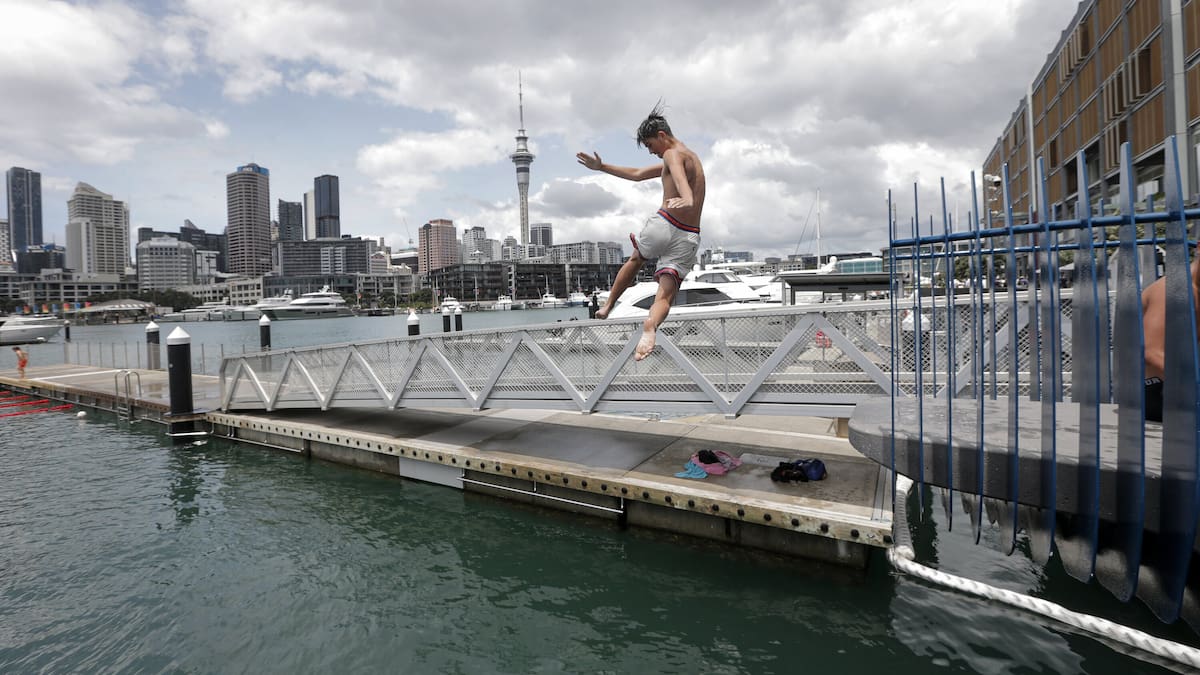
Auckland is lovely and chaotic, too, and full of tumult, injustices, life and possibilities. You can go swimming in the Karanga Plaza pool and, if you want, join the kids manu jumping off the wharf. More such pools, our own mayor promises, are coming. There’s great food everywhere, at all price points.
Few of us would want to trudge the length of the city, Brynderwyns to Bombays, but the walk along the waterfront from Westhaven to St Heliers is glorious. You can do the same on the other parts of the isthmus at the Manukau Harbour.
And you can cycle through some greats parts of the city, almost all the way on safe routes. More safe cycleways will take you snaking up to Glen Innes, or through town and all the way west to Hobsonville Point, or south to Mangere Bridge and the coastal route to the airport.
There’s Tai Chi on Queen’s Wharf and in Avondale, Mairangi Bay, Newmarket, Henderson, Takapuna, Farm Cove and Laingholm, and folk dancing on Sunday afternoons at the new Te Rimutahi pavilion on Ponsonby Rd.
And pretty soon, still channeling the New York state of mind, you’ll be able to take the subway. Fair enough, it’s not a big subway, but trains from as far away as Pukekohe, Panmure, Manukau and Swanson will take you through it.
Ride into town and go shopping, catch a show, cruise Karangahape Rd, zoom up the Sky Tower for the view or wander round the art gallery for different kinds of views. Get yourself some of the pleasures of our own hot summer nights.
“Hope is alive,” Mamdani declared yesterday.
Our own mayor is not a socialist like Mamdani. He’s a self-avowed grumpy old bugger and he doesn’t spend much time painting pictures of a better city. But at his inauguration last Friday night he could hardly stop grinning and he did say his election was “a message of hope”.
And Hopetown – which is spelled Hopetoun on the street behind the CRL’s Karanga-a-Hape Station – isn’t that where we live?
Rough sleeping on High St in Auckland. Photo / Lynn Grieveson/Getty Images
Moving on: The proposed rough-sleeping ban
The Government is “doing work on changing the law” to give police the power to move rough sleepers on. It’s a nationwide issue but the flashpoint is Queen St.
There are some fundamental issues at stake here, the first being that people have the right to feel safe in town. But that doesn’t mean the fix is to call in the police so they can, in effect, hide the problem.
The city centre has seen a rapid rise in the number of rough sleepers, from 426 just over a year ago to more that 800 today. Something has to happen.
But why is it a police issue? The police themselves don’t want it to be. Commissioner Richard Chamberlain has pointed out that it’s not illegal for people to sleep in public and it’s not the police’s job to move people on if they’re not breaking the law.
What would Mamdani do? He’s promised to treat homelessness, drug addiction and mental illness as community mental health issues, not matters primarily for the police. And he says he’ll fund the work accordingly.
City missioner Helen Robinson would approve. She told RNZ on Thursday the Auckland City Mission knows those 800 rough sleepers in the city by name. They have complex mental and physical health problems and what’s needed in Auckland alone is about 1000 places they can call home, with wraparound services. Plus, at least in the short term, 1000 emergency or shelter beds.
I was at the Government’s announcement on September 5 of 300 new places for rough sleepers, nationwide, complete with those essential wraparound services. Housing Minister Chris Bishop said he was off to talk with Robinson that same day, to ensure the Government was getting it right and the plan would work.
Two months on, only “a couple” of places have been provided. This isn’t easy.
Housing First Auckland programme manager Rami Alrudaini told RNZ that an enforcement or punitive “move-on” approach to rough sleeping would only “displace the problem and cause more harm”.
“Delivering proven programmes that provide housing, health, and wraparound support is the most effective way to address homelessness,” he said.
This “housing first” approach, as described by Alrudaini, is understood by everyone in the field. The business association Heart of the City, the police, the Government and the Opposition are all long-time supporters.
What’s also understood is that just moving people on won’t solve anything.
When Police Minister Mark Mitchell said yesterday police should have “more tools” to deal with rough sleepers, he was careful to put it in context. “You’re not just going to pick up someone that’s in a vulnerable position and drop them off in another vulnerable position. You’re actually going to take them to a place of safety. That’s the whole idea of it.”
I love that he said that, but how is it true?
The Government isn’t expanding emergency housing, as Mitchell seems to be suggesting. It’s closed most of it down. Instead, it’s to be a police matter.
But the police already have the power to move on or arrest anyone behaving in a threatening or violent manner, taking drugs, urinating or defecating in the street or otherwise breaking the law.
And as many observers have pointed out, much of the anti-social behaviour and nearly all of the violence comes from drunk visitors to town, not the people who spend the night on the street there.
Maybe the first step would be to rethink the approach to emergency shelter and provide those 1000 beds as proposed by Robinson. Youth worker Aaron Hendry says it will need to be well organised, because some people, especially women, find the streets safer than some hostels can be.
And the next step is to get those extra “housing first” places sorted. Then we could have a sensible discussion about what comes after.
Right now, says Bishop, “The intention is for all of those [300] places to be contracted and available with people in them by Christmas.”
But if Auckland gets 200 of them, that’s still only a fifth of the way to meeting the need.
At that announcement in September, Bishop told me he respects Robinson enormously and is always keen to get her advice. For her part, she may find that is just a little bit frustrating.
As for the police, don’t we know they already have enough to do?
New signage for a hitherto unknown station on the soon-to-open CRL.
The optimists of Queen St
I ran into Scott Blanks of the Classic Comedy Club recently. They’re on Queen St, a few doors up from Q Theatre and the town hall. He told me he’s jumped on the CRL “bandwagon”, pun intended, with some new signage: Classic Underground, in the style of a London Underground station sign. Clever.
Blanks is calling himself a Queen St optimist and I’m all for it. While others bleat, he says the club’s on track to present 430 shows this year. Incredibly, that’s more than eight a week, with a cumulative audience, he says, of more than 28,000.
The council also stands with the optimists. Its Queen St Christmas decorations this year will include a series of 5m-tall light columns, designed by Angus Muir in collaboration with the council’s Barbara Holloway.
Christmas is coming to the CBD. New interactive light columns will be on display in Queen St from December 1.
From December 1, each of the five columns will light up with a different theme: Santa’s workshop, a festive forest, under the sea, a Kiwi Christmas and a classic Christmas feast.
Interactive buttons and knobs will allow kids (and adults, I guess) to call an elf or make a wish, decorate the trees of a festive forest, play Kiwi Christmas songs, make a seagull squawk or even project their face on to the sun.
The giant Christmas tree will be back in Te Komititanga Square from December 1.
And on November 22 the big Christmas tree, Te Manaaki, will be re-erected in Te Komititanga Square with a concert by the band Drax Project. It’s 18.4 metres tall and will be covered in 10,000 LED lights, 4000 pōhutukawa flowers and 200 giant baubles. Like last year, the lights will do their thing in a five-minute show every 10 minutes.
Te Manaaki is paid for by Heart of the City and Commercial Bay, with support from Auckland Council via the city centre targeted rate.
Ponsonby Rd: More fun with fewer cars, amirite?Photo / Sylvie Whinray
Excess parking on Ponsonby Rd
Want to know why it’s so hard to find a park on Ponsonby Rd? The drivers who got there before you are staying longer than they’ve paid for, or just not paying at all.
Auckland Transport (AT) head of transport parking and compliance, Rick Bidgood, says more than 12,000 parking infringements have already been issued to vehicles along Ponsonby Rd so far this year.
“That is a huge number. This is a space not being used as it was designed for.”
Bidgood says Ponsonby Rd is “always” in the top three areas for parking infringements and nearby residential side streets are “getting up there as well”.
“We’re seeing hundreds of parking infringements being issued to vehicles on side streets each month, such as Brown, Cowan, John, and Lincoln Sts.”
AT wants to change this and is seeking public submissions on proposals that include:
Extending paid parking into some of the side streets.Introducing evening paid parking.Extending the residents’ parking zone.Adding 10-minute zones for Uber Eats and other meal delivery drivers.Adding parking corrals for e-scooters, to tidy them up.
It’s reported that “locals and visitors have been left fuming”. Really? If you think the best way to stop the fines is to abandon parking fees, think again. We don’t live in Taihape and there are now far too many cars for that to work.
Parking fees and enforcement are the best way to enable the most people to find a park. Not paying isn’t anarchistically heroic, it’s just selfish.
No word, sadly, on the transport facility I think Ponsonby Rd needs the most: a bike lane.
Feedback is open until December 1.
Humpback whale in the Hauraki Gulf. Photo / R.Robinson/depth.co.nz
The big fish show
The Maritime Museum on Princes Wharf has just opened Ngā Huhua: Abundance, an immersive exhibition celebrating the lifeforce of Te Moana-nui-a-Toi, the outer Hauraki Gulf Marine Park.
Humpback whales! Turtles! Astonishing schools of pilchards wrapped in a ball! The museum says the exhibition brings the outer gulf alive “through storytelling, ocean science, mātauranga Māori, contemporary art and the voices of tangata whenua (Ngāti Rehua Ngātiwai ki Aotea)”.
A pilchard ball in the Hauraki Gulf. Photo / R.Robinson/depth.co.nz
“The exhibition reveals how both the giants and the smallest creatures play vital roles in maintaining the balance of this thriving marine world. Each year, these species gather in abundance during the seasonal upwelling of food-rich waters, a natural rhythm that has sustained life here for thousands of years. Today, that lifeforce is under pressure from climate change and human activity.”
Eden Park, set for more concerts than ever. Photo / David Rogers/Getty Images
Boom time for Eden Park
The Government has announced a plan to allow Eden Park to host 32 concerts a year: 12 large ones (30,000+ people) and 20 medium-size ones (10,000-30,000 people). This is up from the total of 12 currently allowed.
In a long summer concert season, this would mean more than one big show every week.
It’s also proposed to allow concerts up to eight hours long, which opens the door to music festivals on the site, plus more night-time events, more markets and trade fairs, larger conferences and more noise.
The idea is to make more money for the city.
“We know that big concerts deliver big economic benefits,” says Chris Bishop in his capacity as RMA Reform Minister. “For instance, over three years, 14 Auckland shows including Coldplay and Pearl Jam generated $33.7 million for the local economy.”
Bishop points to a report by the Incite consultancy that reckons the city will lose “at least $432 million” in money spent here over the next 10 years, unless changes are made.
The proposal has gone to Auckland Council, which has until the end of the month to respond.
This shouldn’t surprise anyone. Making the most of the facility is what’s supposed to happen. It’s been to the detriment of the city as a whole that we’ve seen so little of it at Eden Park.
But let’s also remember what this is not.
First, it’s not the visitor levy Mayor Wayne Brown desperately seeks. This is important. The more things happen in the city, the more the council has to ensure it has the infrastructure to cope: transport, public safety and all sorts of other services. It all costs money.
The Government wants to enable more activity, but refuses to allow the council to collect revenue from visitors to pay for it.
And remember: those extra events generate more spending, and thus more GST. They boost business profits, generating more company tax, and employ more people which generates more income tax.
The Government gets all that extra tax, but ratepayers get the bill. The Government is simply not playing fair with the city.
Second, this is not an extension of the reasonable compromise that exists between the interests of the locals and the larger interests of the city. It’s reasonable to expect the neighbours to put up with some noise and disruption, but at what point does it become unreasonable?
It’s the Kingsland conundrum. The success of Eden Park is predicated on the greatest possible expansion of activities. But the more Eden Park succeeds, the greater the case will be to close it and build a new stadium somewhere else.
The council clung to Eden Park last year, rejecting options where it makes more sense to keep adding more events. The council is at fault here.
Last term, 15 councillors accepted a total of 150 free tickets for corporate hospitality at Eden Park, for concerts and big games. Maybe if the new council decides that sort of thing is inappropriate, it might take a clearer-eyed view of the future of our self-proclaimed “national stadium”.
Pakuranga MP Simeon Brown. Photo / Mark Mitchell
Roads are like ice cream: The Reeves Rd flyover fuss
Pakuranga MP Simeon Brown is outraged at the traffic congestion he believes is caused buy the new Reeves Rd flyover in his electorate. So is his political mentor, local councillor Maurice Williamson. Brown has written to Auckland Transport demanding something be done.
Both men are former Ministers of Transport, so you’d think they might know better. They’re not supposed to interfere in that way. They are supposed to know that a big new bit of traffic infrastructure often takes a bit of trial and error, by planners and road users alike, to get it working properly. Especially when it isn’t even finished.
Think of it like ice cream. In a quiet suburban street on Saturday afternoon, the kids are playing in their backyards or crouched in front of their screens, then along comes Mr Whippy with his infuriating Greensleeves jingle. Suddenly, all the kids want an ice cream.
They didn’t before, they weren’t even thinking about it. But Mr Whippy has just created big demand out of nowhere. This happens in all kinds of human activity. Nobody needed an iPad, until iPads were invented. When Blunt invented a better umbrella, it created a desire for better umbrellas. It’s called “induced demand”.
Induced demand also happens with roads: when they add more lanes, it encourages more driving.
This is not a new idea: the phenomenon has been observed since the 1930s, studied and written about often, and among transport economists it’s not controversial.
But transport engineers who like building big roads resist it. So do many politicians: it’s counter-intuitive, so it’s a hard sell. Creating more room for cars should ease congestion, shouldn’t it? There are always votes in a promise to build more roads.
But the truth is, if they really want to manage congestion, they have to find socially acceptable ways to take vehicles off the roads.
The most famous example is the Katy Freeway in Houston. As a kind of king-hit attack on congestion, the Katy was widened in 2011 to 26 lanes. A year later, the Houston Chronicle declared it so successful that “what was once a daylong traffic jam is now for the most part smooth sailing”.
But just two years after that, induced demand had kicked in. Most peak-hour commutes took even longer than they had before the extra lanes were added.
There’s also a famous example of the reverse – reduced demand – right here in Auckland. When the Northern Busway was proposed in 2000, many North Shore locals (and many politicians) said the people of the Shore would never get out of their cars. But now about 40% of commuters in the morning peak over the harbour bridge are in a bus.
To put it another way, a single-lane dedicated busway can carry about the same number of people as four lanes of motorway traffic.
It’s hard to reduce demand for roads in a place like Pakuranga. The suburbs sprawl endlessly, everyone has become very used to driving everywhere, the public transport options are still limited, and there’s a deeply embedded idea that cars are essential for most if not all trips.
But all those things were also true on the North Shore. There’s no reason to think that eastern Auckland won’t undergo the same massive shift in commuter behaviour seen on the Shore, once the Eastern Busway opens in 2027.
All Simeon Brown and Maurice Williamson need to do is wait a bit.
Instead, they’ve demanded that a proposed cycleway be cancelled, because it’s part of the problem. But the cycleway hasn’t even been built, so it’s not causing the congestion they’re complaining about.
Auckland Transport executive Jane Small says it has the new traffic system near the flyover under review, which is entirely appropriate. New systems should always be reviewed.
But AT should not be panicked into making any changes that will undermine the efficiency of the busway.
Because if the busway is not able to work well, it may not work at all.
Small also notes that the work isn’t complete and there are still some traffic diversions in place. And, she says, “Integration of new major infrastructure can take several weeks to settle in to new patterns as user behaviours change.”
Unfortunately, there’s another factor in all this. Simeon Brown is not the Minister of Transport but he is the Minister for Auckland, and in that capacity plays a lead role in the relationship between the central Government and the council.
Mayor Wayne Brown wants more autonomy for the city, but if the minister doesn’t get his way on the Pakuranga Highway, will he be prepared to cede it?
Tōtara Park in Manurewa beat 100 other parks around the world for the Outstanding Large Urban Parks Award in Turkey.
Parks that win prizes
Two council parks and the council itself have come away big winners in the World Urban Parks Symposium 2025 held in Istanbul, Turkey, last month. And a third park has picked up three prizes in this country’s Best Design Awards.
Tōtara Park, next to the Botanic Gardens in Manurewa, beat 100 other parks around the world for the Outstanding Large Urban Parks Award in Turkey. It’s been a council park since 1968, under the management of the Manukau City Council (MCC) and then the Auckland Council, and the award recognises the way its grown with the city around it.
There are ancient trees in Tōtara Park, and active pursuits like mountain biking, swimming and horse riding, along with ecological restoration and passive recreation.
Robert Findlay had a key role managing the park for the MCC, from 1988 right through to 2010, and says he’s “over the moon” with the recognition. He should be: Tōtara Park is a gem, hiding in plain sight on our doorstep.
At the same event, the Outstanding New Park Award went to Te Auaunga/Walmsley and Underwood Reserves in Mt Roskill. This long strip of beautiful parkland, which follows the route of Te Auaunga/Oakley Creek, is a much-used community resource, always busy with kids, families, walkers and cyclists, with several playing fields on its edges. And when the rains come, it becomes one of the city’s most successful flood detention sinks.
Inner-city green space working like a dream, with apartment blocks starting to rise along the route. If you’re looking for a model of how good housing density plus public space can be, check it out.
The council also won a Leading Parks Organisation Award in Turkey.
And Waimahara, the magnificent multidimensional aural/visual/sculptural artworks of Myers Park, in the Mayoral Drive underpass, won three Best awards: the Toitanga Award recognising Māori storytelling and artistic expression through collaborative design; the Spatial Award, for transforming an unsafe, unloved corner of the city into a welcoming public environment; and a purple pin as the top project in the Toitanga category.
Exciting times! Councillor Andy Baker leaving the council inauguration ceremony in the town hall last month with new councillor Bo Burns. Photo / Dean Purcell
Brown hands out the baubles of office
Speaking of transport, Mayor Brown has announced which councillors will get the baubles of office – committee chairs and other key appointments – in the new council which has its first working meeting next week.
Second term, same as the first. Andy Baker keeps his role chairing the transport, resilience and infrastructure committee, and Maurice Williamson is nominated for a second term on the board of Auckland Transport.
Brown wants Shane Henderson to join him, and is proposing all three as the council’s reps on the powerful new regional transport committee. Transport Minister Chris Bishop will appoint another three, and there will be an independent chair.
Williamson, as noted above, is an outspoken advocate for more roads. Henderson is equally outspoken on the need for better public transport, cycling and walking (he takes the new WX1 express bus to work from Te Atatū and sometimes rides a scooter). Baker sits moderately between them.
This is Brown having a bob each way on transport. Do everything but better, faster, cheaper, he would say. Despite his trenchant criticisms of the Government’s more-roads policy, he is not installing councillors to drive a PT-first vision.
For the other key roles, Richard Hills will remain the planning tsar, Desley Simpson keeps charge of cost savings and Greg Sayers oversees the budget work.
There is nothing of significance for Brown’s biggest critics: John Watson, Mike Lee, Alf Filipaina and Christine Fletcher.
On the campaign trail, Fletcher told a Mt Albert audience that the way to manage the mayor was to flutter her eyelashes at him. I’ve heard he didn’t appreciate that.
I’ll be on leave next week so this newsletter will return in the week after.
To sign up for Simon Wilson’s weekly newsletter, click here, select Love this City and save your preferences. For a step-by-step guide, click here.