
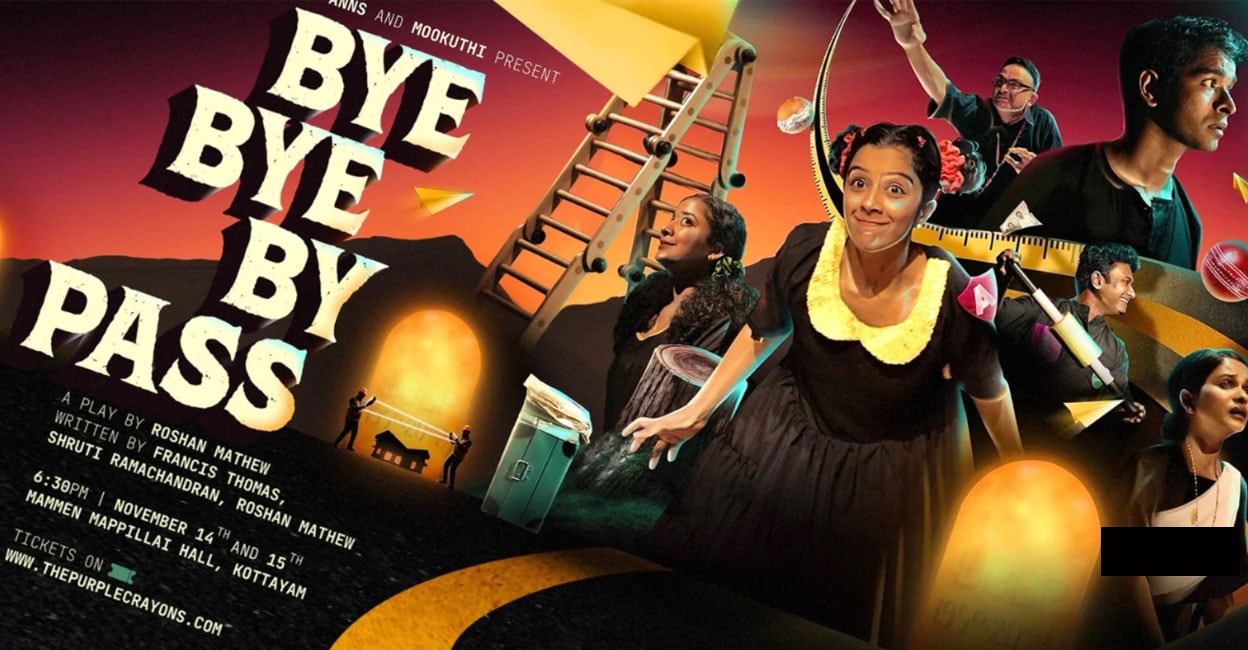
The first time I heard Roshan Mathew narrate the tale of Alummoottil was in a video recorded years ago at Spoken Fest, Mumbai. His voice alone was enough to summon the scenes. It was like this: a young boy perched on the “firm yet round belly” of his Achachan. Then, it was the sudden panic that swept through the household when the PWD notice arrived to announce that their home stood in the path of a new bypass between Kottayam and Thiruvalla. What I did not expect, five years later, as The Purple Crayons staged “Bye Bye Bypass” in Kottayam, was the sheer force with which those memories would return, rearranged, and sharpened by theatre.
The timing feels eerily apt. With Kerala now living through the churn of two major road projects (the Coastal Highway and the widening of NH 66), the play’s nostalgia acquires a quiet political edge. What begins as a gently drawn slice of family life becomes an invitation to slow down and notice what disappears. These included bedrooms that once held entire childhoods, kitchens that smelt of particular summers, shuttered wells, and small towns we now whizz past without pause.
On stage, Roshan adopts a flexible-theatre form to narrate the story of the Athimoottil House with disarming clarity. Live music, clean lighting cues, and a cast that slips easily through the fourth wall keep the momentum brisk. Yet, the play’s most persuasive moments come from its visual playfulness like the rediscovery of old photographs, or cousins staging a backyard cricket match. The first scene, built with a single white cloth and sharply cut lighting, casts a quiet spell. The second is a three-way movement piece and carries the mischievous pulse of holiday cricket at a grandparent’s home.
As Thumbi (Darshana Rajendran), Innachi (Aswathy Manoharan), and Kunjeli (Sanjay Menon) take the field, the yard grows around them in the mind’s eye. You feel an imagined itch on your ankles; you see the invisible boundary walls; you know precisely where the sewage flows and which shot counts as an automatic “out.” And when Nandu (Syamaprakash MS) trudges into the muck to retrieve the ball just to secure his place in the team, it summons a specific childhood ache. It is a reminder of the things one is willing to do to belong, whether among English-speaking cousins or local children, when you are the outsider.
Symbolism courses through the production. The opening moment where Achachan (Vaisakh Shankar) mimes the felling of a tree, sets the tone. His movements are so precise you almost hear the trunk yield. The illusion briefly falters when the imagined debris does not fly back at him. But this is the nature of live performance: the fragile beauty of a moment that is never repeated in quite the same way.
Ammachi (Nilja K. Baby) faces a different challenge in a later scene where she shifts abruptly from a devastating confession about her adopted son to a lighter beat. The visible carryover of emotion is not a flaw. It merely lays bare how hard such transitions can be, both for performers and audiences who have travelled with them.
Roshan structures the play in a rhythm that loops between humour and ache. Just when the levity settles, a swell of feeling rises, crests, and recedes. This echoe, perhaps, his Achachan’s own art of storytelling. The closing passage lands differently. When the packers and movers arrive, and the actors bind the house with a rope to mark its end, something tightens in the throat. This is especially true if you know the experience of living in rented homes and packing up lives without a trace. In that moment, it is hard not to wish for your own vanished photographs, or the street corners and rooms that once held you, now flattened into memory.