
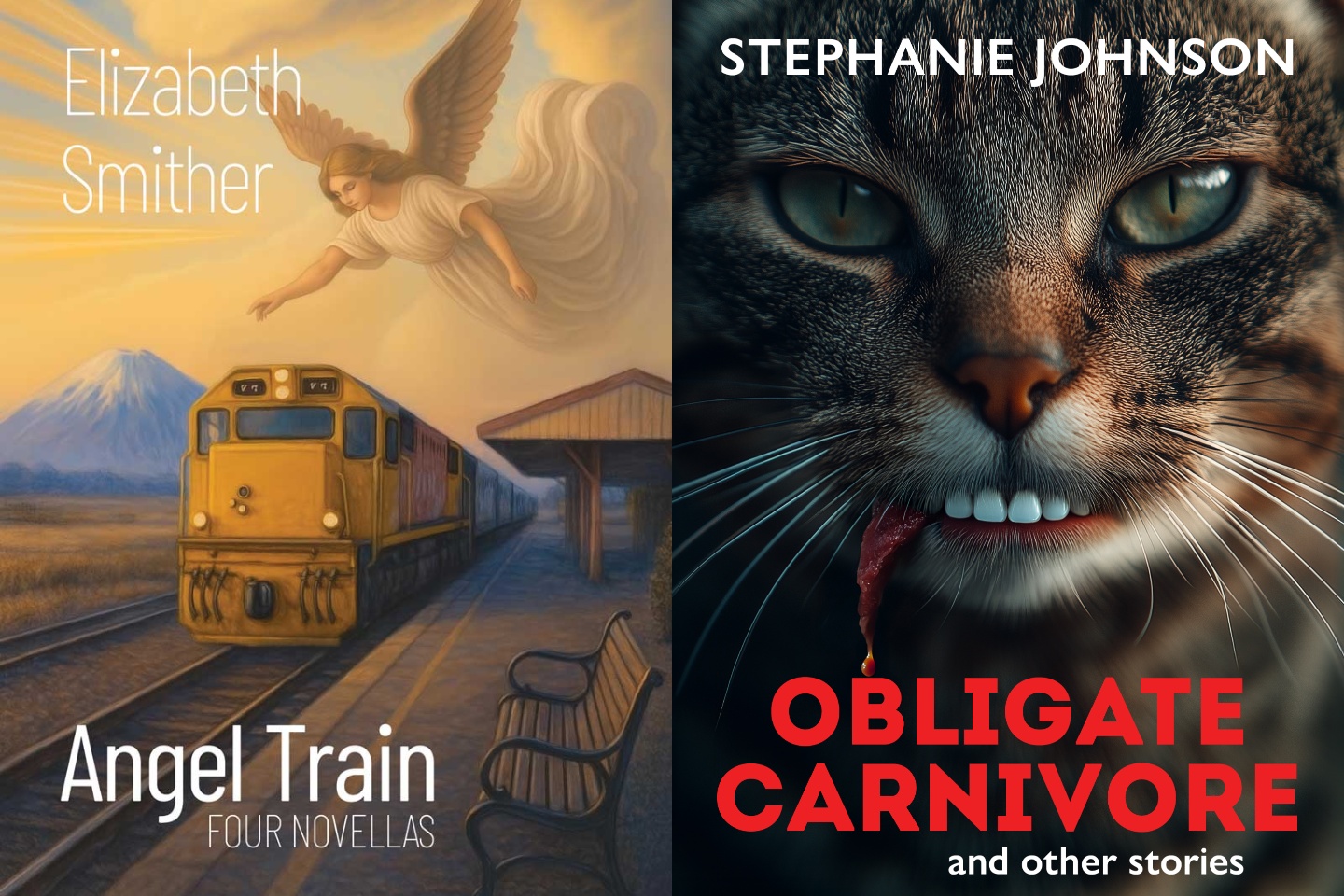
Two books by distinguished New Zealand authors have been ejected from the Ockham book awards because their covers were generated by AI.
Short fiction collections Angel Train by Elizabeth Smither and Obligate Carnivore by Stephanie Johnson, both published by Quentin Wilson of Christchurch, featured AI-created cover designs—and thereby ruled ineligible for next year’s $65,000 fiction prize at the Ockhams. “We’re very distressed,” said Wilson, who added that the ruling essentially means the books are being judged by their covers.
According to Wilson, the Ockham awards committee alerted publishers to an amendment to the eligibility conditions in August, outlawing AI covers. He thought the books he entered for the Acorn Jann Medlicott fiction prize were on safe ground but was belatedly told by the designer that the covers were heavily reliant on AI.
He does not have an axe to grind with the Ockhams, and to continue the metaphor of bladed weapons, he has fallen on his on sword. “This is my problem, and I own it,” he said.
But he remains outraged by the ruling. He feels the fiction prize is surely a matter of text, of the quality of the writing, not the packaging.
So does Stephanie Johnson. She messaged in an email, “First and foremost, I have no desire to damage in any way the reputation of the Ockham book awards. The competition is a lively and vital part of our literary scene and a much-anticipated event on the calendar. We are lucky, as readers and writers, to have it.
“But the jettisoning of my book from the competition is deeply unsettling. It’s not as if I held any hope for it being even longlisted, but I appreciated the idea of it sitting alongside its peers on the judges’ desks. The reason for its disqualification is ironic, given my distrust and dislike of AI in the creative sphere. I have never used it in my writing process and never will.”
She detailed the discussions she had with Quentin Wilson about the cover image of a cat with human teeth: “When I first saw it I was delighted. I assumed it was a photograph and that the teeth had been photo-shopped in.”
She continued, “After Quentin rang me to tell me the book had been disqualified I wrote immediately to Belinda Cooke, manager of the awards, and she replied politely and firmly, holding to the position that any use of AI at all in the production of a book excludes it. I had said in my letter that when I judged the 2023 awards I took no notice of the cover. Belinda informed me that I should have done.”
Cooke was asked to comment. She replied she was out of town.
Johnson checked the judging guidelines, and realised that judges were asked to consider “literary merit” as well as “quality of illustration and graphic presentation, [and] production factors including jacket design”. It came as a surprise. She had not read the fine print or if she had, paid it not a whit of notice.
“As a writer of over 20 books myself, and a voracious fiction reader, I am generally indifferent to covers as I believe most writers are. Very often, the writer has little or nothing to do with the cover, other than to express like or dislike. I’ve had some brilliant covers in my time and also some average ones.
“The old adage ‘Never judge a book by its cover’ is of course metaphorical and used to dissuade people from judging others on their appearance. But I do believe it holds true for real books. What the judges of the Jann Medlicott Prize are looking for is exemplary writing – fully dimensional characters, strong voice, narrative tension, appealing style, complex story-telling, evocative scene-setting etc.
“Judges are selected, it seems, on their experience and skill in the literary world, not in the design world….If a fantastic novel or collection of stories has a bad cover, should that affect the judging outcome? I don’t believe so.”
Sue Reidy is very well qualified to comment on the issue. She is an author and an experienced book designer. Her take on the Ockham ban? “I designed and illustrated numerous book jackets in my time and I would have been heartbroken back then at seeing my creative opportunities to work ripped away from me by the use of AI.
“The challenge for artists, designers and photographers today is to figure out ways to reinvent themselves despite AI, and to produce artwork that could only have been made by a living, breathing human being with imagination, soul and craft skills. It’s a huge challenge in an unregulated AI environment.
“This is me speaking with my artist voice. As a writer, I think that books should be judged solely on the quality of their writing in book awards such as the Ockhams.”
Well said. The decision to outlaw AI covers is a good thing. It’s a strong response to the pernicious influence of the robot mind. Huzzah to the Ockham overlords for enforcing it. But to hold it up for the first time and exclude the hard work and brilliance of works of literary art by Elizabeth Smither and Stephanie Johnson is a punishment and a cruelty. The annual Ockham awards giveth to New Zealand literature, generously; but it taketh away any chance of Smither and Johnson competing. Both authors have won the $60,000 Prime Minister’s award for literary achievement and both are at the top of their game in their two newly published short fiction collections. Both books stood an even chance of making the Ockham longlist or shortlist. The opening novella of Smither’s Angel Train is a late masterpiece (the author was born in 1941). Barbara Else lavished it with praise in a recent review. David Hill has written a rave review of Johnson’s Obligate Carnivore for ReadingRoom. It will appear next week. Among his comments: “Great cover and title …”
Angel Train: Four Novellas by Elizabeth Smither (Quentin Wilson Publishing, $37.50) and Obligate Carnivore by Stephanie Johnson (Quentin Wilson Publishing, $37.50) are both available in bookstores nationwide. Johnson’s book of short stories is launched this Wednesday (November 19) at 6pm at the Women’s Bookshop on 105 Ponsonby Rd in Auckland.