
“Whatever the problem, build another road” has been a hallmark of policy from the current government. And we’ve long suggested that is simply not affordable or practical – including just a month ago, when the latest costs were released for a bunch of the government’s flagship Roads of National Significance (RoNS) programme.
In a speech yesterday to a roading industry conference, Transport Minister Chris Bishop has given the first indication that reality is indeed starting to hit home.
Is Minister of Transport Chris Bishop (left) finally realising the mess his predecessor (right) has left him? Image via RNZ.
In the speech, Bishop started by covering the usual government talking points about the economy and building the RoNS, but the most interesting bit is towards the end of his speech, where he discusses the challenges ahead.
In particular, he notes just how expensive it is to build more RoNS – and what it would take to fully fund that via our existing process of fuel taxes and road user charges:
Based on current estimates, delivering the RoNS programme in full over the next 20 years would cost $56 billion. Funding this entirely from petrol tax and road user charges, would require a one-off 70% increase. Equivalent to a 49 cent per litre increase in petrol tax.
To be clear, this 49 cent per litre increase, would only allow the RONS to be delivered. It would not provide any funding for other major transport projects such as the Second Waitematā Harbour Crossing, or the North West Busway.
That’s quite the hike: 70 per cent, to be paid by everyone who drives, via fuel taxes and RUC equivalent, whether or not they ever drive on one of the RoNs that levy would go towards.
Will this be what finally pushes the public to start questioning the value of these new roads?
Further on in his speech, Bishop notes that there are already significant petrol tax hikes coming anyway, although I can’t imagine either National or Labour going ahead with the full 12c planned:
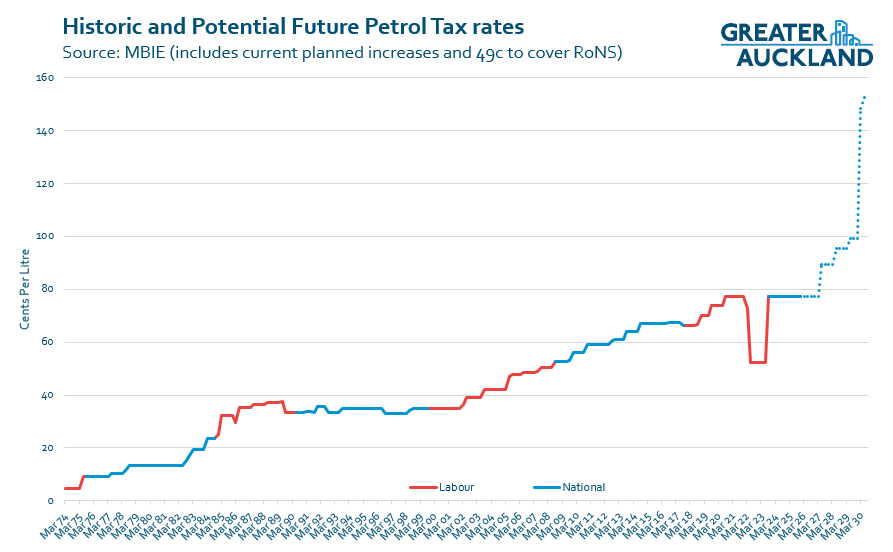
Petrol tax is due to go up by 12c per litre in 2027, by six cents on 1 January 2028, and 4 cents in each year after that.
…..
As I’ve said, to deliver all of the RONS petrol tax and RUC would have to rise by 70% or 49c per litre. This would be on top of the planned increases we’ve set out for 2027 onwards.
Currently, petrol taxes are just over 77c per litre. With the planned increases plus the 49c per litre “RoNS tax”, by 2030 we’d be paying about double the fuel taxes we currently do. To put that in perspective, here’s an example of what it might look like:
One of the reasons for the currently planned increases is that this funding problem isn’t just a future issue – there’s already a massive funding gap that the government are racing to cover. Back to Bishop’s speech:
Our transport system is supposed to be user pays. In other words, road users pay petrol tax and road user charges and the money goes out the other end on maintenance, upgrades and new projects.
But in recent years, Crown funding has been tipped in more and more, which comes from general taxation – in other words, all taxpayers.
The 2018-21 National Land Transport Programme outlined expenditure of $17 billion over 3 years, and was largely funded by road users, who contributed $13 billion.
Fast forward to the 2024-27 NLTP, and the total investment has nearly doubled at $32.9 billion, but road users are still contributing roughly the same amount, $14.3 billion.
The increased investment has come primarily from Crown funding, with around $12.8 billion of direct Crown funding provided over 2024-27.
Ironically, IF they did actually honour user pays idea and hike fuel tax and RUCs high enough to cover all this (not to mention all the other costs imposed by motoring) then that really would likely solve congestion and emissions as driving rates would plummet.
Helpfully, then Bishop also acknowledges the big problem with pouring ever more Crown funding into roads… but then goes on to say that he supports doing this.
Every dollar of extra Crown capital we put into roading is a dollar that can’t go into health, or education, or defence, or any of the other calls on capital the Crown has.
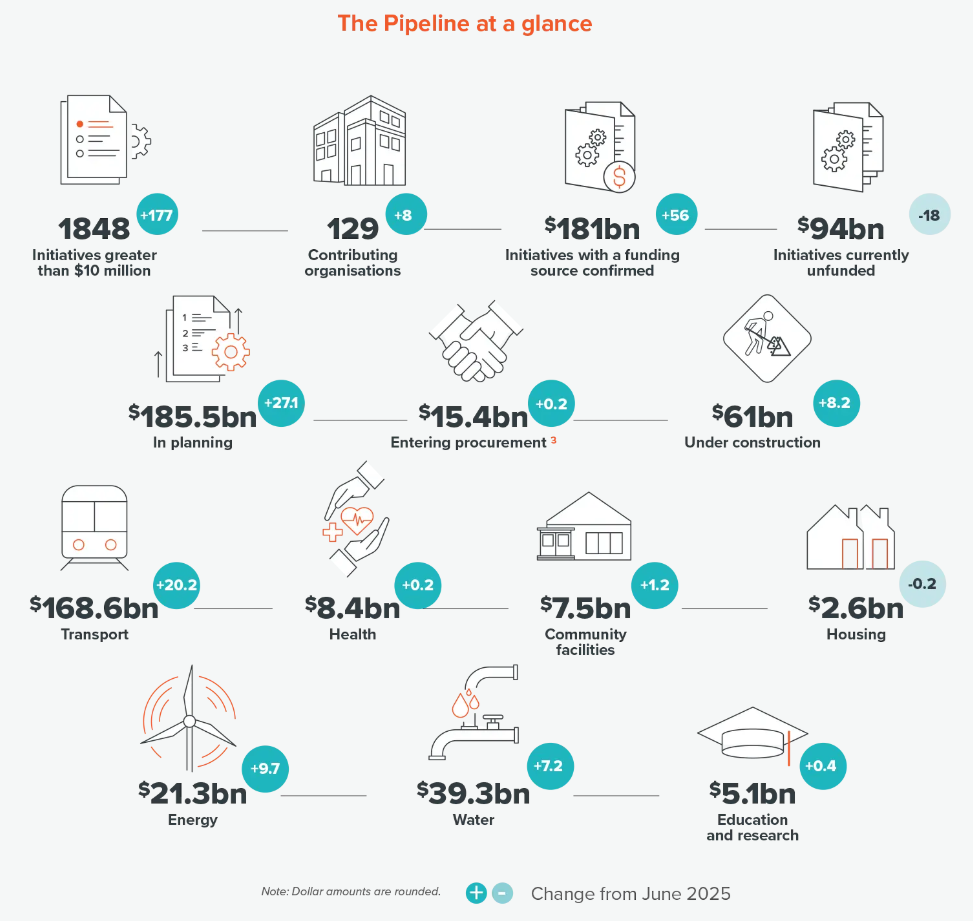
Notably, a few days ago Bishop released the latest quarterly Infrastructure Pipeline snapshot, which shows transport making up over 61% of all projects in the nation’s pipeline of all infrastructure. Some other ways to think of the numbers in the graphic below:
Transport, mostly in the form of roads, will soak up more than four times as much investment as water (the next biggest category). and around eight times more than energy infrastructure (the third largest category)New Zealand is planning to spend twenty times more money on roads than on health infrastructure.And we’re planning to spend 33 times more money on roads than on education & research combined.
And remember: in practically every other sector, this government has vigorously descoped and/or defunded projects under the guise of “saving money” – but somehow when it comes to roads, the complete opposite applies.
Getting back to Bishop’s speech: he goes on to say that PPPs, tolls and infrastructure levies aren’t coming to save us:
PPPs are not a magic money tree. They are a procurement tool, that’s all.
They are essentially the Government taking out an extra mortgage to build a road sooner. So yes, they help in terms of procurement and driving efficiency, but the projects still have to be paid for.
Fifth, on tolls.
If I had a dollar [for] every time someone said to me “just chuck a toll on, it will pay for the road in no time”, I would almost have enough money to pay for one of these RONS.
Tolls are useful but they don’t fully fund roads. Not even close. New Zealand just doesn’t have the traffic volumes. They are critical tools in helping fill in the funding stack, and provide important ongoing revenue for maintenance costs. But they are not going to pay for these roads by themselves.
The same is true for infrastructure levies to make sure beneficiaries pay for benefits from public expenditure.
Finally, we get to what this all means in reality. In short, reality bites.
Sixth, and finally, we also have other priorities in the land transport space.
We have critical public transport projects to fund, as well as the second harbour crossing in Auckland – which will be the most expensive infrastructure project ever built in New Zealand.
So where does all this leave us?
The government is committed to the Roads of National Significance but delivering them all tomorrow is not realistic.
Nor, by the way, is it an option for the construction sector.
What we need is a credible, long-term pipeline of transport projects with a variety of funding options and in a logical sequence.
I’ve been calling this a Major Transport Projects Pipeline, or MTPP.
It includes the RONS but also major public transport projects we need to advance as well.
That’s what we are committed to, as well as demonstrating a realistic funding track, synced to what the market can actually sustain.
We’re working hard on that now and will have more to say soon.
…..
This is going to be hard. Hard choices lie ahead. Not everyone is going to get what they want, exactly when they want it.
Some roads won’t be starting for many years.
For a government that has talked such a big talk about building these roads, even the suggestion that some of them could be 20 years away from getting started is an obviously a massive walkback. But an inevitable one after they campaigned using clearly unbelievably low costings for their unwise: “you get a massive highway, and you get a massive highway” all around the country. It should also be noted that this campaign also exaggerated the value of highway building.
It is good that this speech opens this issue too, as nice as it may be to have premier standard roads everywhere, that can only come by diverting funding away from other things, and not just other transport modes, also hospitals, schools, housing, police, etc, and fair incomes for teachers, nurses, and doctors, basically a country that’s viable to live in. The RoNS opportunity cost- where will you be driving to on the big new empty roads, and will you be able to afford to anyway?
While we wait for the “more to say soon”, one obvious solution to help tackle this would be to send NZTA back to the drawing board. Remove the requirement (imposed by Simeon Brown in his ludicrously didactic GPS) that these all be four-lane grade separated highways, and require NZTA to come up with cheaper, more practical solutions.
As we’ve pointed out many times in the past, most of these proposed mega-projects are for corridors that only carry 10-15,000 vehicles per day, which is well below the level needed to justify a four-lane expressway standard road.
On most of the designated RoNS corridors, affordable improvements like additional passing lanes, curve easements and safety barriers could deliver the majority of the benefits of an expressway for a fraction of the cost. These are also the kinds of projects that are much more able to delivered by smaller local firms, keeping cash in the local economy. Whereas the mega-projects that have become far too common often require bringing in significant and costly international expertise.
Lastly: it’s frankly wild that the minister responsible for delivering this flagship policy is being more publicly critical of it than Labour has been in opposition over the last two years. That’s a massive missed opportunity to improve the conversation, especially when it’s this easy to really get your teeth into it.
This post, like all our work, is brought to you by the Greater Auckland crew and made possible by generous donations from our readers and fans. If you’d like to support our work, you can join our circle of supporters here, or support us on Substack.
Share this