
‘That is a death sentence for many’: UN secretary-general on climate action plans Damian Carrington
“How much more must we suffer?” asked António Guterres at Cop30. He said frontline communities bearing the brunt of the climate crisis had heard enough excuses and were demanding results.
The UN secretary-general is in Belém to urge the world’s nations to find compromises in the final hours of Cop30 and deliver a deal to accelerate climate action: “We are down to the wire and the world is watching.”
The stakes could not be higher. He said the emissions cuts pledged to date by countries – nationally determined contributions in UN jargon – would lead to a global temperature rise of more than 2C: “That is a death sentence for many… we must move much faster, with a drastic cut in emissions.”
Guterres said that overshooting the 1.5C target is now inevitable: “We know what that means, more heat and hunger, more disasters and displacement, and the higher risk of crossing climate tipping points and irreversible damage, including here in the Amazon.”
But he said temperatures could be returned to 1.5C by end of the century with action: “I strongly appeal to global nations to show willingness and flexibility to deliver results that protect people and keep 1.5C alive,”
Agreeing a roadmap to phase out fossil fuels is a difficult issue at Cops, despite the burning of coal, oil and gas being the root cause of the climate crisis. That is because petrostates can easily obstruct and delay a process that works by consensus decision making.
But Guterres said: “The world must pursue a just, orderly and equitable transition away from fossil fuels.” Asked if Cop30 would be a failure without a roadmap to transition away from fossil fuels, he was diplomatic, saying this is not the moment to talk about possible failure, but the moment to stop failure happening.
He was notably firm on wanting finance for adaptation tripled – the current target is a doubling of the money from rich nations to pay to protect people around the world from extreme weather, which is being turbocharged by the climate crisis.
“For millions, adaptation is not an abstract goal,” he said. “It is the difference between rebuilding and being swept away, between replanting and starving, between staying on ancestral land or losing it forever.’ He also supported a just transition, to ensure those working in the fossil fuel industry are supported into new livelihoods.
“None of this can happen without finance that is predictable, accessible and guaranteed,” Guterres said. Climate finance – the provision of money from the rich nations that caused the climate crisis to the poorer nations who are impacted the most – is the basis of trust between the nations. But rows continue about the delivery of the $1.3tn a year by 2035 pledged at last year’s Cop.
Guterres was asked for his message to Donald Trump, who recently called the climate crisis a “con job”. “We are waiting for you,” he said. Asked if he thought Trump and the US would engage positively on climate at some point, he said: “Hope is the last thing to die.”
Key events
Show key events only
Please turn on JavaScript to use this feature
In the wake of the fire, the premises has been returned to local authority and is no longer considered a Blue Zone, according to an update from the UNFCCC.
The fire chief has ordered a full evacuation of the venue, but will provide an update around 4pm local time.
Meanwhile, reactions to the unexpected emergency have continued to roll in.
Mohamed Adow, director of think tank Power Shift Africa said in a statement issued to the Guardian that what could have been a traumatic event was well-handled and speaks to the possibility of collaboration.
“Even in a moment of chaos, one thing stood out: people from every corner of the world, different nations, creeds and affiliations, looked out for one another,” he said. “When faced with a crisis, cooperation wasn’t a slogan, but a human instinct in its rawest, truest form.”
He connected the sentiments as an example of how to move through the ongoing negotiations:
“That spirit is precisely what climate action demands. The climate crisis doesn’t care for our borders or diplomatic dramas. It requires the same urgency, solidarity and shared purpose we saw today, minus the flames, ideally. If we can respond to the planet’s emergencies with the same unity shown in that tense moment, COP30 might yet be remembered not for an incident, but for a turning point.”
ShareDamian Carrington
Talks are still on pause but earlier today, my colleague Damian Carrington wrote about how conservative nations – from the Vatican to Iran – are pushing to narrow the definition of gender at Cop30:
The move is aimed at excluding trans and non-binary people and threatens to increase the difficulty of already tortuous negotiations, AFP reports.
The effort uses footnotes in key texts to attach country-specific interpretations. Paraguay, Argentina, Iran, Indonesia, Malaysia as well as the Vatican have so far entered footnotes into the draft Gender Action Plan (GAP) meant to guide work for the next decade.
Similar footnotes have also appeared in a text related to the “just transition” – the framework to shift to environmentally sustainable economies without leaving workers and communities behind.
The Vatican, for example, says it understands gender as “grounded on the biological sexual identity that is male and female.”
“We do not agree at all with what some countries are putting in the agenda footnotes,” Alicia Barcena, Mexico’s secretary of environment, told AFP. “We feel we are going backwards – we should never go backwards.”
“If every Party could footnote core terms like finance, ambition or equity, we would have no negotiation left – only fragmentation. Gender equality is an agreed principle under this Convention – it needs no qualification,” said Bridget Burns, executive director of the Women’s Environment and Development Organization.
The issue has become so sensitive that Cop30’s Brazilian presidency has elevated it from technical negotiations to a higher political level, where ministers are now trying to hash out a compromise.
You can read more on the issue in Chloe Farand’s story for the Guardian.
After dozens of firefighters battled the Cop30 blaze it has been contained, according to Brazil’s tourism minister, Celso Sabino, speaking to a local news channel.
Forensic teams will try to establish how the fire started but he said he doubts it was criminal.
“You’d have to be a really awful person to set fire to a Cop,” he tells reporters.
Officials are also reporting that there were no injuries from the fire and that everyone was safely evacuated. The building has taken some damage, however, and it will be several hours before attendees will be allowed back in.
The fire has added even more urgency to deliberations as time ticks down to come to agreement – but it has also brought the issues themselves into sharper focus.
“The tragic fire at COP30, which has derailed UN Climate Conference, the People’s Plenary, and obstructed the negotiations is unfortunately a potent metaphor,” US-based activist Jes Vesconte said, speaking with my colleague Dharna Noor.
“As capitalist fossil fuel companies, imperialist countries, and militarist powers block the talks here (or in abstentia in the case of the US) — they are putting profits over planet and people, profiteering off ecocide, genocide and countless deaths, at the expense of all life on Earth, and pouring fuel on the fire of the burning planet.”
Updated at 13.07 EST
 Oliver Milman
While we wait for more information about the status of the fire – and the negotiations it disrupted – my colleague Oliver Milman has an update on just how absent the US is from the summit:
Some negotiators at Cop30 have feared a late intervention from Donald Trump, even though the US hasn’t sent a delegation to Belem – a first for America in this era of annual climate summits.
Instead, the Trump administration has sought to studiously ignore Cop30 and during the conference has pushed ahead with its pro-fossil fuel agenda in the US, tearing down limits placed upon drilling and mining in Alaska and weakening endangered species and clean water rules that industry finds irksome.
Asked by the Guardian for its take on the negotiations, which have included a demand for a phaseout of fossil fuels that Trump would surely balk at, a White House spokeswoman said that other countries are “lining up” to import American oil and gas.
“The president has set a strong example for the rest of the world by reversing course on the green energy scam and unleashing our natural resources, like beautiful, clean coal and natural gas, to strengthen our grid stability and lower energy costs,” she said.
“President Trump has been clear: he will not jeopardize our country’s economic and national security to pursue vague climate goals that are killing other countries.”
Trump, then, may well be the phantom that haunts this Cop, as depicted in a rather grotesque statue placed in front of the venue by the artist Jens Galschiøt, rather than one that actively shapes it.
Most countries have steered clear of criticizing the US’ absence, bar one brave Tuvaluan, and the lack of Trump should, many think, remove a hefty barrier to the negotiations. As Christiana Figueres, the former UN climate chief, said last week when asked about the Trump administration’s no-show: “Ciao, bambino!’
So far there isn’t any information on what sparked the fire but emergency crews are working to contain the flames. Rains have started which may aid in their efforts.
Power was cut to the buildings as a precaution. Some delegates have been allowed back into their darkened offices, but the venue is largely under evacuation.
The fire erupted in a pavilion, an area of spaces hosted by each country where they can have private meetings and offices away from official negotiating rooms.
The area is part of the sprawling Blue Zone, inaccessible to the public.
ShareA fire has ignited forcing evacuations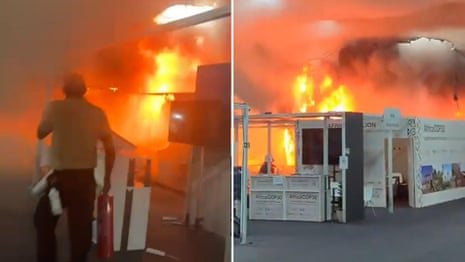 People evacuated after fire breaks out at Cop30 venue – video
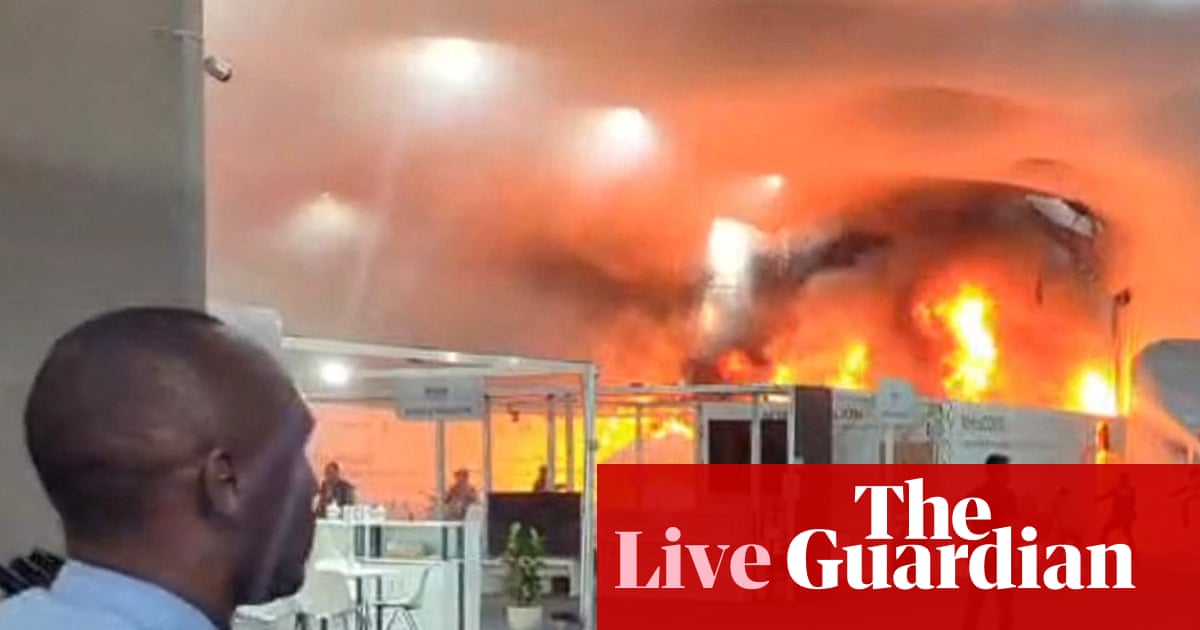
A fire has broken out in the Blue Zone. Videos posted on online showed flames billowing from pavilion as security personnel blew whistles and called for evacuations.
In areas farther from the fire, alarms disrupted afternoon discussions as attendees were asked to leave the venue. Smoke could be seen wafting from the temporary structures by throngs of people who evacuated outside.
Fire trucks have arrived on scene.
This is a breaking story and we will share more as we have it.
Updated at 13.44 EST
Gabrielle Canon here, taking over for Ajit to take you through the second half of day 10.
Let’s start with a quick recap of where things stand:
The summit started with 121 agenda items on the table, according to Carbon Brief, which has hosted a live tracker of what’s been agreed, drafted, or postponed.
The breakdown currently shows 51 items done, 38 in drafts, and 4 with informal text, and 10 still in the red – a number that’s persisted since Monday.
The days left are winding down to check off these agenda items, which include some of the most challenging issues to reach consensus.
Among the biggest questions is whether a fossil fuels roadmap that will help implement a phaseout and a just transition will make the cut. Ministers are also hoping to work out financing and who will put up the finds to ensure the most impacted nations don’t continue to bear the brunt of the climate crisis.
New draft text is expected tonight.
Updated at 12.14 EST
US President Donald Trump may have snubbed Belém and the UN climate process, but my colleague Fiona Harvey has spotted him in the form of a statue outside the venue.
A statue of an artwork depicting Donald Trump at Cop30 in Belem, Brazil. Photograph: Fiona Harvey/The Guardian
Titled “The Orange Plague”, the statue claims to depict US President Donald Trump as a self-proclaimed king of justice, sitting atop a frail man as he wields a golf club next to an Earth-shaped golf ball.
The sculpture by Jens Galschiøt seeks to “highlight America’s failure to share responsibility for Earth’s future.” The Danish artist, who has exhibited at climate summits dating back to 2002, is best known for his “Pillar of Shame” series of sculptures, which memorialise the loss of life during the 1989 Tiananmen Square Massacre in Beijing, China.
Staff taking down “Pillar of Shame” that was defaced with black paint in front of Chiang Kai-shek Memorial Hall, in Taipei, Taiwan in 2022. Photograph: Ann Wang/Reuters
It’s unclear how long the statue will last in Belém.
Next year’s Cop is set to take place in a stunning resort city on the Mediterranean – a tourist magnet that boasts a rich history stretching back to the empires of ancient Greece and Rome.
But in recent years, the weight of the climate crisis has borne down on Antalya. The southern Turkish city and surrounding province of the same name have been plagued in recent years by horrific fires and severe floods.
Cars wade through flooded roads after heavy rains in Antalya, Turkey, in 2024. Photograph: Anadolu/Getty ImagesWildfires in a forested area in Alanya district of Antalya, Turkey, in 2025. Photograph: Anadolu/Getty ImagesPeople running away from the fire-devastated Sirtkoy village, near Manavgat, Antalya, Turkey. Photograph: APDark smoke drifting over a hotel complex during a forest fire near the town of Manavgat, Antalya, on July 29, 2021. Photograph: Ilyas Akengin/AFP/Getty Images
Like other countries on the Mediterranean, Turkey is no strange to violent weather made stronger by carbon pollution. A World Weather Attribution analysis this summer found weather conditions leading to deadly wildfires in July in Turkey, Cyprus and Greece were made 10 times more likely due to climate change.
Share‘That is a death sentence for many’: UN secretary-general on climate action plansDamian Carrington
“How much more must we suffer?” asked António Guterres at Cop30. He said frontline communities bearing the brunt of the climate crisis had heard enough excuses and were demanding results.
The UN secretary-general is in Belém to urge the world’s nations to find compromises in the final hours of Cop30 and deliver a deal to accelerate climate action: “We are down to the wire and the world is watching.”
The stakes could not be higher. He said the emissions cuts pledged to date by countries – nationally determined contributions in UN jargon – would lead to a global temperature rise of more than 2C: “That is a death sentence for many… we must move much faster, with a drastic cut in emissions.”
Guterres said that overshooting the 1.5C target is now inevitable: “We know what that means, more heat and hunger, more disasters and displacement, and the higher risk of crossing climate tipping points and irreversible damage, including here in the Amazon.”
But he said temperatures could be returned to 1.5C by end of the century with action: “I strongly appeal to global nations to show willingness and flexibility to deliver results that protect people and keep 1.5C alive,”
Agreeing a roadmap to phase out fossil fuels is a difficult issue at Cops, despite the burning of coal, oil and gas being the root cause of the climate crisis. That is because petrostates can easily obstruct and delay a process that works by consensus decision making.
But Guterres said: “The world must pursue a just, orderly and equitable transition away from fossil fuels.” Asked if Cop30 would be a failure without a roadmap to transition away from fossil fuels, he was diplomatic, saying this is not the moment to talk about possible failure, but the moment to stop failure happening.
He was notably firm on wanting finance for adaptation tripled – the current target is a doubling of the money from rich nations to pay to protect people around the world from extreme weather, which is being turbocharged by the climate crisis.
“For millions, adaptation is not an abstract goal,” he said. “It is the difference between rebuilding and being swept away, between replanting and starving, between staying on ancestral land or losing it forever.’ He also supported a just transition, to ensure those working in the fossil fuel industry are supported into new livelihoods.
“None of this can happen without finance that is predictable, accessible and guaranteed,” Guterres said. Climate finance – the provision of money from the rich nations that caused the climate crisis to the poorer nations who are impacted the most – is the basis of trust between the nations. But rows continue about the delivery of the $1.3tn a year by 2035 pledged at last year’s Cop.
Guterres was asked for his message to Donald Trump, who recently called the climate crisis a “con job”. “We are waiting for you,” he said. Asked if he thought Trump and the US would engage positively on climate at some point, he said: “Hope is the last thing to die.”