
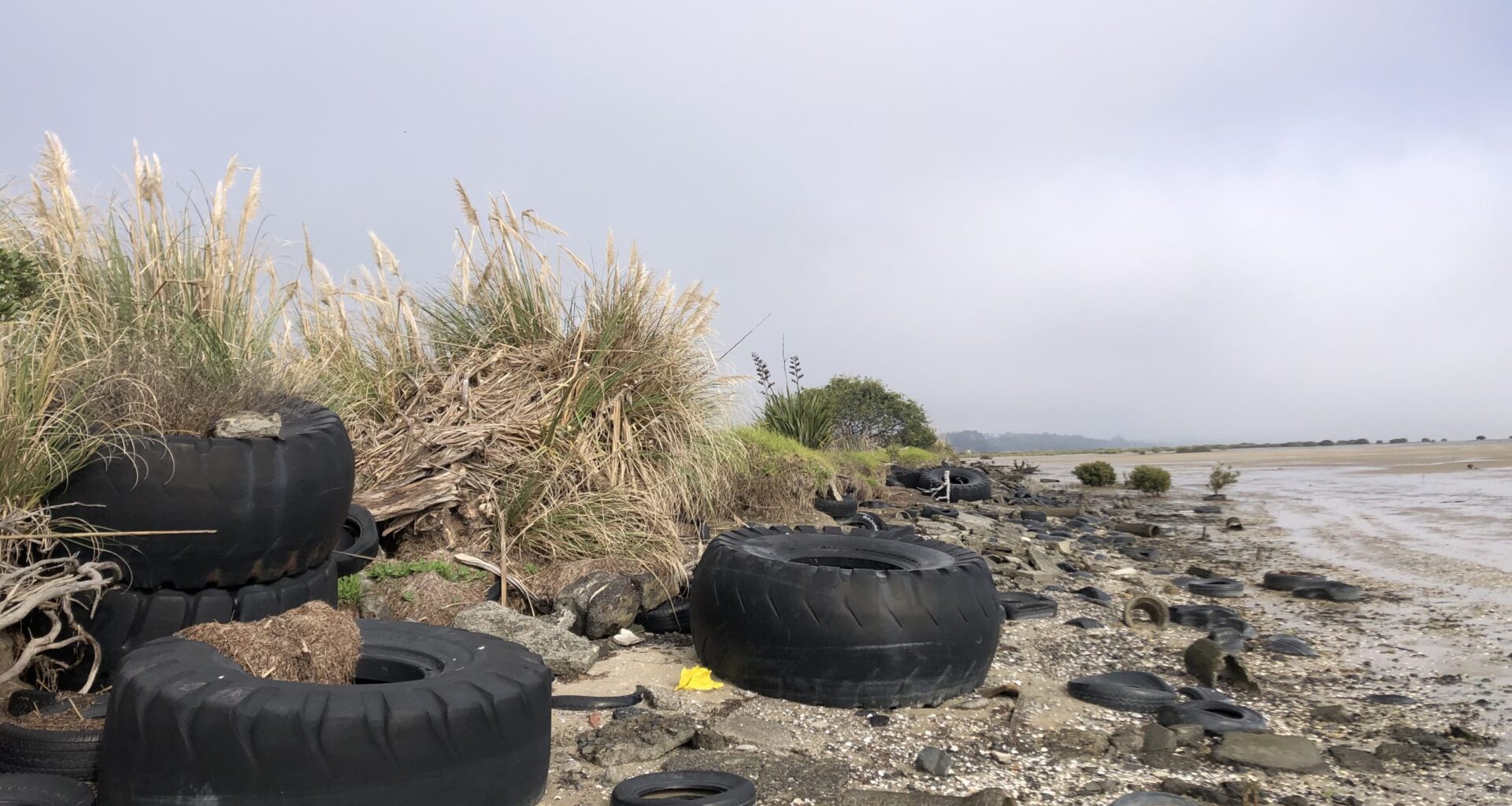
For years, the black, squishy particles confounded researchers surveying Auckland’s coastal waters for microplastic pollution.
These ubiquitous fragments were definitely plastic – they melted when heated in the lab – yet were clearly unlike the plastic packaging or clothing fibres that scientists typically tracked.
After repeatedly probing them with a needle under the microscope, the puzzle was finally solved with sophisticated analytical tools.
The mystery material? Tiny pieces of vehicle tyre.
Now it’s clear that driving is contributing to New Zealand’s – and the world’s – single largest source of marine microplastic pollution.
“We’ve now got the data to show high loads of tyre microplastics in comparison to other types, such as from takeaway containers or clothing,” says Dr Samantha Ladewig, a marine microplastics researcher at the University of Auckland.
“Tyres come out on top by a long way.”
That points to an obvious problem, but also an opportunity: shifting trips to buses, trains or other mass-transit options slashes per-person tyre pollution, and with it the microplastics washing into our harbours.
Now among the world’s most pervasive pollutants, microplastics are fragments smaller than five millimetres, formed as everyday materials break down into ever-tinier pieces.
They’ve been detected everywhere, from the open ocean, to Antarctica, to the Southern Alps’ remote mountain air.
Once seen mainly as a marine problem, microplastics are now turning up in our rainwater, food and air.
One study estimated about 74 tonnes – roughly the equivalent of three million plastic bottles – fall over Auckland each year. In the city’s blue backyard, whales that feed in the Hauraki Gulf have been shown to ingest large amounts of plastic microparticles each day.
Ladewig says the recent insights about tyre particles further reinforce that what happens on land, from roads to runoff, has direct consequences for the coastal ecosystems we rely on.
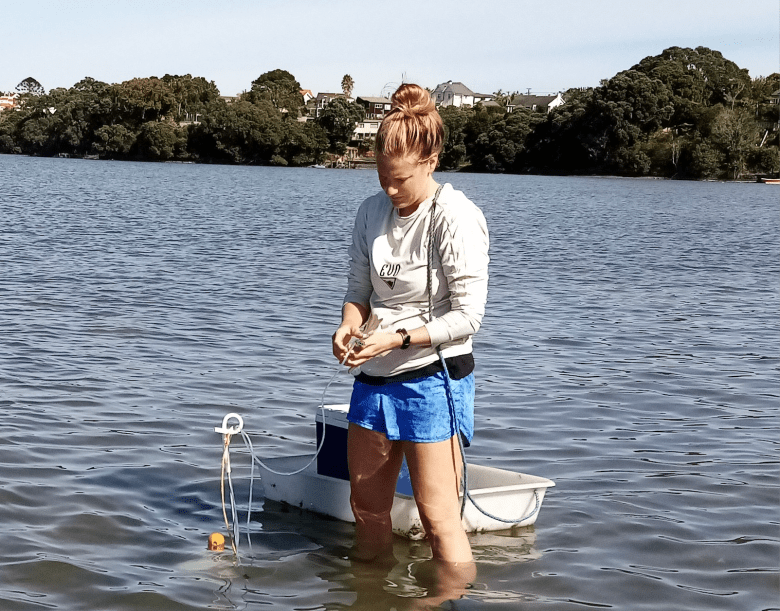 Dr Samantha Ladewig, a marine microplastics researcher at the University of Auckland, is pictured collecting dissolved oxygen and nitrogen water samples in Auckland’s Ngataringa Bay in 2020. Ladewig’s research has identified tyre particles as a major source of microplastic pollution in our coastal waters. Photo/Supplied by Samantha Ladewig
When tyres wear on roads, the synthetic rubber polymers and fillers mix with road materials to form a complex pollutant. These particles are swept up by stormwater, eventually flowing into the Waitematā and Manukau Harbours.
Already, Ladewig’s team has found that those black, tyre-sourced particles are the most common form of microplastic in sediments south of the Auckland Harbour Bridge.
Their latest data point to Cox’s Bay as a particular hotspot, where muddy sediments appear to trap particles washing off nearby roads.
How tiny particles can change big systems
Once these particles enter the ocean, they can have subtle yet significant impacts.
Ladewig’s work in the Waitematā Harbour has shown plastics are affecting bio-geochemical cycles, which are the pathways that move essential elements like oxygen and nitrogen, connecting ecosystem components and maintaining life.
“Generally speaking, under controlled conditions, microplastics seem to increase the amount of oxygen consumed by the sediment community when infauna [aquatic organisms that live within the seafloor] are present – and decrease the amount of oxygen consumed without infauna,” she says.
“So, effects to seafloor ecosystem functions are real.”
In the Manukau Harbour, researchers also found that important local clams contained concentrations of microplastics that were three to four orders of magnitude higher than what was found in the surrounding city sediments.
That indicated that sediment deposit feeders are a massive sink for coastal plastics.
As well, Ladewig says plastic can potentially hinder the process by which carbon is taken out of the atmosphere and stored in marine sediments, which is key for climate regulation.
It can also reduce the rate at which excess nitrogen, often running off from agricultural sources, is naturally removed from the water column, thus impacting water quality.
The ingestion of plastic can also potentially reduce the ability of key fauna to transport or process carbon: essentially their food.
Ladewig also points to the startling rate of plastic degradation in local environments.
Scientists have revealed how a visible piece of polyester fibre could go from a 10cm sewing string to nothing visible to the eye in just six months in New Zealand marine sediments.
This rapid breakdown means the particles are likely turning into smaller, potentially more problematic nano-plastics, whose effects on ecosystem health are even more difficult to quantify.
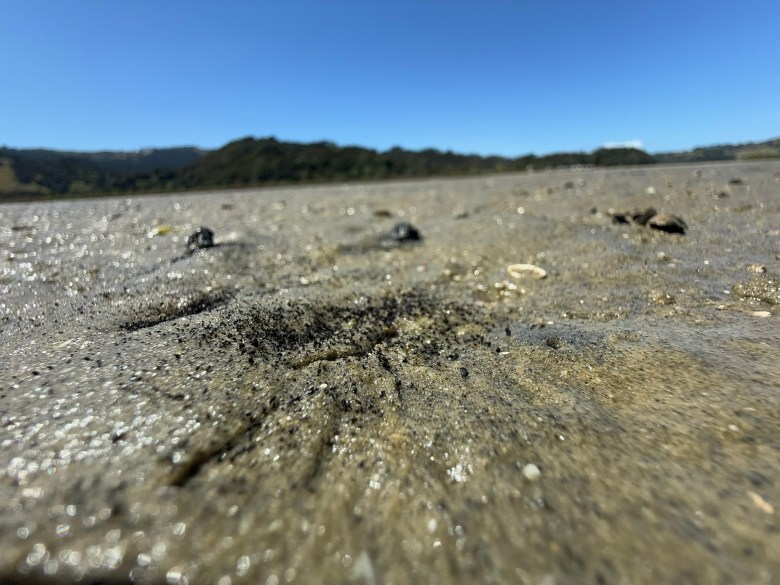 Microplastics, sourced from tyre wear, are pictured amid the sediment in Whangateau, north of Auckland. Studies have shown these to be the largest source of microplastic pollution in our coastal waters. Photo: Supplied by Samantha Ladewig
“It makes us wonder what that means for New Zealand marine sediments – are they acting as some sort of bioreactor for plastic pollution?”
She says the findings and uncertainties highlight the urgent need for researchers to shift their focus from measuring the problem, to helping address it.
Turning research into real-world solutions
Rather than focusing on individual recycling habits, Ladewig says the real solutions lie upstream: in systemic, source-based action, especially around tyre wear.
Yet, because the main issue has been narrowed down to tyres, she says, collaboration across sectors has been surprisingly straightforward.
One priority area is stormwater treatment.
Auckland Transport already uses devices like interceptors, but these are designed to trap larger debris. The next step is testing if current rain garden systems can capture micro- and nano-sized particles before they reach the sea, or if we need to employ other types of devices.
Ladewig points to some overseas examples that could work here, such as using biochar: a plant-based material placed at stormwater drains to filter out particles as water flows through.
“I think the next step for New Zealand is just to test some of these devices and see what works best for them,” she says.
Then, of course, there’s targeting the source itself – tyres and driving – a global challenge.
Some jurisdictions are already tightening rules: new regulations to be rolled out in the European Union, for instance, would restrict sales to tyres with low wear rates.
Since New Zealand often follows Europe’s environmental lead, Ladewig says this approach could dramatically cut the amount of synthetic rubber being shed onto our roads in the first place. “We could be getting tyres that don’t wear as quickly as some tyres do.”
Transport habits also matter, particularly at a time people are increasingly opting for heavier vehicles, like SUVs and utes, that increase the rate of particle shedding. So simply choosing smaller, lighter vehicles could make a difference. But the biggest gain would be in improving mass transportation to enable people to go car-free.
Some stark numbers Ladewig has earlier cited put the problem into perspective: a single passenger car can emit roughly 132 milligrams of tyre-wear particles per kilometre at typical urban speeds of 50km per hour.
Based on typical annual travel in Auckland, passenger vehicles alone could be releasing about 1600 tonnes of tyre particles each year: an unseen tide of plastic washing into the sea.
Buses, meanwhile, can carry dozens of passengers while emitting around 700 milligrams per kilometre – far fewer per person than a car.
“There are lots of solutions out there,” Ladewig says. Collectively, mass transportation, better tyres, lighter vehicles, and better treatment of storm water can reduce the steady stream of microplastics into our environment.
The world is facing unprecedented environmental challenges. Planetary Solutions, an initiative of the Sustainability Hub at Waipapa Taumata Rau, University of Auckland, and Newsroom, explores these issues – and the practical ways we can all be part of the solution.