
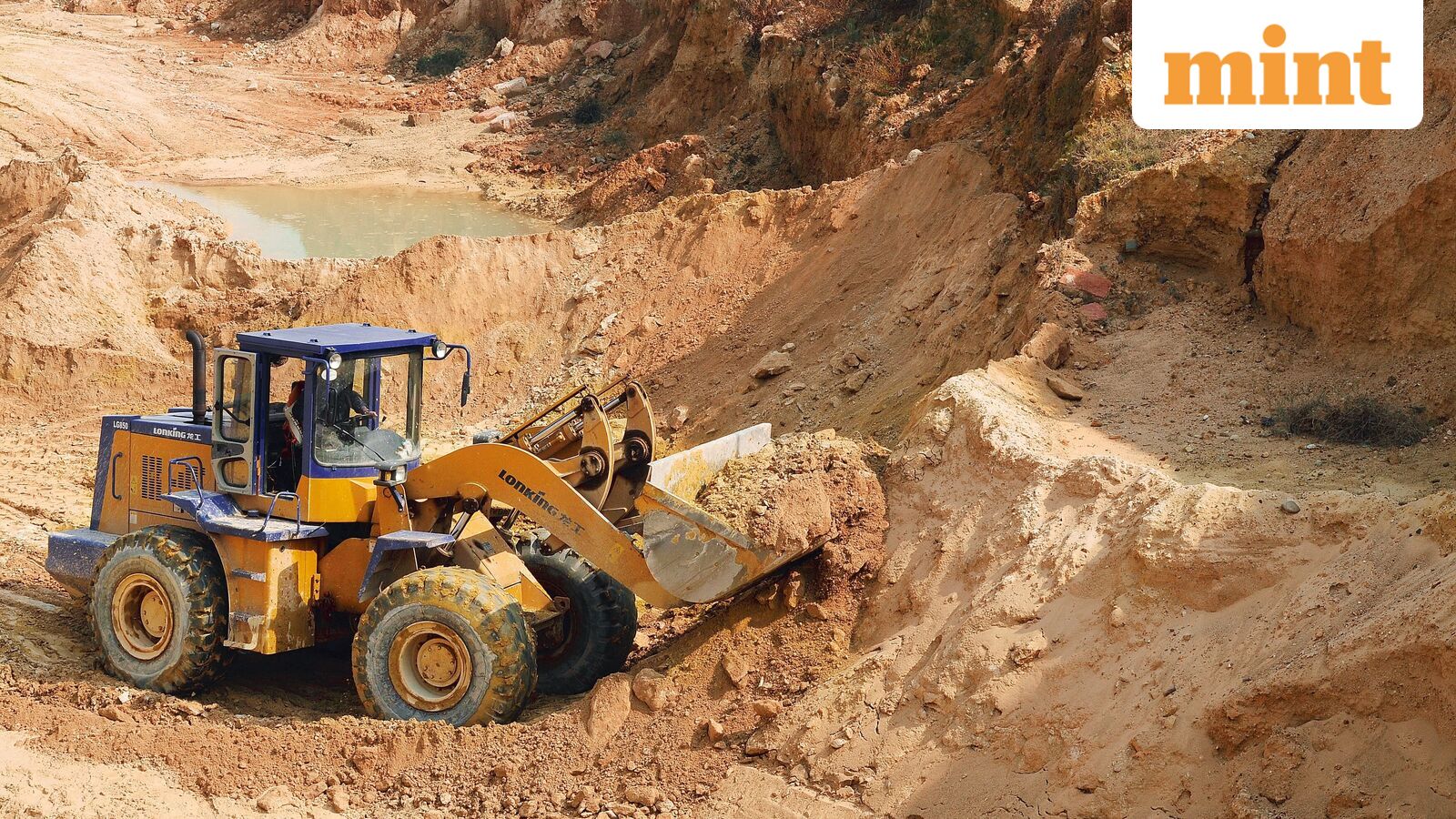
Fresh curbs announced last month have only heightened Western unease, exposing how deeply China dominates critical segments of these supply chains.
Last month, it added more curbs. Such restrictions continue to unnerve the West, as they reveal China’s single-handed control over crucial parts of the supply chain of such minerals.
There has been much talk of the need to diversify production and refining of key metals like lithium and rare-earths, but as this article explains, in the longer term, the bottleneck created by a few countries’ dominance in production will ease only very slowly.
There has been growing talk of diversifying both production and refining of key metals such as lithium and rare earths. But, as this article explains, the bottleneck created by the dominance of a few countries in production will ease only gradually.
Time frames
A key set of minerals at the centre of this concern has, over the past few decades, become critical to the economic success of the semiconductor industry and green technologies, and in battery manufacturing.
These so-called energy minerals include copper, lithium, nickel, cobalt, graphite, and rare-earth elements. Rare-earth metals are a group of 17 metals characterised by special properties that make them valuable when used together with common metals such as iron. Examples include samarium, gadolinium, and scandium.
First, consider demand and supply. While prices of all such critical minerals have gone through cycles, they haven’t increased significantly in the long run. Price trends have been muted mainly because supply has increased sharply, often outstripping the rise in demand for such minerals, in recent years.
Take copper, for instance. Its prices have risen by just 30% over the last 13 years. Prices of rare earths have actually fallen during this period. The standout mineral has been lithium, whose price soared six times between 2020 and 2023, before falling again. But its net increase over 13 years is only 28%.
Diversified demand
The International Energy Agency (IEA) released a report about these key energy minerals earlier this year. It pointed out that increasing demand for these was being driven by “energy applications such as electric vehicles, battery storage, renewables and grid networks”.
In 2024, the green-energy sector (for example, the sector that manufactures solar cells or electric vehicles) accounted for approximately 19% of the demand for such minerals. Grid battery-storage technologies accounted for another 1.5%.
Copper is a key element in the manufacturing of power infrastructure. That’s where China is dominant. In fact, the expansion of the electrical grid infrastructure in that country has been the single largest source of growth in global copper demand over the last two years.
The growing significance of investments in artificial intelligence (AI) will only add to the mix. Data centres, which are critical to AI companies, are heavily reliant on batteries, which are lithium-based. Thus, the longer-term demand picture for such minerals remains robust.
Supply dependence
Despite the growing interest, market vagaries and price swings introduce uncertainty for companies looking to make long-term investments in the mining and refining of such minerals. Take lithium. Following the dramatic price run-up of the last few years, the subsequent decline in prices has occurred because major suppliers, including China, Indonesia, and key African countries, have aggressively expanded their supply.
The closure of a key lithium mine in China in mid-2025 caused prices to rise again. At current prices, much of lithium production could be unprofitable in the near term. Mining projects, exploration to production, take years to come online. Western producers are exposed to market swings, unlike their Chinese counterparts, who are supported by state subsidies.
In a recent testimony to the US Congress, Jonathan Evans, chief executive of Lithium Americas, which is developing a key US lithium mine, said: “To maintain its dominance, China has depressed global lithium prices to discourage investment by non-Chinese firms and deter public or private capital from entering the market.”
Energizing demand
Policy uncertainty in the West, especially in the US towards green energy, has not helped. In recent months, the US has actively removed incentives to invest in green-energy technologies, forcing several fossil-fuel miners to stall their plans to pivot to such technologies. Sales of electric vehicles, too, have slowed in key markets such as Europe.
Yet, the IEA report forecasts that demand for key minerals from energy technologies will continue to grow in the long term. Demand for lithium, graphite, nickel and cobalt will be driven by battery deployment in EVs.
If the so-called ‘green transition’ is to happen, it’s important for countries to secure supplies of such minerals over time. This is where geopolitics comes in. Last month, China introduced new restrictions on the export of rare earths, though these have been suspended for a year. US treasury secretary Scott Bessent claimed the US would be able to break China’s stranglehold on the energy minerals sector within two years.
Chinese dominance
This is highly optimistic. The big geopolitical challenge here is the dominance of China in the sector. While China’s presence in mining varies by mineral, it accounted for a huge share of refining for all the minerals in question in 2024—for example, 96% in graphite, 91% in magnet rare earths and 78% in cobalt.
Decades of state support to the sector and government subsidies have meant that Chinese refiners are far less affected by the vagaries of market demand and price movements than companies in the West.
According to the IEA report, while China’s dominance in refining is set to reduce in future years, it will remain the dominant player.
“Looking ahead to 2035, the average share of the top three refined material suppliers is projected to decline only marginally to 82%, effectively returning to the concentration levels seen in 2020. China’s stronghold extends beyond refining; two-thirds of global battery recycling capacity growth since 2020 has been in China,” says the report.
www.howindialives.com is a database and search engine for public data.