
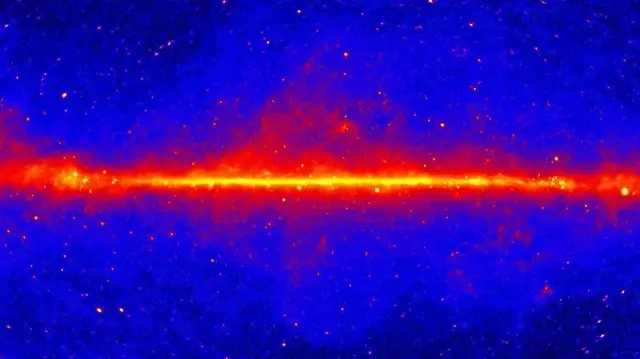
NASA’s Fermi Gamma-ray Space Telescope may have provided humanity’s first direct observational evidence of dark matter, according to new research published Wednesday. Gamma radiation detected from the Milky Way’s galactic center appears to carry the distinctive signature of the elusive substance that has previously only been inferred through gravitational effects.
Matching Theoretical Predictions
University of Tokyo researcher Tomonori Totani analyzed data from the space telescope and identified gamma rays with photon energy of 20 gigaelectronvolts extending in a halo formation toward our galaxy’s core. He noted this gamma-ray component “closely matches the shape expected from the dark matter halo,” potentially representing emissions predicted to result from theoretical dark matter particle interactions. The findings were detailed in the Journal of Cosmology and Astroparticle Physics.
Historical Context and Scientific Significance
Dark matter was first proposed in the 1930s when Swiss astronomer Fritz Zwicky observed galaxies moving faster than their visible mass could explain, suggesting an invisible structural component. Despite constituting approximately 85% of the universe’s matter, dark matter has remained undetectable through conventional means because it doesn’t interact with electromagnetic forces—neither absorbing, reflecting, nor emitting light. Totani stated that if confirmed, this would represent “the first time humanity has ‘seen’ dark matter” and would indicate “a new particle not included in the current standard model of particle physics.”
Potential Implications for Physics
The detection method relies on identifying gamma rays theoretically produced when dark matter particles annihilate. Totani characterized such a confirmation as “a major development” in both astronomy and fundamental physics, potentially opening new avenues for understanding the universe’s composition. The research could provide crucial experimental evidence for physics beyond the Standard Model, offering insights into the mysterious substance that shapes cosmic structures through gravitational effects while remaining invisible to conventional observation methods.