
Di Rienzi, S. C. et al. The human gut and groundwater harbor non-photosynthetic bacteria belonging to a new candidate phylum sibling to cyanobacteria. Elife 2, https://doi.org/10.7554/eLife.01102 (2013).
Soo, R. M. et al. An expanded genomic representation of the phylum cyanobacteria. Genome Biol. Evol. 6, 1031–1045 (2014).
Boden, J. S., Konhauser, K. O., Robbins, L. J. & Sánchez-Baracaldo, P. Timing the evolution of antioxidant enzymes in cyanobacteria. Nat. Commun. 12, 4742 (2021).
Fournier, G. P. et al. The Archean origin of oxygenic photosynthesis and extant cyanobacterial lineages. Proc. Biol. Sci. 288, 20210675 (2021).
Wang, C. L. et al. Archean to early Paleoproterozoic iron formations document a transition in iron oxidation mechanisms. Geochim. Cosmochim. Acta 343, 286–303 (2023).
Kump, L. R. The rise of atmospheric oxygen. Nature 451, 277–278 (2008).
Chen, G. et al. Reconstructing Earth’s atmospheric oxygenation history using machine learning. Nat. Commun. 13, 5862 (2022).
Planavsky, N. J. et al. Evolution of the structure and impact of Earth’s biosphere. Nat. Rev. Earth Env. 2, 123–139 (2021).
Lyons, T. W., Reinhard, C. T. & Planavsky, N. J. The rise of oxygen in Earth’s early ocean and atmosphere. Nature 506, 307–315 (2014).
Schirrmeister, B. E., de Vos, J. M., Antonelli, A. & Bagheri, H. C. Evolution of multicellularity coincided with increased diversification of cyanobacteria and the Great Oxidation Event. Proc. Natl Acad. Sci. USA 110, 1791–1796 (2013).
Schirrmeister, B. E., Gugger, M. & Donoghue, P. C. J. Cyanobacteria and the great oxidation event: evidence from genes and fossils. Palaeontology 58, 769–785 (2015).
Schirrmeister, B. E., Antonelli, A. & Bagheri, H. C. The origin of multicellularity in cyanobacteria. BMC Evol. Biol. 11, 45 (2011).
Blank, C. E. & Sánchez-Baracaldo, P. Timing of morphological and ecological innovations in the cyanobacteria – a key to understanding the rise in atmospheric oxygen. Geobiology 8, 1–23 (2010).
Hammerschmidt, K., Landan, G., Domingues Kümmel Tria, F., Alcorta, J. & Dagan, T. The order of trait emergence in the evolution of cyanobacterial multicellularity. Genome Biol. Evol. 13, https://doi.org/10.1093/gbe/evaa249 (2021).
Guéguen, N. & Maréchal, E. Origin of cyanobacterial thylakoids via a non-vesicular glycolipid phase transition and their impact on the Great Oxygenation Event. J. Exp. Bot. 73, 2721–2734 (2022).
Castenholz, R. W. Cyanobacteria. Oxygenic photosynthetic bacteria. In Bergey’s Manual of Systematic Bacteriology, (eds, Garrity, G., Boone, D. R. & Castenholz, R. W.) 473–599 (Springer-Verlag, 2001).
Rippka, R., Deruelles, J., Waterbury, J. B., Herdman, M. & Stanier, R. Y. Generic assignments, strain histories and properties of pure cultures of cyanobacteria. J. Gen. Microbiol. 111, 1–61 (1979).
Urrejola, C. et al. Loss of filamentous multicellularity in Cyanobacteria: the extremophile Gloeocapsopsis sp. Strain UTEX B3054 retained multicellular features at the genomic and behavioral levels. J. Bacteriol. 202, https://doi.org/10.1128/JB.00514-19 (2020).
Sánchez-Baracaldo, P. Origin of marine planktonic cyanobacteria. Sci. Rep. 5, 17418 (2015).
Flombaum, P. et al. Present and future global distributions of the marine cyanobacteria Prochlorococcus and Synechococcus. Proc. Natl Acad. Sci. USA 110, 9824–9829 (2013).
Herrero, A., Stavans, J. & Flores, E. The multicellular nature of filamentous heterocyst-forming cyanobacteria. FEMS Microbiol. Rev. 40, 831–854 (2016).
Nieves-Morión, M., Flores, E. Whitehouse, M. J., Thomen, A. & Foster, R. A. Single-cell measurements of fixation and intercellular exchange of C and N in the filaments of the heterocyst-forming cyanobacterium Anabaena sp. strain PCC 7120. Mbio. 12, https://doi.org/10.1128/mBio.01314-21 (2021).
Wolk, C. P. Movement of carbon from vegetative cells to heterocysts in Anabaena cylindrica. J. Bacteriol. 96, 2138–2143 (1968).
Wolk, C. P., Austin, S. M., Bortins, J. & Galonsky, A. Autoradiographic localization of 13N after fixation of 13N-labeled nitrogen gas by a heterocyst-forming blue-green alga. J. Cell Biol. 61, 440–453 (1974).
Mariscal, V. Cell-cell joining proteins in heterocyst-forming cyanobacteria. In The Cell Biology of Cyanobacteria, (eds, Flores, E., Herrero, A.) 293–304 (Caister Academic Press, 2014).
Mullineaux, C. W. & Nürnberg, D. J. Tracing the path of a prokaryotic paracrine signal. Mol. Microbiol. 94, 1208–1212 (2014).
Flores, E., Herrero, A., Forchhammer, K. & Maldener, I. Septal junctions in filamentous heterocyst-forming cyanobacteria. Trends Microbiol. 24, 79–82 (2016).
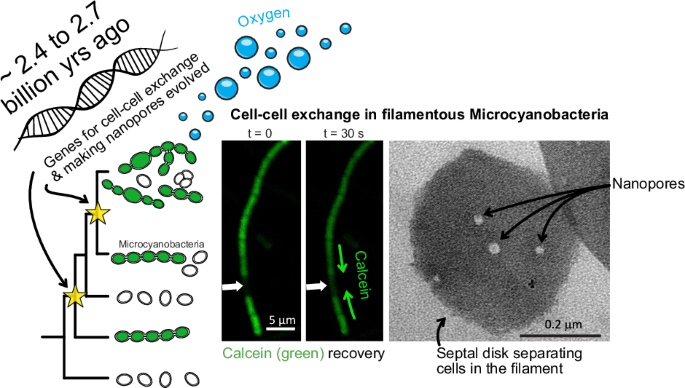
Kieninger, A. K., Forchhammer, K. & Maldener, I. A nanopore array in the septal peptidoglycan hosts gated septal junctions for cell-cell communication in multicellular cyanobacteria. Int. J. Med. Microbiol. 309, 151303 (2019).
Weiss, G. L., Kieninger, A. K., Maldener, I., Forchhammer, K. & Pilhofer, M. Structure and function of a bacterial gap junction analog. Cell 178, 374–384.e315 (2019).
Merino-Puerto, V., Mariscal, V., Mullineaux, C. W., Herrero, A. & Flores, E. Fra proteins influencing filament integrity, diazotrophy and localization of septal protein SepJ in the heterocyst-forming cyanobacterium Anabaena sp. Mol. Microbiol. 75, 1159–1170 (2010).
Merino-Puerto, V. et al. FraC/FraD-dependent intercellular molecular exchange in the filaments of a heterocyst-forming cyanobacterium, Anabaena sp. Mol. Microbiol. 82, 87–98 (2011).
Arévalo, S. & Flores, E. Pentapeptide-repeat, cytoplasmic-membrane protein HglK influences the septal junctions in the heterocystous cyanobacterium Anabaena. Mol. Microbiol. 113, 794–806 (2020).
Springstein, B. L. et al. A novel septal protein of multicellular heterocystous cyanobacteria is associated with the divisome. Mol. Microbiol. 113, 1140–1154 (2020).
Arévalo, S. & Flores, E. Heterocyst septa contain large nanopores that are influenced by the Fra proteins in the filamentous cyanobacterium Anabaena sp. Strain PCC 7120. J. Bacteriol. 203, https://doi.org/10.1128/JB.00081-21 (2021).
Flores, E. et al. Septum-localized protein required for filament integrity and diazotrophy in the heterocyst-forming cyanobacterium Anabaena sp. strain PCC 7120. J. Bacteriol. 189, 3884–3890 (2007).
Mullineaux, C. W. et al. Mechanism of intercellular molecular exchange in heterocyst-forming cyanobacteria. EMBO J. 27, 1299–1308 (2008).
Mariscal, V., Herrero, A., Nenninger, A., Mullineaux, C. W. & Flores, E. Functional dissection of the three-domain SepJ protein joining the cells in cyanobacterial trichomes. Mol. Microbiol. 79, 1077–1088 (2011).
Mariscal, V., Nürnberg, D. J., Herrero, A., Mullineaux, C. W. & Flores, E. Overexpression of sepJ alters septal morphology and heterocyst pattern regulated by diffusible signals in Anabaena. Mol. Microbiol. 101, 968–981 (2016).
Omairi-Nasser, A., Mariscal, V., Austin, J. R. 2nd & Haselkorn, R. Requirement of Fra proteins for communication channels between cells in the filamentous nitrogen-fixing cyanobacterium Anabaena sp. PCC 7120. Proc. Natl Acad. Sci. USA 112, E4458–E4464 (2015).
Stucken, K. et al. The smallest known genomes of multicellular and toxic cyanobacteria: Comparison, minimal gene sets for linked traits and the evolutionary implications. PLoS One 5, e9235 (2010).
Springstein, B. L. et al. Identification and characterization of novel filament-forming proteins in cyanobacteria. Sci. Rep. 10, 1894 (2020).
Black, T. A., Cai, Y. & Wolk, C. P. Spatial expression and autoregulation of hetR, a gene involved in the control of heterocyst development in Anabaena. Mol. Microbiol. 9, 77–84 (1993).
Kim, Y. et al. Structure of transcription factor HetR required for heterocyst differentiation in cyanobacteria. Proc. Natl Acad. Sci. USA 108, 10109–10114 (2011).
Zhang, J. Y., Chen, W. L. & Zhang, C. C. hetR and patS, two genes necessary for heterocyst pattern formation, are widespread in filamentous non-heterocyst-forming cyanobacteria. Microbiology 155, 1418–1426 (2009).
Zhang, W. et al. A gene cluster that regulates both heterocyst differentiation and pattern formation in Anabaena sp. strain PCC 7120. Mol. Microbiol. 66, 1429–1443 (2007).
Elhai, J. & Khudyakov, I. Ancient association of cyanobacterial multicellularity with the regulator hetR and an RGSGR pentapeptide-containing protein (PatX). Mol. Microbiol. 110, 931–954 (2018).
Antonaru, L. A. & Nürnberg, D. J. Role of PatS and cell type on the heterocyst spacing pattern in a filamentous branching cyanobacterium. FEMS Microbiol. Lett. 364, https://doi.org/10.1093/femsle/fnx154 (2017).
Tomitani, A., Knoll, A. H., Cavanaugh, C. M. & Ohno, T. The evolutionary diversification of cyanobacteria: Molecular-phylogenetic and paleontological perspectives. Proc. Natl Acad. Sci. USA 103, 5442–5447 (2006).
Strunecký, O., Ivanova, A. P. & Mareš, J. An updated classification of cyanobacterial orders and families based on phylogenomic and polyphasic analysis. J. Phycol. 59, 12–51 (2023).
Enzingmuller-Bleyl, T. C. et al. On the trail of iron uptake in ancestral cyanobacteria on early Earth. Geobiology 20, 776–789 (2022).
Sánchez-Baracaldo, P., Ridgwell, A. & Raven, J. A. A Neoproterozoic transition in the marine nitrogen cycle. Curr. Biol. 24, 652–657 (2014).
Chen, M. Y. et al. Comparative genomics reveals insights into cyanobacterial evolution and habitat adaptation. ISME J. 15, 211–227 (2020).
Alcorta, J., Alarcón-Schumacher, T., Salgado, O. & Díez, B. Taxonomic novelty and distinctive genomic features of hot spring cyanobacteria. Front. Genet. 11, https://doi.org/10.3389/fgene.2020.568223 (2020).
Rockwell, N. C. & Lagarias, J. C. Cyanobacteriochromes from Gloeobacterales provide new insight into the diversification of cyanobacterial photoreceptors. J. Mol. Biol. 168313, https://doi.org/10.1016/j.jmb.2023.168313 (2023).
Velázquez-Suárez, C., Valladares, A., Luque, I. & Herrero, A. The role of Mre Factors and cell division in peptidoglycan growth in the multicellular cyanobacterium. Mbio 13, https://doi.org/10.1128/mbio.01165-22 (2022).
Nürnberg, D. J. et al. Branching and intercellular communication in the section V cyanobacterium Mastigocladus laminosus, a complex multicellular prokaryote. Mol. Microbiol. 91, 935–949 (2014).
Nürnberg, D. J. et al. Intercellular diffusion of a fluorescent sucrose analog via the septal junctions in a filamentous cyanobacterium. Mbio 6. https://doi.org/10.1128/mbio.02109-14 (2015).
Arévalo, S. et al. Coexistence of communicating and non-communicating cells in the filamentous cyanobacterium. Msphere 6. https://doi.org/10.1128/msphere.01091-20 (2021).
Lehner, J. et al. Prokaryotic multicellularity: a nanopore array for bacterial cell communication. FASEB J. 27, 2293–2300 (2013).
Mandakovic, D. et al. CyDiv, a conserved and novel filamentous cyanobacterial cell division protein involved in septum localization. Front. Microbiol. 7, 94 (2016).
Donia, M. S. et al. Complex microbiome underlying secondary and primary metabolism in the tunicate-Prochloron symbiosis. Proc. Natl Acad. Sci. USA 108, E1423–E1432 (2011).
Sánchez-Baracaldo, P., Bianchini, G., Di Cesare, A., Callieri, C. & Chrismas, N. A. M. Insights into the evolution of Picocyanobacteria and phycoerythrin genes (mpeBA and cpeBA). Front. Microbiol. 10. https://doi.org/10.3389/fmicb.2019.00045 (2019).
Boden, J. S., Zhong, J., Anderson, R. E. & Stüeken, E. E. Timing the evolution of phosphorus-cycling enzymes through geological time using phylogenomics. Nat. Commun. 15, 3703 (2024).
Bianchini, G., Hagemann, M. & Sánchez-Baracaldo, P. Stochastic character mapping, bayesian model selection, and biosynthetic pathways shed new light on the evolution of habitat preference in cyanobacteria. Syst. Biol. https://doi.org/10.1093/sysbio/syae025 (2024).
Sánchez-Baracaldo, P., Raven, J. A., Pisani, D. & Knoll, A. H. Early photosynthetic eukaryotes inhabited low-salinity habitats. Proc. Natl Acad. Sci. USA 114, E7737–E7745 (2017).
Tice, M. M., Thornton, D. C. O., Pope, M. C., Olszewski, T. D. & Gong, J. Archean microbial mat communities. Annu. Rev. Earth. Planet. Sci. 39, 297–319 (2011).
Sánchez-Baracaldo, P., Hayes, P. K. & Blank, C. E. Morphological and habitat evolution in the cyanobacteria using a compartmentalization approach. Geobiology 3, 145–165 (2005).
Bjerrum, C. J. & Canfield, D. E. Ocean productivity before about 1.9 Gyr ago limited by phosphorus adsorption onto iron oxides. Nature 417, 159–162 (2002).
Konhauser, K. O., Lalonde, S. V., Amskold, L. & Holland, H. D. Was there really an Archean phosphate crisis? Science 315, 1234 (2007).
Ozaki, K., Thompson, K. J., Simister, R. L., Crowe, S. A. & Reinhard, C. T. Anoxygenic photosynthesis and the delayed oxygenation of Earth’s atmosphere. Nat. Commun. 10, 3026 (2019).
Schad, M., Konhauser, K. O., Sánchez-Baracaldo, P., Kappler, A. & Bryce, C. How did the evolution of oxygenic photosynthesis influence the temporal and spatial development of the microbial iron cycle on ancient earth? Free Radic. Biol. Med. 140, 154–166 (2019).
Garcia-Pichel, F. et al. Timing the evolutionary advent of cyanobacteria and the later Great Oxidation Event using gene phylogenies of a sunscreen. Mbio. 10, https://doi.org/10.1128/mbio.00561-19 (2019).
Zheng, Z. et al. An amidase is required for proper intercellular communication in the filamentous cyanobacterium Anabaena sp. PCC 7120. Proc. Natl Acad. Sci. USA 114, E1405–E1412 (2017).
Khudyakov, I., Gladkov, G. & Elhai, J. Inactivation of three RG(S/T)GR pentapeptide-containing negative regulators of HetR results in lethal differentiation of PCC 7120. Life 10. https://doi.org/10.3390/life10120326 (2020).
Arbel-Goren, R. et al. Robust, coherent, and synchronized circadian clock-controlled oscillations along filaments. Elife 10. https://doi.org/10.7554/eLife.64348 (2021).
Shih, P. M. et al. Improving the coverage of the Cyanobacterial phylum using diversity-driven genome sequencing. Proc. Natl Acad. Sci. USA 110, 1053–1058 (2013).
Katoh, K. & Standley, D. M. MAFFT multiple sequence alignment software version 7: improvements in performance and usability. Mol. Biol. Evol. 30, 772–780 (2013).
Kalyaanamoorthy, S., Minh, B. Q., Wong, T. K. F., von Haeseler, A. & Jermiin, L. S. ModelFinder: fast model selection for accurate phylogenetic estimates. Nat. Methods 14, 587–591 (2017).
Trifinopoulos, J., Nguyen, L. T., von Haeseler, A. & Minh, B. Q. W-IQ-TREE: a fast online phylogenetic tool for maximum likelihood analysis. Nucleic Acids Res. 44, W232–W235 (2016).
Lopez-Maury, L., Florencio, F. J. & Reyes, J. C. Arsenic sensing and resistance system in the cyanobacterium Synechocystis sp strain PCC 6803. J. Bacteriol. 185, 5363–5371 (2003).
Hoang, D. T. C. O., Haeseler, A. V., Minh, B. Q. & Vinh, L. S. UFBoot2: improving the ultrafast bootstrap approximation. Mol. Biol. Evol. 35, 518–522 (2017).
Guindon, S. et al. New algorithms and methods to estimate maximum-likelihood phylogenies: assessing the performance of PhyML 3.0. Syst. Biol. 59, 307–321 (2010).
Bowers, R. M. et al. Minimum information about a single amplified genome (MISAG) and a metagenome-assembled genome (MIMAG) of bacteria and archaea. Nat. Biotechnol. 35, 725–731 (2017).
Black, K., Buikema, W. J. & Haselkorn, R. The hglK gene is required for localization of heterocyst-specific glycolipids in the cyanobacterium Anabaena sp. strain PCC 7120. J. Bacteriol. 177, 6440–6448 (1995).
Escudero, L., Mariscal, V. & Flores, E. Functional dependence between septal protein SepJ from Anabaena sp. strain PCC 7120 and an amino acid ABC-type uptake transporter. J. Bacteriol. 197, 2721–2730 (2015).
Lupas, A., Van Dyke, M. & Stock, J. Predicting coiled coils from protein sequences. Science 252, 1162–1164 (1991).
Krogh, A., Larsson, B., von Heijne, G. & Sonnhammer, E. L. Predicting transmembrane protein topology with a hidden Markov model: application to complete genomes. J. Mol. Biol. 305, 567–580 (2001).
Ronquist, F. et al. MrBayes 3.2: efficient Bayesian phylogenetic inference and model choice across a large model space. Syst. Biol. 61, 539–542 (2012).
Lartillot, N., Lepage, T. & Blanquart, S. PhyloBayes 3: a Bayesian software package for phylogenetic reconstruction and molecular dating. Bioinformatics 25, 2286–2288 (2009).
Tria, F. D. K., Landan, G. & Dagan, T. Phylogenetic rooting using minimal ancestor deviation. Nat. Ecol. Evol. 1, 0193 (2017).
Bianchini, G. & Sánchez-Baracaldo, P. TreeViewer: flexible, modular software to visualise and manipulate phylogenetic trees. Ecol. Evol. 14, e10873 (2024).
Drummond, A. J., Ho, S. Y. W., Phillips, M. J. & Rambaut, A. Relaxed phylogenetics and dating with confidence. PLOS Biol. 4, 699–710 (2006).
Golubic, S. & Lee, S. J. Early Cyanobacterial fossil record: preservation, palaeoenvironments and identification. Eur. J. Phycol. 34, 339–348 (1999).
Sergeev, V. N., Gerasimenko, L. M. & Zavarzin, G. A. The Proterozoic history and present state of cyanobacteria. Microbiol 71, 623–637 (2002).
Golubic, S., Sergeev, V. N. & Knoll, A. H. Mesoproterozoic Archaeoellipsoides: akinetes of heterocystous cyanobacteria. Lethaia 28, 285–298 (1995).
Sims, A. P., Mann, D. G. & Medlin, L. K. Evolution of the diatoms: insights from fossil, biological and molecular data. Phycologia 45, 361–402 (2006).
Foster, R. A. et al. Nitrogen fixation and transfer in open ocean diatom-cyanobacterial symbioses. ISME J. 5, 1484–1493 (2011).
Cornejo-Castillo, F. M. et al. Cyanobacterial symbionts diverged in the late Cretaceous towards lineage-specific nitrogen fixation factories in single-celled phytoplankton. Nat. Commun. 7, 11071 (2016).
Bown, P. R. & Young, J. R. Techniques. In: Calcareous nannofossil biostratigraphy (ed.Bown, P. R.) 16–28 (Chapman and Hall, London, 1998). https://doi.org/10.1007/978-94-011-4902-0_2.
Bekker, A. et al. Dating the rise of atmospheric oxygen. Geochim. Cosmochim. Ac 68, A780–A780 (2004).
Planavsky, N. J. et al. Evidence for oxygenic photosynthesis half a billiion years before the Great Oxidation Event. Nat. Geosci. 7, 283–286 (2014).
Bosak, T., Knoll, A. H. & Petroff, A. P. The meaning of stromatolites. Ann. Rev. Earth Planet. Sci. 41, 21–44 (2013).
Hofmann, H. J. Precambrian microflora, Belcher Islands, Canada – significance and systematics. J. Paleontol. 50, 1040–1073 (1976).
Boden, J. S., Grego, M., Bolhuis, H. & Sanchez-Baracaldo, P. Draft genome sequences of three filamentous cyanobacteria isolated from brackish habitats. J. Genomics 9, 20–25 (2021).
Bolger, A. M., Lohse, M. & Usadel, B. Trimmomatic: a flexible trimmer for Illumina sequence data. Bioinformatics 30, 2114–2120 (2014).
Bankevich, A. et al. SPAdes: a new genome assembly algorithm and its applications to single-Cell sequencing. J. Comput. Biol. 19, 455–477 (2012).
Chrismas, N. A. M., Barker, G., Anesio, A. M. & Sanchez-Baracaldo, P. Genomic mechanisms for cold tolerance and production of exopolysaccharides in the Arctic cyanobacterium Phormidesmis priestleyi BC1401. BMC Genomics 17, https://doi.org/10.1186/s12864-016-2846-4 (2016).
Mulkidjanian, A. Y. et al. The cyanobacterial genome core and the origin of photosynthesis. Proc. Natl Acad. Sci. USA 103, 13126–13131 (2006).
Markowitz, V. M. et al. IMG: The integrated microbial genomes database and comparative analysis system. Nucleic Acids Res. 40, D115–D122 (2012).
Simao, F. A., Waterhouse, R. M., Ioannidis, P., Kriventseva, E. V. & Zdobnov, E. M. BUSCO: assessing genome assembly and annotation completeness with single-copy orthologs. Bioinformatics 31, 3210–3212 (2015).
Orakov, A. et al. GUNC: detection of chimerism and contamination in prokaryotic genomes. Genome Biol. 22, 178 (2021).
McLachlan, J. Some considerations of the growth of marine algae in artificial media. Can. J. Microbiol. 10, 769–782 (1964).
Goldman, J. C. & McCarthy, J. J. Steady state growth and ammonium uptake of a fast-growing marine diatom 1. Limnol. Oceanogr. 23, 695–703 (1978).
de Pedro, M. A., Quintela, J. C., Höltje, J. V. & Schwarz, H. Murein segregation in Escherichia coli. J. Bacteriol. 179, 2823–2834 (1997).
Nieves-Morion, M., Mullineaux, C. W. & Flores, E. Molecular diffusion through Cyanobacterial septal junctions. Mbio 8, https://doi.org/10.1128/mbio.01756-16 (2017).
Schindelin, J. et al. Fiji: an open-source platform for biological-image analysis. Nat. Methods 9, 676–682 (2012).
Nieves-Morión, M. et al. Specific glucoside transporters influence septal structure and function in the filamentous, heterocyst-forming cyanobacterium Anabaena sp. strain PCC 7120. J. Bacteriol. 199, https://doi.org/10.1128/jb.00876-00816 (2017).
Boden, J. et al. Supplementary Dataset for Manuscript Entitled ‘Evolution of Multicellularity Genes in the Lead Up to the Great Oxidation Event. https://doi.org/10.17605/OSF.IO/8BXAR (2025).
Sánchez-Baracaldo, P., Bianchini, G., Wilson, J. D. & Knoll, A. H. cyanobacteria and biogeochemical cycles through Earth history. Trends Microbiol. 30. https://doi.org/10.1016/j.tim.2021.05.008 (2021).