
New Zealand’s holiday homes have the power to impress.
Having a place that’s your own private retreat, somewhere to rest and recharge – with the ocean at your doorstep – is the ultimate summer getaway. We’re talking about dream baches that have the wow factor. Leanne Moore has found 10
of the best, all set in stunning coastal locations and designed for easy summer living.
Castle Rock bach by Herbst Architects. Photo / Patrick Reynolds
1.
Location: Castle Rock, Whangārei Heads, Northland
Designed by: Herbst Architects
This bach is named after Castle Rock, the large, natural bluff that’s part of the dramatic landscape at Whangārei Heads. Built on a ridge below it, Castle Rock House was designed by Herbst Architects to maximise the spectacular views of the surrounding area. Multiple outdoor rooms celebrate casual summer living and access to the bedrooms is via a covered external walkway. The structure steps down the hillside, embedded in the landscape by a gabion wall. The dark-stained timber exterior minimises the visual noise, allowing the building to almost blend with the surrounding habitat.
Langs Beach bach by Bossley Architects. Photo / Simon Devitt
Location: Langs Beach, Northland
Designed by: Bossley Architects
Set on a narrow site sloping gently down from the road to the beach, the volume of this house increases as you transition through the spaces towards the sea. Culminating in a large, light-filled living area with multiple communal gathering places, it’s designed for comfort and scaled for family use. Architect Pete Bossley of Bossley Architects says he was inspired by the remarkable site: its connection to the beach, the view through the pōhutukawa trees to the ocean and the sound of the waves lapping on the foreshore. The result is a relaxed holiday home that enjoys its premium front row position.
Te Arai bach by Fearon Hay. Photo / Simon Wilson
3.
Location: Te Arai, north of Auckland
Fearon Hay wanted to provide a structure that did not challenge or reduce the site’s natural beauty. “The idea of a cabin in the woods was an idea that stuck very early on,” says architect Tim Hay. Te Arai Beach House emerges from the forest, faces the ocean and offers a sense of protection from both. Sonja Hawkins, interior designer and owner of the beach house, did the same with her approach to the interior: “We wanted a very simple dwelling that allowed us to live a simple life,” says Hawkins, who created a stripped-back yet tactile environment that has a quiet beauty.
Buckletons Beach bach by RTA Studio. Photo / Patrick Reynolds
4.
Location: Buckletons Beach, Tāwharanui Peninsula
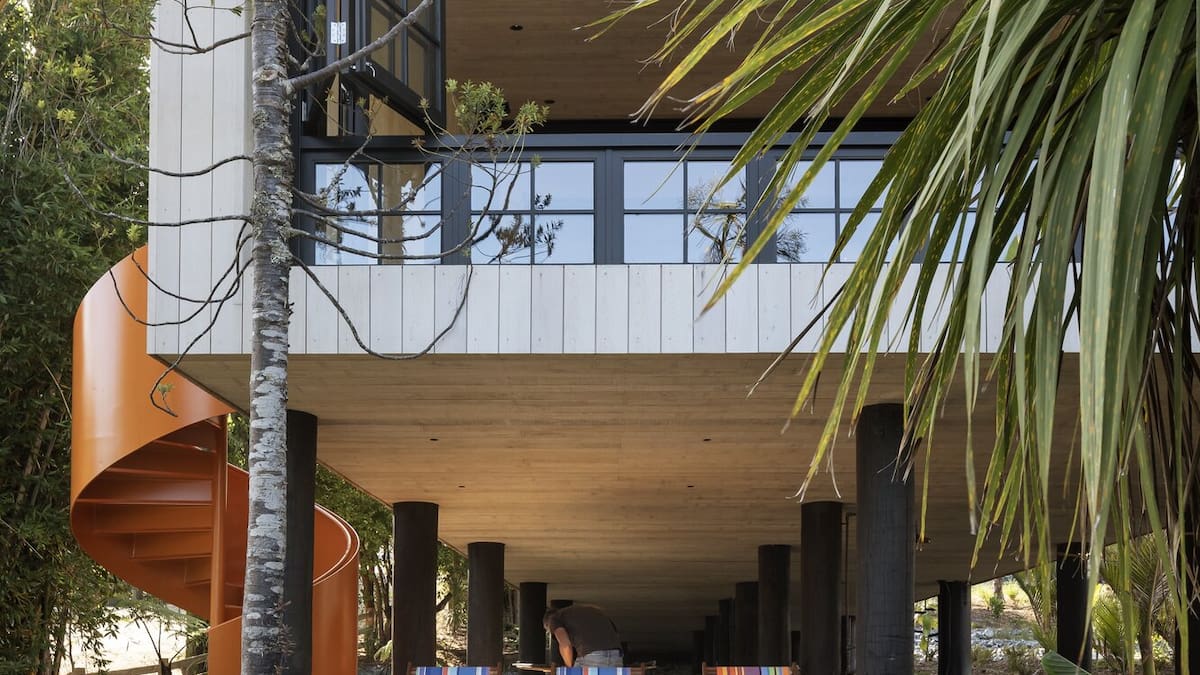
Designing a building to custom-fit its location is what architects do, but in this case, RTA Studio has literally taken it next level. Poles lift this bach out of the ground, and in doing so, the building engages more closely with nature. “It feels like you are living in the trees with tūī feeding right in front of you,” says architect Richard Naish. Built to respond to the ocean at one end and native trees at the other, its simple form stretches horizontally to the water and vertically to the foliage. But it’s more than that. Designed for the (usually dry) riverbed that runs underneath, the height also gives it a resilience to sea-level changes.
Awaawaroa Bay bach, Waiheke Island, by Cheshire Architects. Photo / Jackie Meiring
5.
Location: Awaawaroa Bay, Waiheke Island
Designed by: Cheshire Architects
The layout of this island getaway by Cheshire Architects maintains the spirit of the original structures created by the owners. Somewhere between camping and housing, the new version immerses its occupants in the whenua and its seasons, firmly off the grid. “We resisted making every wall from glass. Instead we kept the outlooks measured,” says architect Nat Cheshire. Each building has a clear job. One is for preparing and consuming food and conversation; the nourishment of the body and mind. One is for sleeping and bathing. One is for whānau and guests. The living room is taut and a bit hard on the outside, but soft on the inside. The sleeping buildings are deep within canvas, like little cabins hidden inside a cloud. The central open space, neither garden nor room, performs a key role in this elegant encampment. The movement between the buildings matters as much as the time spent inside them.
Waiheke Island bach by Elmore Booth. Photo / Sam Hartnett
6.
Designed by: Elmore Booth
First impressions of this site is the outlook: expansive ocean horizons, distant islands, and the curve of bays below. Yet just as powerful are the canopies of ancient pōhutukawa and the dense bush that tumbles down the slope. Designers Libby Elmore and Oli Booth of Elmore Booth did not want the building to dominate its extraordinary setting but to distil it: “Our aim was not to reveal everything at once, but to choreograph moments of concealment and surprise. Views are layered and framed, so that the experience shifts from vastness to intimacy as you move through the home,” says Booth. Landscape design by Xanthe White softens the built edges, and offers privacy and wind protection. It is a house designed to be lived in slowly, in rhythm with the land and sea that surround it.
Great Barrier/Aotea bach by Herbst Architects. Photo / Jackie Meiring
7.
Location: Great Barrier/Aotea
Designed by: Herbst Architects
Not Yet Completed: Started in 1999.
It’s fair to say this bach is a work in progress, and that’s not entirely unexpected when the owners are a couple of architects. So far, there have been four iterations, with more to come, according to Lance and Nicola Herbst of Herbst architects. The most recent renovation was in 2020. Every time the couple enjoy a break on the island – and even when they’re not there – they are dreaming up new ideas for the bach. The husband and wife team, who met while studying architecture at the University of Cape Town, immigrated to Auckland in 1998. The bach is one of the first projects they undertook in New Zealand. The island is now home to eight houses by Herbst Architects – all off grid – each designed to have minimal impact on the environment. In their work, the couple are constantly asking themselves: “What’s the best way to live in and feel connected to the New Zealand landscape and climate?” And the answers are gradually being incorporated into their ever-increasing portfolio of award-winning houses – and their own evolutionary holiday home.
Great Barrier/Aotea bach by JCA Studio. Photo / David Straight
8.
Location: Great Barrier/Aotea
A long curving stretch of beach punctuated by a large, weathered rock at the centre influenced the composition of this Great Barrier getaway. The low, horizontal form, complemented by a taller, denser, two-level element, echoes the nearby shoreline and the exaggerated glazed openings dissolve the line between inside and out, creating interior spaces that are bathed in light throughout the days and the seasons. Designer Jeremy Chapman of JCA Studio describes it as a pergola for living. The landscaping anchors the architectural volume to the site. Like the tide that eddies around the beach rock, so too does the movement of the planting around the building and decks.
Kūaotunu bach, Coromandel Peninsula, by Crosson Architects. Photo / Simon Devitt
9.
Location: Kūaotunu, Coromandel Peninsula
Designed by: Crosson Architects
This beach house is an exploration of strong sculptural forms referencing the mine shafts of the long-abandoned Coromandel gold mines. Situated on a stunning site just above the sand dunes at Kūaotunu, the bach’s roofline is punctuated by the upward thrust of the shafts, which give it a scale that relates to the topography of the surrounding landscape. The shafts mine the sunshine and starlight, extending into the sky as opposed to the earth. “Homes in these sensitive locations have to meld and blend in over time,” says architect Ken Crosson. “But we also like our architecture to be memorable. I think the light mines played into that idea really neatly.”
Miro Bay bach, Pelorus Sound, by Tennent Brown Architects. Photo / Paul McCredie
10.
Location: Miro Bay, Pelorus Sound
Designed by: Tennent Brown Architects
A family who likes to leave the world behind when they take a break chose this remote bay in Pelorus Sound for their holiday home. Tennent Brown was charged with coming up with a structure to accommodate the multi-generational family, while keeping the architecture’s emphasis on the surrounding nature. Due to its location, the bach is off-grid – it uses solar hot water and photovoltaic electricity. There’s also a wetback for heating water. Tennent Brown designed a series of sheds, the two largest connected by a covered veranda. The result is communal spaces built to capture the sun and views – with private areas for peace and quiet.
More homes and spaces
Explore stories of creative homes, sustainable living, bold design and personal transformations from today’s most forward-thinking talents.