
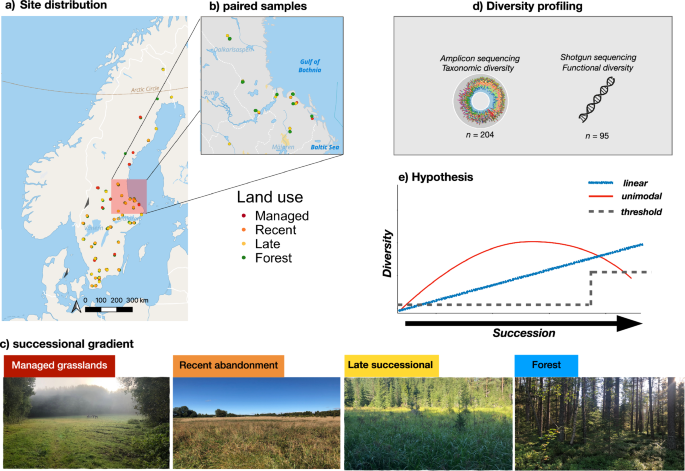
Winkler, K., Fuchs, R., Rounsevell, M. & Herold, M. Global land use changes are four times greater than previously estimated. Nat. Commun. 12, 2501 (2021).
Newbold, T. et al. Global effects of land use on local terrestrial biodiversity. Nature 520, 45–50 (2015).
Campbell, J. E., Lobell, D. B., Genova, R. C. & Field, C. B. The global potential of bioenergy on abandoned agriculture lands. Environ. Sci. Technol. 42, 5791–5794 (2008).
Walker, L. R. & Moral, R. del. Primary Succession and Ecosystem Rehabilitation. (Cambridge University Press, 2003).
Horn, H. S. The ecology of secondary succession. Annu. Rev. Ecol. Syst. 5, 25–37 (1974).
Clements, F. E. Nature and structure of the climax. J. Ecol. 24, 252–284 (1936).
Simberloff, D. A succession of paradigms in ecology: essentialism to materialism and probabilism. Synthese 43, 3–39 (1980).
Vera, F. W. M. et al. Grazing Ecology and Forest History. (CABI, Oxford, 2000).
Johnson, E. A. & Miyanishi, K. Testing the assumptions of chronosequences in succession. Ecol. Lett. 11, 419–431 (2008).
Arias-Navarro, C., Baritz, R. & Jones, A. The State of Soils in Europe. https://doi.org/10.2760/7007291 (2024).
Eriksson, O., Cousins, S. A. O. & Bruun, H. H. Land-use history and fragmentation of traditionally managed grasslands in Scandinavia. J. Veg. Sci. 13, 743–748 (2002).
Gustavsson, E., Lennartsson, T. & Emanuelsson, M. Land use more than 200 years ago explains current grassland plant diversity in a Swedish agricultural landscape. Biol. Conserv. 138, 47–59 (2007).
Auffret, A. G., Kimberley, A., Plue, J. & Waldén, E. Super-regional land-use change and effects on the grassland specialist flora. Nat. Commun. 9, 3464 (2018).
Bremer, L. L. & Farley, K. A. Does plantation forestry restore biodiversity or create green deserts? A synthesis of the effects of land-use transitions on plant species richness. Biodivers. Conserv. 19, 3893–3915 (2010).
Prangel, E. et al. Afforestation and abandonment of semi-natural grasslands lead to biodiversity loss and a decline in ecosystem services and functions. J. Appl. Ecol. 60, 825–836 (2023).
Kindermann, E. et al. Resurveying inner-alpine dry grasslands after 70 years calls for integrative conservation efforts. Biol. Conserv. 289, 110393 (2024).
Öckinger, E., Eriksson, A. K. & Smith, H. G. Effects of grassland abandonment, restoration and management on butterflies and vascular plants. Biol. Conserv. 133, 291–300 (2006).
Moyano, J. et al. Unintended consequences of planting native and non-native trees in treeless ecosystems to mitigate climate change. J. Ecol. 112, 2480–2491 (2024).
Quested, H., Eriksson, O., Fortunel, C. & Garnier, E. Plant traits relate to whole-community litter quality and decomposition following land use change. Funct. Ecol. 21, 1016–1026 (2007).
Zhou, Z., Wang, C., Jiang, L. & Luo, Y. Trends in soil microbial communities during secondary succession. Soil Biol. Biochem. 115, 92–99 (2017).
Tian, J. et al. Ecological succession pattern of fungal community in soil along a retreating glacier. Front. Microbiol. 8, 1028 (2017).
Cline, L. C. & Zak, D. R. Soil microbial communities are shaped by plant-driven changes in resource availability during secondary succession. Ecology 96, 3374–3385 (2015).
Egidi, E., Coleine, C., Delgado-Baquerizo, M. & Singh, B. K. Assessing critical thresholds in terrestrial microbiomes. Nat. Microbiol. 8, 2230–2233 (2023).
Allison, S. D. A trait-based approach for modelling microbial litter decomposition. Ecol. Lett. 15, 1058–1070 (2012).
Cortez, J., Garnier, E., Pérez-Harguindeguy, N., Debussche, M. & Gillon, D. Plant traits, litter quality and decomposition in a Mediterranean old-field succession. Plant Soil 296, 19–34 (2007).
Hernandez, D. J., Kiesewetter, K. N., Almeida, B. K., Revillini, D. & Afkhami, M. E. Multidimensional specialization and generalization are pervasive in soil prokaryotes. Nat. Ecol. Evol. 7, 1408–1418 (2023).
Hättenschwiler, S., Tiunov, A. V. & Scheu, S. Biodiversity and litter decomposition in terrestrial ecosystems. Annu. Rev. Ecol. Evol. Syst. 36, 191–218 (2005).
Hannula, S. E. & van Veen, J. A. Primer sets developed for functional genes reveal shifts in functionality of fungal community in soils. Front. Microbiol. 7, 1897 (2016).
Louca, S. et al. Function and functional redundancy in microbial systems. Nat. Ecol. Evol. 2, 936–943 (2018).
Walker, L. R., Wardle, D. A., Bardgett, R. D. & Clarkson, B. D. The use of chronosequences in studies of ecological succession and soil development. J. Ecol. 98, 725–736 (2010).
Cousins, S. A. O. & Eriksson, O. After the hotspots are gone: Land use history and grassland plant species diversity in a strongly transformed agricultural landscape. Appl. Veg. Sci. 11, 365–374 (2008).
Mason, W. L. Changes in the management of British forests between 1945 and 2000 and possible future trends. Ibis 149, 41–52 (2007).
Hooftman, D. A. P. & Bullock, J. M. Mapping to inform conservation: a case study of changes in semi-natural habitats and their connectivity over 70 years. Biol. Conserv. 145, 30–38 (2012).
Mietkiewicz, N., Kulakowski, D., Rogan, J. & Bebi, P. Long-term change in sub-alpine forest cover, tree line and species composition in the Swiss Alps. J. Veg. Sci. 28, 951–964 (2017).
da Silva Camilo, G., de Freitas Terra, B. & Araújo, F. G. Using the relationship between taxonomic and functional diversity to assess functional redundancy in streams of an altered tropical watershed. Environ. Biol. Fishes 101, 1395–1405 (2018).
Chen, H. et al. Functional redundancy in soil microbial community based on metagenomics across the globe. Front. Microbiol. 13, 878978 (2022).
Bobay, L.-M. & Ochman, H. The evolution of bacterial genome architecture. Front. Genet. 8, 72 (2017).
Ricotta, C. et al. Measuring the functional redundancy of biological communities: a quantitative guide. Methods Ecol. Evol. 7, 1386–1395 (2016).
Ricotta, C. et al. The ternary diagram of functional diversity. Methods Ecol. Evol. 14, 1168–1174 (2023).
Douglas, G. M. et al. PICRUSt2 for prediction of metagenome functions. Nat. Biotechnol. 38, 685–688 (2020).
Sun, S., Jones, R. B. & Fodor, A. A. Inference-based accuracy of metagenome prediction tools varies across sample types and functional categories. Microbiome 8, 46 (2020).
Malard, L. A. & Guisan, A. Into the microbial niche. Trends Ecol. Evol. 38, 936–945 (2023).
Gubry-Rangin, C., Aigle, A., Herrera-Alsina, L., Lancaster, L. T. & Prosser, J. I. Niche breadth specialization impacts ecological and evolutionary adaptation following environmental change. ISME J. 18, wrae183 (2024).
Fang, J. et al. Threshold effects of soil pH regulate the biogeography of bacterial communities in inland wetlands across eastern China. Soil Ecol. Lett. 7, 240274 (2024).
Garnier, E. et al. Plant functional markers capture ecosystem properties during secondary succession. Ecology 85, 2630–2637 (2004).
Berthrong, S. T., Jobbágy, E. G. & Jackson, R. B. A global meta-analysis of soil exchangeable cations, pH, carbon, and nitrogen with afforestation. Ecol. Appl. 19, 2228–2241 (2009).
Tscherko, D., Hammesfahr, U., Marx, M.-C. & Kandeler, E. Shifts in rhizosphere microbial communities and enzyme activity of Poa alpina across an alpine chronosequence. Soil Biol. Biochem. 36, 1685–1698 (2004).
Jobbágy, E. G. & Jackson, R. B. Patterns and mechanisms of soil acidification in the conversion of grasslands to forests. Biogeochemistry 64, 205–229 (2003).
Fierer, N. et al. Reconstructing the microbial diversity and function of pre-agricultural tallgrass prairie soils in the United States. Science 342, 621–624 (2013).
Inkpen, S. A. et al. The coupling of taxonomy and function in microbiomes. Biol. Philos. 32, 1225–1243 (2017).
Wang, C. et al. Bacterial genome size and gene functional diversity negatively correlate with taxonomic diversity along a pH gradient. Nat. Commun. 14, 7437 (2023).
Zhang, H.-Y., Bissett, A., Aguilar-Trigueros, C. A., Liu, H.-W. & Powell, J. R. Fungal genome size and composition reflect ecological strategies along soil fertility gradients. Ecol. Lett. 26, 1108–1118 (2023).
Bhatnagar, J. M., Peay, K. G. & Treseder, K. K. Litter chemistry influences decomposition through activity of specific microbial functional guilds. Ecol. Monogr. 88, 429–444 (2018).
Berg, B. Litter decomposition and organic matter turnover in northern forest soils. Ecol. Manag. 133, 13–22 (2000).
Silverstein, M. R., Bhatnagar, J. M. & Segrè, D. Metabolic complexity drives divergence in microbial communities. Nat. Ecol. Evol. 8, 1493–1504 (2024).
Hernández, D. L. & Hobbie, S. E. The effects of substrate composition, quantity, and diversity on microbial activity. Plant Soil 335, 397–411 (2010).
Dal Bello, M., Lee, H., Goyal, A. & Gore, J. Resource–diversity relationships in bacterial communities reflect the network structure of microbial metabolism. Nat. Ecol. Evol. 5, 1424–1434 (2021).
Foote, R. L. & Grogan, P. Soil carbon accumulation during temperate forest succession on abandoned low productivity agricultural lands. Ecosystems 13, 795–812 (2010).
Bongers, F. J. et al. Functional diversity effects on productivity increase with age in a forest biodiversity experiment. Nat. Ecol. Evol. 5, 1594–1603 (2021).
Biggs, C. R. et al. Does functional redundancy affect ecological stability and resilience? a review and meta-analysis. Ecosphere 11, e03184 (2020).
Auber, A. et al. A functional vulnerability framework for biodiversity conservation. Nat. Commun. 13, 4774 (2022).
Rocca, J. D. et al. Relationships between protein-encoding gene abundance and corresponding process are commonly assumed yet rarely observed. ISME J. 9, 1693–1699 (2015).
Chen, J. & Sinsabaugh, R. L. Linking microbial functional gene abundance and soil extracellular enzyme activity: Implications for soil carbon dynamics. Glob. Change Biol. 27, 1322–1325 (2021).
Cooke, R. S. C., Bates, A. E. & Eigenbrod, F. Global trade-offs of functional redundancy and functional dispersion for birds and mammals. Glob. Ecol. Biogeogr. 28, 484–495 (2019).
Kerfahi, D. et al. Elevation trend in bacterial functional gene diversity decouples from taxonomic diversity. CATENA 199, 105099 (2021).
Bahram, M. et al. Structure and function of the global topsoil microbiome. Nature 560, 233–237 (2018).
Ricotta, C., Pavoine, S., Cerabolini, B. E. L. & Pillar, V. D. A new method for indicator species analysis in the framework of multivariate analysis of variance. J. Veg. Sci. 32, e13013 (2021).
Cousins, S. A. O. Analysis of land-cover transitions based on 17th and 18th century cadastral maps and aerial photographs. Landsc. Ecol. 16, 41–54 (2001).
Tedersoo, L. et al. Global diversity and geography of soil fungi. Science 346, 1256688 (2014).
Egnér, H., Riehm, H. & Domingo, W. R. Untersuchungen uber die chemische Bodenanalyse als Grundlage fur die Beurteilung des Nährstoffzustandes der Böden. II. Chemische Extraktionsmethoden zur Phosphor- und Kaliumbestimmung. K. Lantbrukshögskolans Ann. 26, 199–215 (1960).
Kattge, J. et al. TRY – a global database of plant traits. Glob. Change Biol. 17, 2905–2935 (2011).
Roscher, C. et al. Interspecific trait differences rather than intraspecific trait variation increase the extent and filling of community trait space with increasing plant diversity in experimental grasslands. Perspect. Plant Ecol. Evol. Syst. 33, 42–50 (2018).
Manrubia, M. et al. Soil functional responses to drought under range-expanding and native plant communities. Funct. Ecol. 33, 2402–2416 (2019).
Bradford, M. A. et al. Thermal adaptation of soil microbial respiration to elevated temperature. Ecol. Lett. 11, 1316–1327 (2008).
Birch, H. F. The effect of soil drying on humus decomposition and nitrogen availability. Plant Soil 10, 9–31 (1958).
Bongiorno, G. et al. Soil management intensity shifts microbial catabolic profiles across a range of European long-term field experiments. Appl. Soil Ecol. 154, 103596 (2020).
Walters, W. et al. Improved bacterial 16S rRNA gene (V4 and V4-5) and fungal internal transcribed spacer marker gene primers for microbial community surveys. mSystems https://doi.org/10.1128/msystems.00009-15 (2015).
Tedersoo, L. & Lindahl, B. Fungal identification biases in microbiome projects. Environ. Microbiol. Rep. 8, 774–779 (2016).
Tedersoo, L. et al. The Global Soil Mycobiome consortium dataset for boosting fungal diversity research. Fungal Divers. 111, 573–588 (2021).
Özkurt, E. et al. LotuS2: an ultrafast and highly accurate tool for amplicon sequencing analysis. Microbiome 10, 176 (2022).
Edgar, R. C., Haas, B. J., Clemente, J. C., Quince, C. & Knight, R. UCHIME improves sensitivity and speed of chimera detection. Bioinformatics 27, 2194–2200 (2011).
Bengtsson-Palme, J. et al. Improved software detection and extraction of ITS1 and ITS2 from ribosomal ITS sequences of fungi and other eukaryotes for analysis of environmental sequencing data. Methods Ecol. Evol. 4, 914–919 (2013).
Edgar, R. C. UPARSE: highly accurate OTU sequences from microbial amplicon reads. Nat. Methods 10, 996–998 (2013).
Hildebrand, F. et al. Dispersal strategies shape persistence and evolution of human gut bacteria. Cell Host Microbe 29, 1167–1176.e9 (2021).
Bahram, M. et al. Metagenomic assessment of the global diversity and distribution of bacteria and fungi. Environ. Microbiol. 23, 316–326 (2021).
Buchfink, B., Xie, C. & Huson, D. H. Fast and sensitive protein alignment using DIAMOND. Nat. Methods 12, 59–60 (2015).
Magoč, T. & Salzberg, S. L. FLASH: fast length adjustment of short reads to improve genome assemblies. Bioinformatics 27, 2957–2963 (2011).
Huerta-Cepas, J. et al. eggNOG 5.0: a hierarchical, functionally and phylogenetically annotated orthology resource based on 5090 organisms and 2502 viruses. Nucleic Acids Res. 47, D309–D314 (2019).
Nayfach, S. & Pollard, K. S. Average genome size estimation improves comparative metagenomics and sheds light on the functional ecology of the human microbiome. Genome Biol. 16, 51 (2015).
Levasseur, A., Drula, E., Lombard, V., Coutinho, P. M. & Henrissat, B. Expansion of the enzymatic repertoire of the CAZy database to integrate auxiliary redox enzymes. Biotechnol. Biofuels 6, 41 (2013).
Piton, G. et al. Life history strategies of soil bacterial communities across global terrestrial biomes. Nat. Microbiol. 8, 2093–2102 (2023).
Kanehisa, M., Furumichi, M., Tanabe, M., Sato, Y. & Morishima, K. KEGG: new perspectives on genomes, pathways, diseases and drugs. Nucleic Acids Res. 45, D353–D361 (2017).
Zeng, J. et al. PCycDB: a comprehensive and accurate database for fast analysis of phosphorus cycling genes. Microbiome 10, 101 (2022).
Tu, Q., Lin, L., Cheng, L., Deng, Y. & He, Z. NCycDB: a curated integrative database for fast and accurate metagenomic profiling of nitrogen cycling genes. Bioinformatics 35, 1040–1048 (2019).
Ben-Shachar, M., Lüdecke, D. & Makowski, D. effectsize: estimation of effect size indices and standardized parameters. J. Open Source Softw. 5, 2815 (2020).
Oksanen, J. et al. vegan: Community Ecology Package. Package version: 2.7-2. https://doi.org/10.32614/CRAN.package.vegan (2025).
Pavoine, S. adiv: An r package to analyse biodiversity in ecology. Methods Ecol. Evol. 11, 1106–1112 (2020).
Bates, D. et al. Fitting Linear Mixed-Effect Models Using lme4. J. Stat. Softw. 67, 1–48 (2015)
Finn, D. R. et al. MicroNiche: an R package for assessing microbial niche breadth and overlap from amplicon sequencing data. FEMS Microbiol. Ecol. 96, fiaa131 (2020).
Archer, E. rfPermute: estimate permutation p-values for random forest importance metrics. Package version: 2.5-.5 https://doi.org/10.32614/CRAN.package.rfPermute (2025).
Beule, L. & Karlovsky, P. Improved normalization of species count data in ecology by scaling with ranked subsampling (SRS): application to microbial communities. PeerJ 8, e9593 (2020).
Lai, J., Zhu, W., Cui, D. & Mao, L. Extension of the glmm.hp package to zero-inflated generalized linear mixed models and multiple regression. J. Plant Ecol. 16, rtad038 (2023).
Ramond, P., Galand, P. E. & Logares, R. Microbial functional diversity and redundancy: moving forward. FEMS Microbiol. Rev. 49, fuae031 (2025).
Hurlbert, S. H. The measurement of niche overlap and some relatives. Ecology 59, 67–77 (1978).