
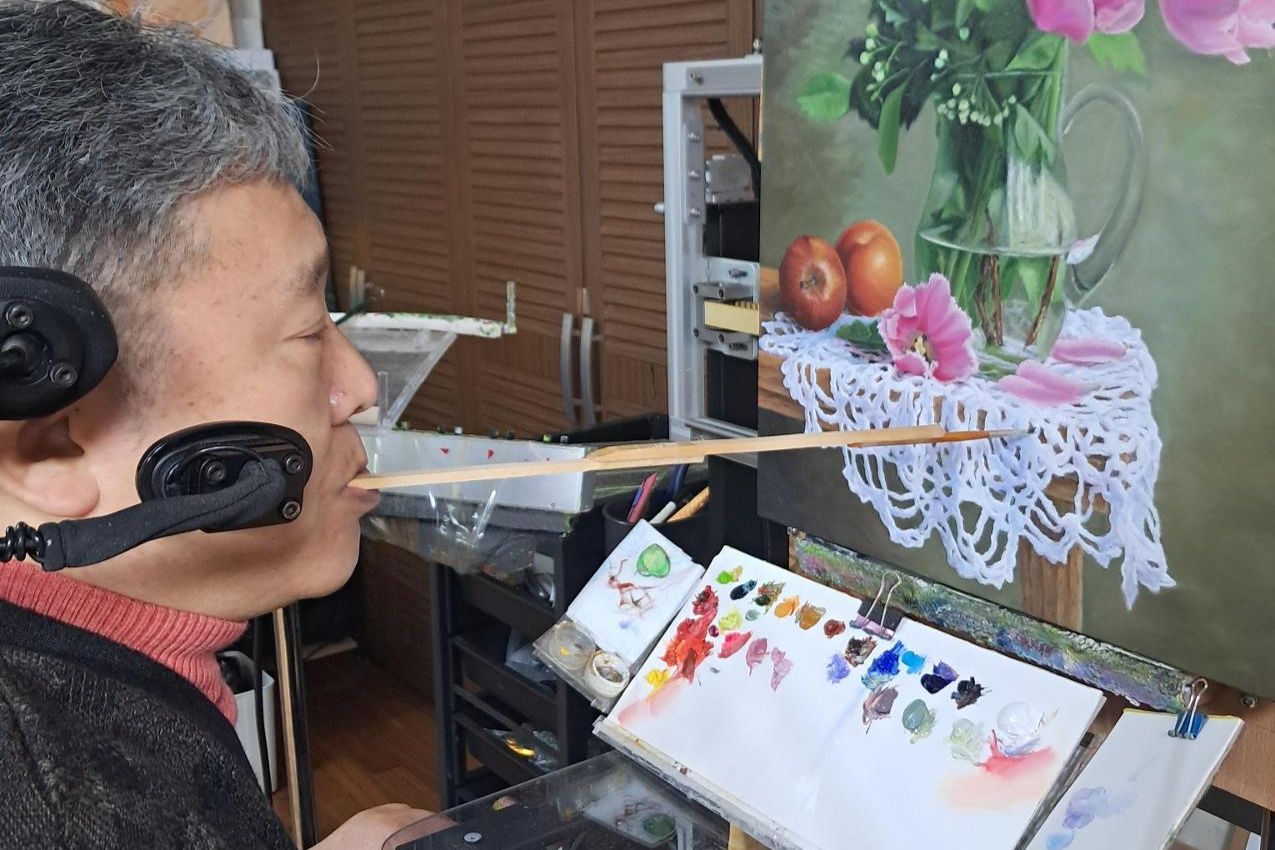
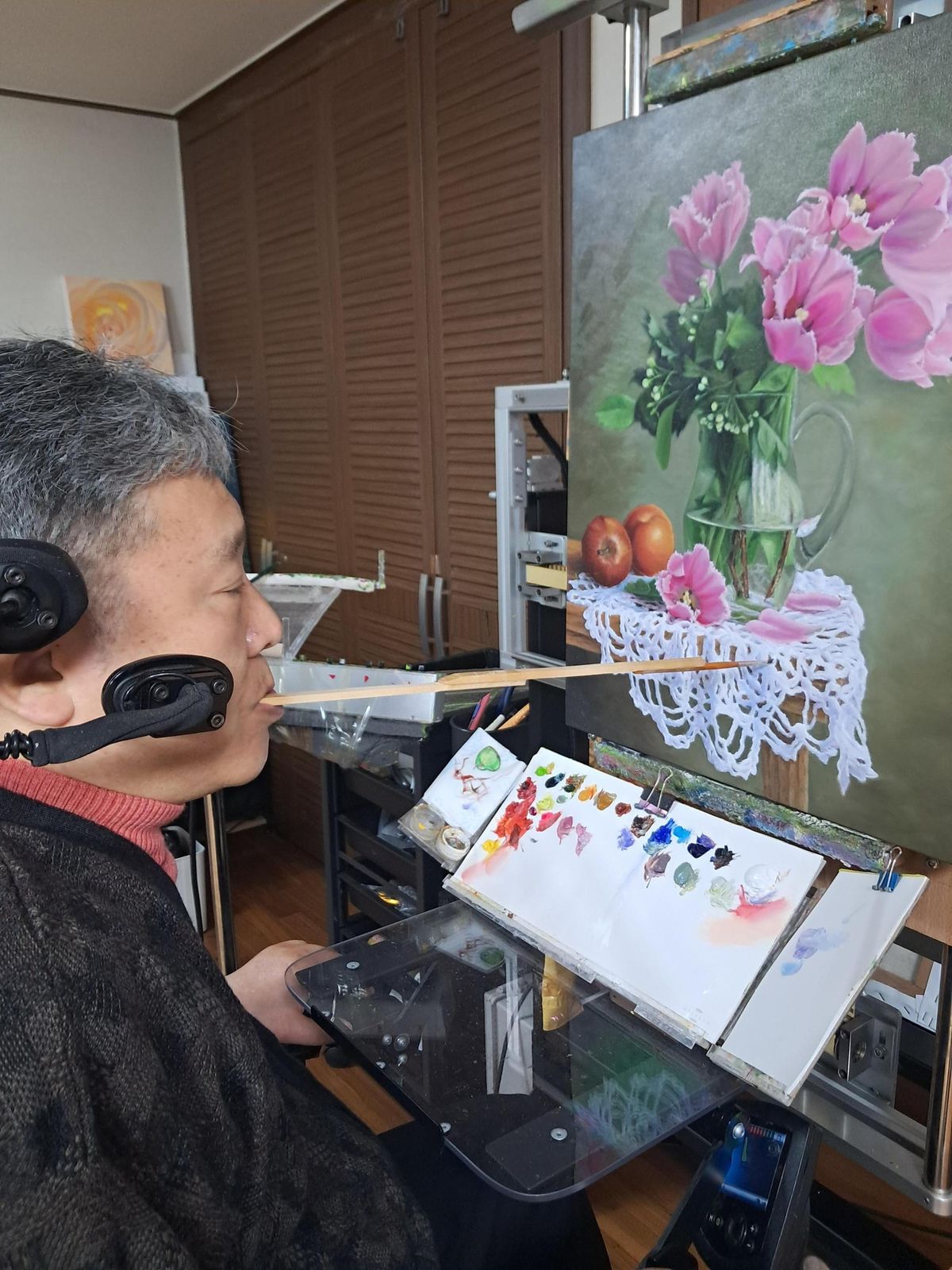
Painter Hwang Jung-eon demonstrates painting with his mouth during an interview at his home in Yongin, Gyeonggi Province, Nov. 27. Korea Times photo by Kim Se-jeong
Painter Hwang Jung-eon didn’t expect art to become his lifeline — until a single moment changed everything. In 1993, a car accident paralyzed him from the neck down, abruptly halting the life he knew. Yet today, Hwang is a recognized oil painter, creating vibrant works with a brush held in his mouth and enjoying a career that has restored his sense of purpose and self-reliance.
He was just 29 when the devastating accident caused a cervical spinal cord injury, leaving him unable to move his limbs. After about a year of treatment and rehabilitation, he learned about mouth painting through his family and friends and decided to give it a try.
Looking back, he thinks he was drawn to it for two reasons.
“One was the idea that it was something I could actually do, and the other was that it would help me train myself to sit in a wheelchair,” the 60-year-old said in his home in Yongin, Gyeonggi Province, Thursday.
When Hwang started, he first practiced holding a paintbrush in his mouth before moving on to drawing lines and circles.
By 1996, he held his first exhibition, which he shared with his painting teacher. “I was amazed at what had happened. I told myself, ‘Something like this is possible.’ My teacher and I cried a lot,” Hwang recalled. He later held two other solo exhibitions.
The most challenging element in mouth painting is learning how to control an elongated brush and press it against the canvas with strength. The length of his brush — now settled at 50 centimeters — was crucial to mastering this skill. Hwang creates it by attaching two clean wooden chopsticks to the end of a standard paintbrush.
“I can move the chopsticks in all directions, even roll them,” he explained.
Problems arise if the brush was too short. “If it’s too short, I can’t reach the corners of the canvas,” he said. “Also, I end up working too close to the canvas and can’t see my work from a distance.”
For a mouth painter, moving the canvas was also a big challenge. In the past, when working on large canvases or reaching corners, his wife had to move the canvas for him. But about 10 years ago, he became able to manage that himself, thanks to a special easel equipped with sensors.
“A professor invented this device for artists with disabilities and gave us one. It’s like magic. It makes my life so much easier,” Hwang said.
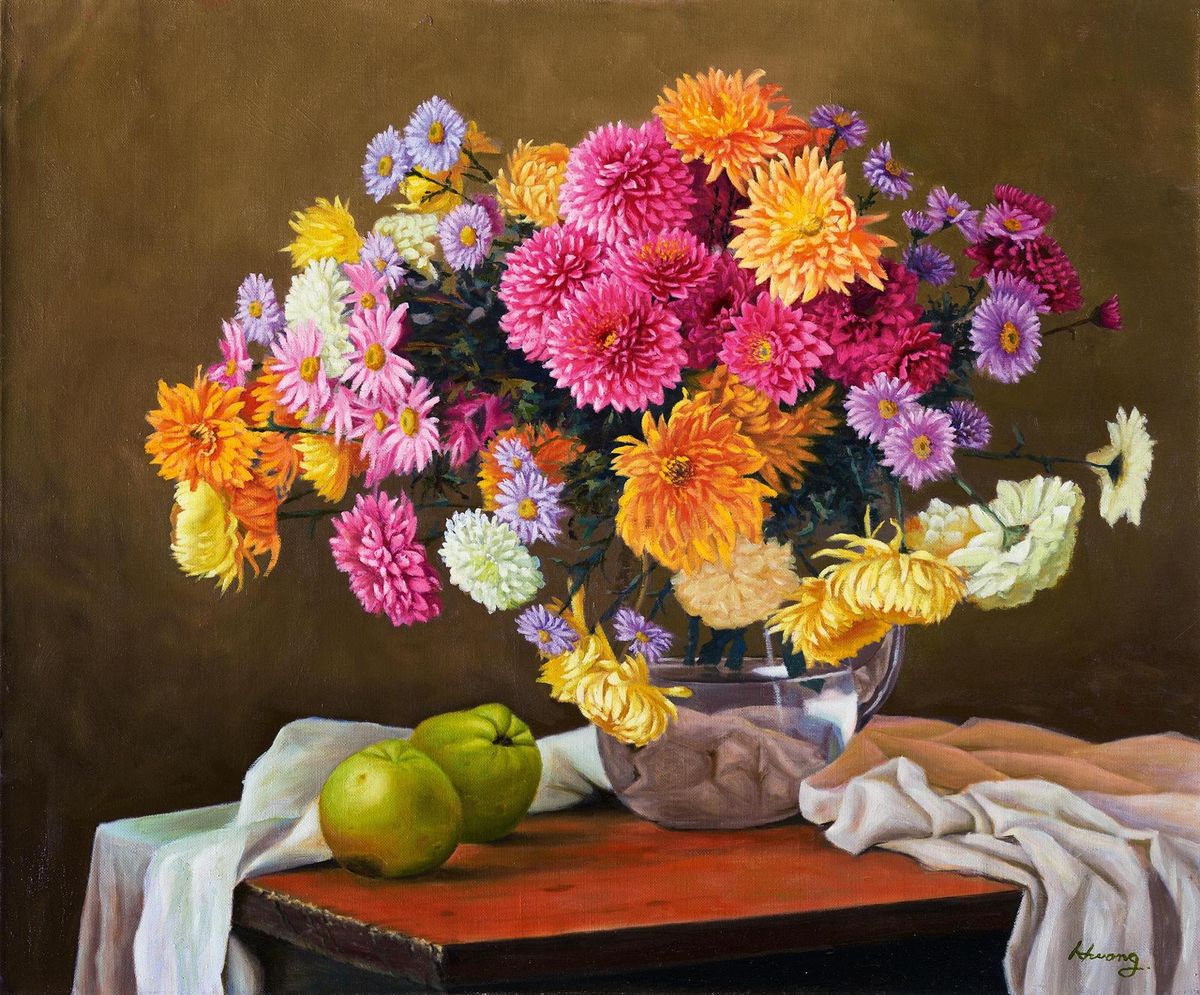
Hwang Jung-eon’s untitled oil painting / Courtesy of Hwang Jung-eon
Passionate about oil painting
Hwang is an oil painter who finds inspiration in nature, with many of his works featuring flowers. Early in his artistic journey, he painted landscapes in watercolor but moved away from the medium after discovering oils.
“Unlike watercolor, oil paint lets you layer colors on the canvas. I was fascinated by that,” he said. For his physical condition, oil painting also offers the control he needs.
Hwang also works extensively with light. “I love working with light. I want to create a strong contrast between bright and dark areas on the canvas.”
On average, he paints three to four hours a day and completes one work each month. Every three months, he sends his latest paintings to the Association of Mouth and Foot Painting Artists of the World (AMFPA), based in Liechtenstein.
A for-profit organization, AMFPA turns submitted artworks into products such as calendars and greeting cards. In return, Hwang is paid for his work.
AMFPA’s Korea branch was founded in 2002, and Hwang is among its longest-serving members, one of 18 artists currently registered here. The association’s financial support system is crucial for him.
“It feels good to earn my own living. It makes me feel great because I feel like a useful member of society,” he said.
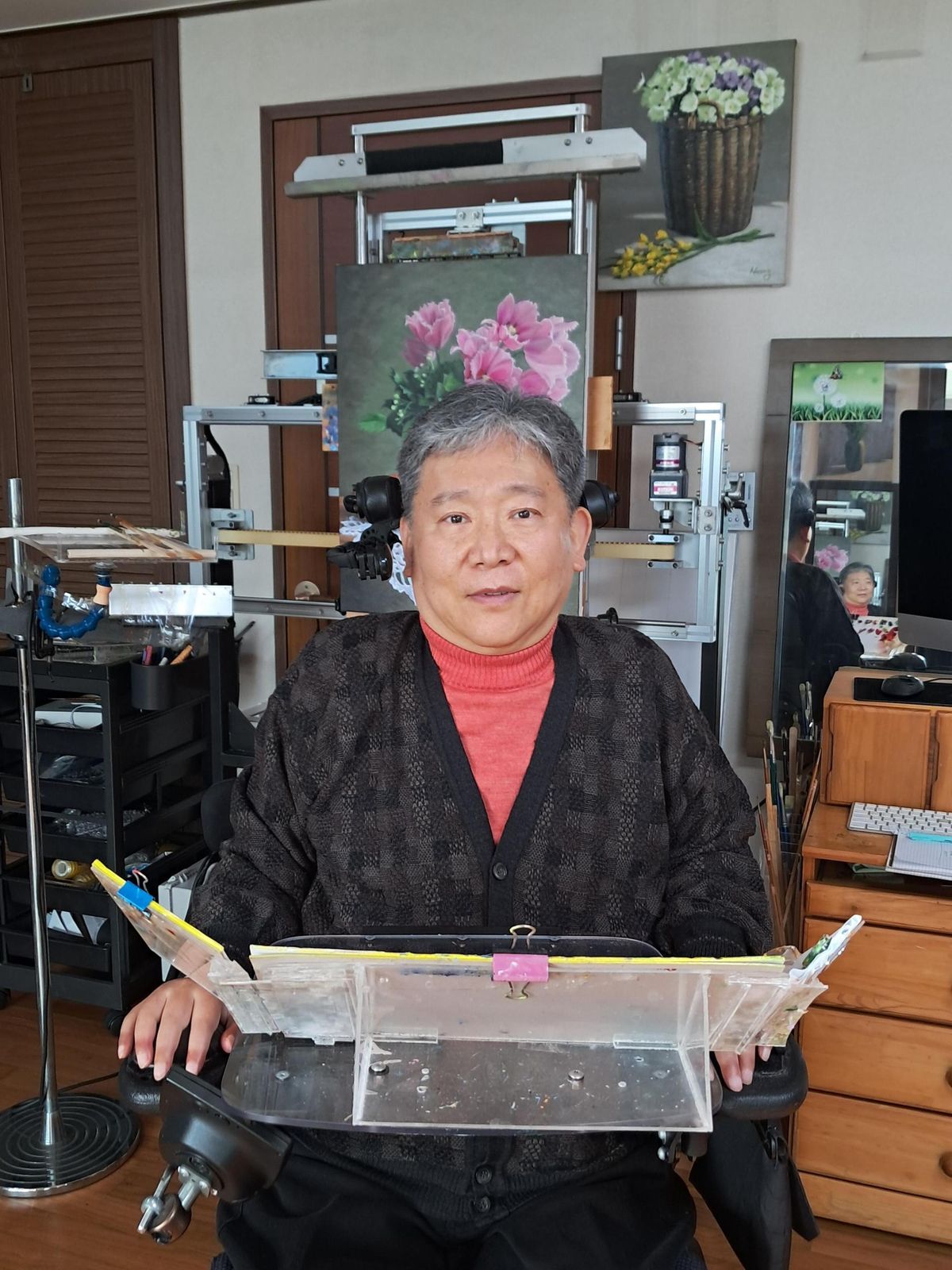
Painter Hwang Jung-eon poses during an interview with The Korea Times at his home in Yongin, Gyeonggi Province, Nov. 27. Korea Times photo by Kim Se-jeong
Painting, Hwang said, has given his life meaning.
“After the accident, that sense of worthlessness was the biggest struggle — the thought that there was nothing left I could do. But once I started painting, everything changed: the atmosphere at home and my mindset when I went outside. It wasn’t just about the financial support. It made me feel I still had something to contribute, that I still had a role somewhere. Realizing that is what allowed me to live again.”
He expressed deep appreciation for his family’s support, especially his older sister, actor Hwang Shin-hye, one of the most popular Korean stars of the 1980s and ’90s.
“When I was in the hospital, she came after work to care for me. She actively searched for information about mouth painting and bought equipment for me. I can’t thank her enough.”
The painter is also grateful for the camaraderie among fellow painters. “We try to support each other. Sometimes, we ask each other what our lives would have been like without painting,” Hwang said.