
Liv Sisson recalls a solo trip to some remote ‘art islands’ in the Seto Inland Sea.
In 2019 I was 24 and return flights from Christchurch to Tokyo via Fiji were $700 return. That sentence alone makes me nostalgic – for a time when travel was cheaper, and for a past self who booked that deal basically on the spot and just a month out.
“OK so, you’re going to Japan. But where in Japan?” my mum queried. “Send me your itinerary.” Pressed for time, I slapped one together – a few days in Tokyo, then onto Osaka, Kyoto. I found random hostels online, copy pasted their addresses into a doc, and sent it to her. I didn’t end up staying in any of those places, or even making it to some of those cities. Instead, I wound up on two remote islands: Naoshima and Teshima. Those islands offered me a dreamlike alternate reality, a spaciousness for thinking unlike anything I’ve found since.
 Me being extremely cool, the Tokyo skyline.
I landed at Narita Airport after dark, trained to Shibuya, got overwhelmed trying to make a transfer, and instead walked 5km to an onsen ryokan (inn/hotel with hot springs) that I’d booked the night before. I crossed the famous crossing while eating a flattened OSM bar from the bottom of my backpack. I would later learn that you do not eat while walking in Japan. I try to not do that to this day. It just causes you to enjoy both activities less and is a choking hazard.
Later, I lay in my little room on the 80th floor, gazed out over the infinite Tokyo skyline and thought “OK, where am I actually gonna go?” Maybe north to Hokkaido for a tramp? I’d read about its lush forests, sea otters, and the massive drift ice sheets that can be seen off the coast. I’d need a car in Hokkaido though. And a translated license. Cancelling that idea, I scouted south on the map. Two islands caught my eye: Naoshima and Teshima. A friend had mentioned them to me. Called them “art islands”.
Several days later, I picked up my Japan Rail Pass and hopped on a shinkansen. After riding the crazy fast train in the wrong direction for several hours, a train conductor sorted me out. Once I was actually headed south, I saw Mt Fuji. Its perfect symmetry, rising up out of the landscape, a snow-capped cone. I thought about Taranaki, a volcano in Aotearoa with similar geology, used as Mt Fuji in The Last Samurai. A friend’s family had a bach there in the mid-2000s when Tom Cruise was in town filming. They named their cat Samurai. Sam for short.
Over the next five hours, I made a series of (correct) transfers. With each one the rail’s gauge and fanciness decreased. At the end of the line, I was deposited with just four others at the seashore. I got a rice ball and a packet of little biscuits shaped like mushrooms from the seaside convenience store, the only thing around/open, and waited for the ferry.
The Seto Inland Sea is not a true inland sea. It’s a section of the Pacific that is partially enclosed by about 2000 barrier islands. On the ferry, I climbed to the top deck. Bits of emerald land dotted the horizon ahead. Below in the inky water, plumes of purple caught my eye – thousands of moon jellyfish, ebbing along with us. Their pearly, bell-shaped bodies stretching forward, then blobbing backwards, over and over.
Excellent Tokyo signage, the mushroom biscuits, the sea.
An hour later we came into port at Naoshima. I poked my head into a guest house called Naoshima Kowloon and asked if they had any bunks free. My roommates were funny. A lanky 18 year old from the UK who said “fair enough” in response to most things. And an aspiring chef from Macau. His sister, a lawyer, had recently been given the family Rolex – an heirloom normally passed down to the men in the family.
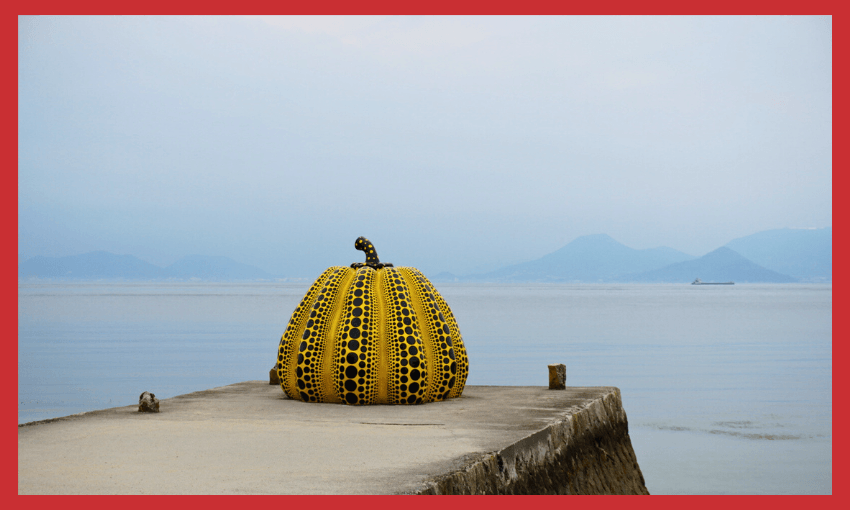
Just steps from the guest house we found a giant pumpkin perched on the pier. It was firetruck red with solid black polka dots – a piece by Yayoi Kusama, one of Japan’s most famous modern artists.
The Seto Inland Sea, the first magical pumpkin.
The next morning I rented a bicycle. There aren’t many cars on Naoshima. I arrived at Chichu Art Museum fully puffed, sweaty and wishing I’d paid more for an eBike. Built in 2004, Chichu is mostly underground. You cannot take photos. I missed this initially and got told off. Camera packed away, I wandered into a James Turrell installation – a square room lined with white marble pews. I sat down and stared deep into a panel of white light overhead.
James Turrell, an artist from LA that I’d only ever read about, plays with light and perception. It wasn’t a panel above me, I realised, but an opening to the actual real-life sky. The sky though was somehow flattened and presented in two dimensions. Later, I stood within another Turrell piece, Open Field. Colourful rectangles of light danced all around me and the other quiet, contemplative, non-photo taking visitors. The walls disappeared and morphed around us, the space seemingly infinite, then bounded, then beckoning us deeper. It was whimsical, disorienting, otherworldly. In the sculpture garden, I scribbled in my journal, watched boats come and go in the distance, seabirds swoop and call.
That pic I wasn’t meant to take.
After a few hours at Chichu, I coasted down from the headland it’s built into and pedalled through the narrow streets of a small fishing village dotted with yakisugi style homes. Yakisugi is a traditional Japanese method of wood preservation. By partially charring the surface of cedar planks, the wood becomes water, fire, fungi and mould resistant. I wandered past the black slatted homes, their market gardens, shrines, and vending machines. I saw onion harvests drying in the sun, and fishing boats returning. On the misty tideline I found green, yellow and pink anemones, slippery seaweed carpets, a broken piece of pottery, and another gigantic pumpkin – this one saffron yellow with black polka dots.
Shoreline finds: seaweed, anemone, broken pottery.
Naoshima has historically been a fishing and farming village. In its lush climate, you can grow rice, lemons, strawberries, citrus and other treasures. Its primeval forests are full of itajii evergreens and sawtooth oak. And of course the sea is everywhere. By the 1980s though, Naoshima had become a copper smelting hub for Mitsubishi Materials. It was heavily polluted, large sections of the island were denuded and young people began moving away. Around that time, son of publishing magnate Tetsuhiko Fukutake purchased a large swathe of the island with a vision to transform it by erecting attractive museums against its serene coastal landscapes. Fukutake tapped architect Tadao Ando, an architect already well known for designing buildings that blend seamlessly into their surroundings. Many people now visit Naoshima and surrounding art islands every three years for the Setouchi Trienniale.
The second magical pumpkin.
After a full day of cycling and happening upon art, I went to an onsen which was also art. Naoshima Bath is an art installation by Shinro Ohtake. It felt like bathing within a scrap book – mosaic tiles, funky light fixtures, colourful toilets, a stuffed elephant keeping a careful eye on me and the other bathers. For dinner, I ate the freshest sashimi of my life and tried some taco rice. I got another packet of mushroom biscuits from the convenience store on my walk back to Naoshima Kowloon. Then I lay in my little bed, wrote in my journal, and decided to stay a few more days in this strange, shimmering seaside dream.
The big dome I spent hours inside, an onion harvest, snacks on the doorstep.
Teshima, a neighbouring art island, offered even more whimsy. I pedalled past reflective rice terraces, farmhouses with royal blue roof tiles. As I hooned around a huge hill, a large white amorphous blob revealed itself – ’Matrix’ by Rei Naito. Inside the blob, water trickles out from the ground, here and there, throughout the day. Light and wind enter through two openings at the top. Visitors are encouraged to sit, lie down and be. It was immensely calming. Even babies were quiet and still. I lay on the blob’s cool concrete floor for close to three hours, watching droplets emerge, bubble, break, intermingle. A single bird swooped through, singing softly. I got the sense she did that often.
Blue roof tiles, shooting hoops.
Back on our bikes, a steep road took us past a dusty school yard. Its basketball hoop had eight nets – ‘No One Wins Multibasket’ by Jasmina Llobet and Luis Fernandez Pons. I, shot some hoops with Zac, my roommate at the guesthouse. The same road took us down to a white sand beach and a gallery tucked into the edge of the coastal forest – Les Archives du Cœur. Inside, we listened to our own heartbeats, the heartbeats of strangers, and I recorded mine onto a CD. I gave this to my partner when I got back to New Zealand. I know he’s never listened to it. But maybe others have, on Teshima. It’s in the permanent archives with thousands, maybe millions of other hearts. Beating as one. On the beach after, I napped in the sand, journaled some more.
I came across that journal recently. In it, I’m curious, wondering what I’m gonna do next, on the trip and in my life. My words and drawings, the scrawl itself, is loose and free, in comparison to the lists, notes and ordinary consciousness of the earlier pages. In the Naoshima and Teshima pages, I’m writing about writing, about how I maybe want to be a writer. In those pages, in that polka-dotted alternate reality, a dream took shape. And here we are.