
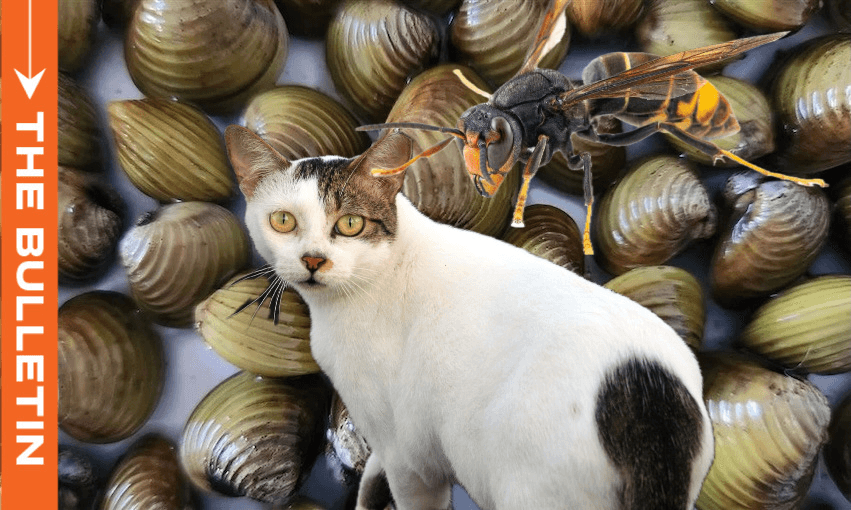
While Auckland battles the hornets, a highly invasive type of clam is poised to devastate waterways further south. Meanwhile the campaign against feral cats is officially gearing up, writes Catherine McGregor in today’s extract from The Bulletin.
To receive The Bulletin in full each weekday, sign up here.
Hornets: new tech for a fast-moving threat
As New Zealand heads into summer, the threat from the invasive Asian yellow-legged hornet is rising, and officials are turning to new tools to keep ahead of it. RNZ’s Victor Waters reports that Biosecurity New Zealand has begun using Dutch tracking devices that can be attached to male hornets and used to follow them back to their nests.
Scientists say the window for eradication is narrowing. In The Conversation, entomologist Phil Lester warns that “what we’ve seen is a potential nightmare”, with the current finds likely only a fraction of what is out there. In Europe, invasion spread rates can get as high as 112km each year once populations become established. “If these European patterns apply even partially to New Zealand, the search radius must expand dramatically” from its current North Shore location, Lester writes.
Once established, the hornet can produce hundreds of queens in a single season and wipe out vast numbers of honey bees, a species that tends to make up the majority of the hornet’s diet. “People are at risk, too,” Lester writes. “Those who approach nests too closely risk severe stings known to cause intense pain, rapid swelling and, in some cases, life-threatening allergic reactions. People have died after being stung by these hornets.” The public is being asked to stay alert and report any suspected sightings, either online or by phoning 0800 809 966
Gold clams: council braces for costly ‘hard calls’
In Taranaki, the discovery of gold clams in Lake Rotomanu has forced regional authorities into emergency planning, writes Helen Harvey in the Taranaki Daily News. A report to councillors warns that the next few weeks will involve “hard calls”, with options ranging from banning motorised boats to draining and drying the entire lake. Because the gold clam is already established elsewhere – originally from east Asia, it was first discovered in New Zealand in Lake Karapiro, in Waikato, in 2023 – MPI is unlikely to provide any funding for the project. Instead, costs will need to be absorbed by existing council budgets.
Scientists say the risks go well beyond Taranaki. As Lincoln University geochemist Adam Hartland explains in The Conversation, the clams are already altering the Waikato River’s chemistry “in ways that could jeopardise drinking water for up to two million people”. As the clam builds its shell, it strips calcium from the water; Hartland’s team has documented a significant drop in calcium levels in the river, which in turn impairs arsenic removal during water treatment. There’s also a risk that the clam population could reduce hydroelectric efficiency in a river that generates upwards of 13% of New Zealand’s power. “Globally, the gold clam has cost billions in damages,” Hartland writes. “New Zealand can’t afford to wait.”
Feral cats: new classification brings new ethical questions
Last month the government added feral cats to the Predator Free 2050 target list, its first expansion since the programme began in 2016. RNZ’s Farah Hancock noted that the move appeared to be “a sudden change of tack” after RNZ pointed out Christopher Luxon had promised during a 2023 election debate to add feral cats to the list but failed to do so. It’s estimated that NZ is home to at least 2.4 million feral cats, apex predators which have been linked to the extinction of several native bird species.
But the shift brings complex ethical questions. In The Conversation (them again), Victoria University’s Courtney Addison notes that while feral cats are legally pests, the line between feral, stray and domestic animals can blur quickly. What’s more, volunteers accustomed to controlling mustelids and possums may now face harder decisions about euthaanising trapped cats. With summer breeding season in full swing, the new categorisation marks an important policy shift – but also a more challenging phase for Predator Free 2050.
Subscribe to +Subscribe