
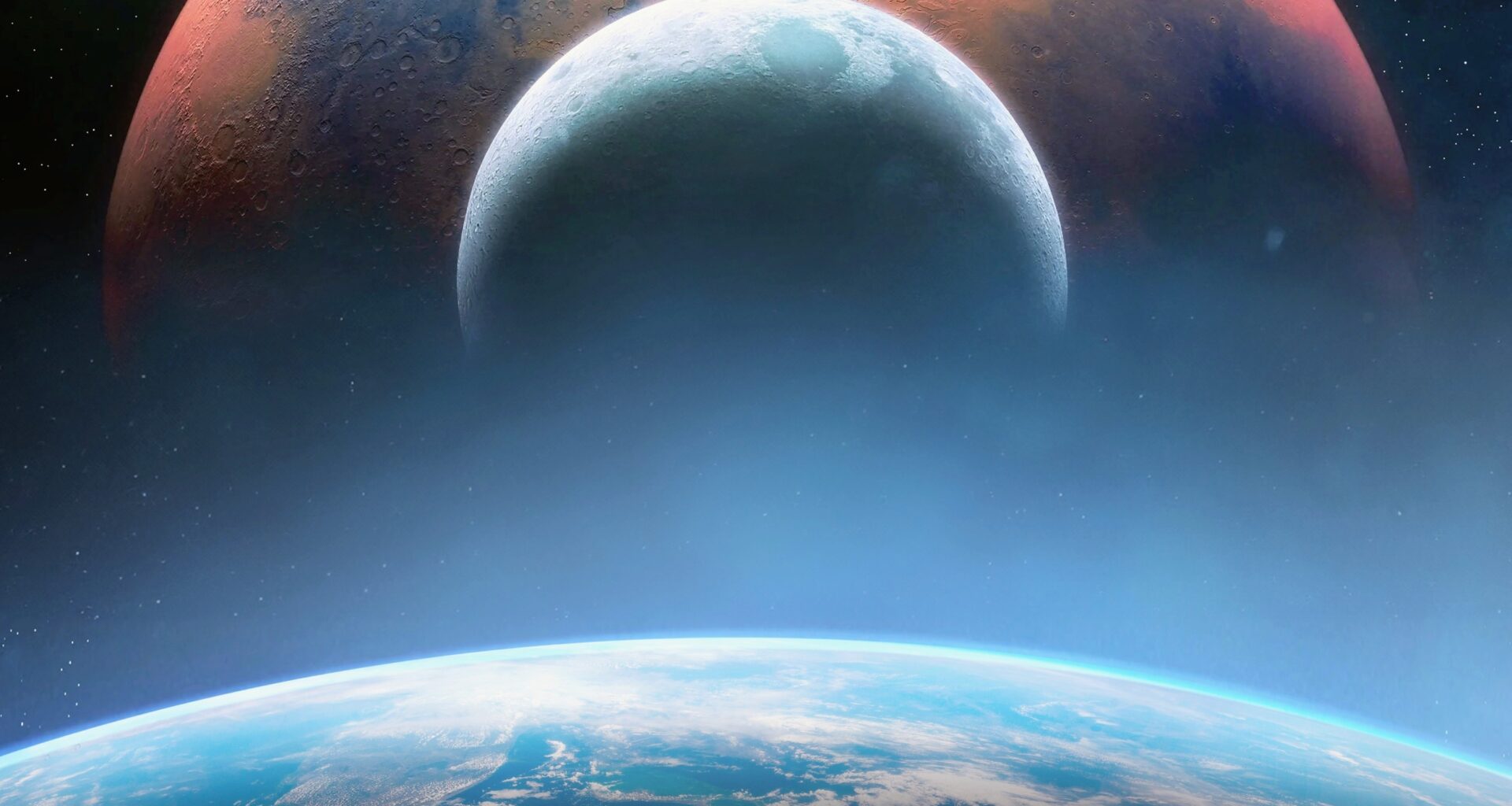
Every movement on Earth depends on steady seconds measured with remarkable precision. Our clocks pulse in harmony with atomic rhythms and satellite signals. Yet that harmony fades beyond Earth’s gravity.
Time bends across space, and clocks shift pace under distant skies. Mars now steps into focus as crews prepare for long voyages. The science of Martian time is becoming increasingly urgent.

Physicists at the National Institute of Standards and Technology present fresh insights.
The experts report that Mars gains hundreds of microseconds each day compared to Earth. That gap widens and narrows with the shape of Mars’ orbit and forces from nearby worlds.
New studies show how gravity fields, tidal effects, and orbital motion create a shifting Martian rhythm. Understanding that rhythm supports future missions and deepens ideas from Einstein’s work on relativity.
Mars clocks gain daily time
Clocks on Mars advance faster by an average of 477 microseconds per day. Variation across a Martian year reaches about 226 microseconds.
Subtle modulation adds another layer with swings of roughly 40 microseconds across seven synodic cycles.
Those cycles arise because Martian and terrestrial orbits do not repeat in simple patterns. Planetary distance shifts, solar gravity, and orbital eccentricity push Martian time into continual change.
Study lead author Bijunath Patla described the moment with optimism. “The time is just right for the Moon and Mars,” he said. “This is the closest we have been to realizing the science fiction vision of expanding across the solar system.”
Gravity’s effect on clocks
General relativity shows how clocks respond to gravity and motion. Strong gravity slows each second, while weak gravity allows faster progress. Mars sits farther from the Sun than Earth.
Solar gravity weakens with distance, so Martian clocks gain speed. Surface gravity on Mars is also about one-fifth of Earth’s value, further lifting Martian clock rates.
Orbital eccentricity shapes time as well. Mars travels in a stretched oval, unlike Earth’s nearly circular path. Clocks shift as Mars swings closer or farther from the Sun.
Formal calculations include gravitational potential, rotational motion, and tiny corrections from planetary interactions.
The theory relies on Mars’ areoid, which approximates a hydrostatic surface where an ideal clock keeps a steady rate.
A constant called LM describes that rate and parallels a constant used for Earth known as LG.
LM gives a foundation for defining Martian coordinate time and comparing it with terrestrial time scales.
The Sun’s pull changes time
A deeper challenge arises from the Sun’s influence on the Earth–Moon system. Solar gravity pulls unevenly on Earth and Moon due to the gap between both bodies. That difference sets up tidal forces.
Those forces alter Earth-Moon motion and shift position and velocity in subtle patterns. Such changes must enter timing models because clock comparisons depend on precise motion tracking.
Models updated with solar tides reduce errors in Earth-Moon timing by almost two orders of magnitude.
Solar tides also shape Earth-Mars comparisons. Corrected models show errors near 100 nanoseconds per day over long periods.
That accuracy grows essential as missions expand. Accurate timing aids navigation, communication, and science tracking across millions of miles.
Standardizing time for Mars
Timing shapes every form of communication. Even small drifts can cripple networks. Distance between Earth and Mars already creates long delays. Patla drew an analogy with early sea crossings.
Messages moved with ships and carried slow replies. Precise coordination for space crews demands a shared timing standard.
“If you get synchronization, it will be almost like real-time communication without any loss of information,” Patla said.
A stable Martian time standard would also guide interplanetary networks. Such networks could one day link orbiters, landers, habitats, and Earth with near-seamless exchange.
Preparing for future timing
Mars presents a proving ground for new time systems. Crewed missions require navigation that depends on accurate clocks. Astronomers refine theory as well.
Einstein’s ideas about proper time gain new tests under shifting gravity, eccentric motion, and multibody interactions.
Study co-author Neil Ashby noted this long view. “It may be decades before the surface of Mars is covered by the tracks of wandering rovers,” he said.
Work now prepares for that future. Each step adds clarity to interplanetary timing. Patla captured the scientific value. “It’s good to know for the first time what is happening on Mars time-wise,” he said.
New calculations reveal how time flows on another world. That knowledge shapes plans for human travel and deepens understanding of relativity.
Mars now offers a laboratory for studying time across space. Future explorers will live by seconds shaped by gravity far from home. Our clocks will guide the path.
The study is published in The Astronomical Journal.
—–
Like what you read? Subscribe to our newsletter for engaging articles, exclusive content, and the latest updates.
Check us out on EarthSnap, a free app brought to you by Eric Ralls and Earth.com.
—–