
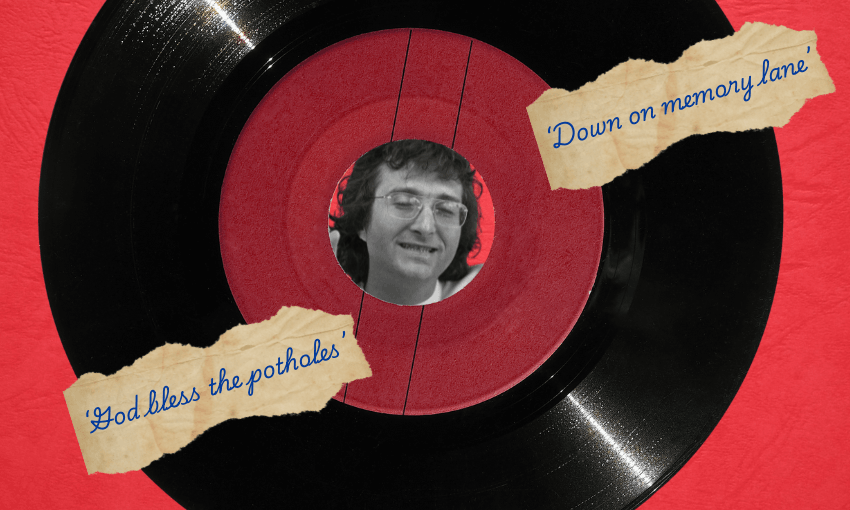
Novelist and musician Damien Wilkins looks closely at the layered life and lyrics of Randy Newman.
This essay is adapted from a talk given at the WORD Festival in Ōtautahi, Christchurch, for a panel called ‘This Band Could Be Your Life’.
Randy Newman mostly exists in the wider public’s mind, if at all, as the guy who wrote that song ‘Short People’, you know the one about how short people got no reason to live and how they wear platform shoes on their nasty little feet. That isn’t the song I’ve chosen to read closely today but I do think it’s worth pausing on it.
First of all, though, let’s say some basic things. Randy Newman was born in 1943, so he’s over 80 now. He was born into a musical family of a very special sort. His three uncles were all composers of film scores in Hollywood’s Golden Age. The most famous of them, Alfred Newman, won several Academy Awards and the uncles were powerful figures in Randy’s childhood, and from a very early age Randy was known as an intensely gifted musician. Now Randy’s father was the only brother who wasn’t a professional musician. He was dissuaded from it by his father and became a doctor, a successful Beverly Hills physician who treated, among others, Pat Boone, but he wanted to be a musician. We need to remember that fact when we come to the song I’ve chosen, which is about that father.
Now because of this orchestral/classical music background and because he composes and sings with the piano in a style influenced mainly by Black musicians such as his beloved Ray Charles and Fats Domino – he spent some of his early years in New Orleans – it’s hard to put Randy Newman comfortably inside rock music. Indeed when he started recording his own material, Newman said he wanted to write popular music as if the Rolling Stones had never happened.
And it’s also hard to put him inside the standard literary singer-songwriter genre with people like Bob Dylan or Neil Young or Leonard Cohen, who basically strummed a guitar. There’s an interview in which Newman talks about his great song ‘Suzanne’, which is about a creep who reads a woman’s name and number in a phone booth and sings to her, imagining she could love him, and Newman admits that it was a kind of answer or reply song to Leonard Cohen’s classic song of the same name. He found that Cohen’s famous line “For you’ve touched her perfect body with your mind” to be a bit meh. He joked that his song lived on a lower moral plane. And I’ve always liked Newman’s wish to re-route the source of emotion in songs, away from the self-conscious “poetry” of confessional writing, to bring things down a peg or two to where most of us live. His songs might be full of these dexterous piano bits but lyrically they live in a plainspokenness. There’s nothing on the surface that is hard to follow in the language. A typical Randy Newman love song early on will have a line like “I’m drunk right now, baby, but I’ve got to be/Or I never could tell you what you mean to me”.
 Randy Newman (Photo: W. Punt for Anefo, via WikiCommons)
Generally, Newman doesn’t write confessional autobiographical songs. He writes from someone’s point of view, someone who is not Randy Newman. And, as his admiring critics have said, he writes as not about. If his subject is, say, racism, the lyrics are not about racism; they live inside the speaking voice or the singing voice and sometimes that person is the racist or the alcoholic or the spurned lover or the creep and more often than not, there’s a moment when the white audience, when we (if we’re white), we who might feel safe in condemning this person in the song, we who feel superior in our moral universe, we who feel different and distant from the singing voice, the character – because Newman above all creates characters, just like in short stories or novels – when we feel suddenly kind of squeamish, kind of implicated, not so pure or safe after all.
Now back to ‘Short People’. If you are a long-time Randy Newman listener, you will probably want to defend your man, to prove to other people that the song isn’t meant to be taken literally, that it’s about prejudice rather than celebrating bigotry. Yes, but there’s something else going on. Surely you have to contend not only with the song’s relish of those mean details: “They got grubby little fingers/And dirty little minds/They’re gonna get you every time” and the great singalong jauntiness of the thing. And then you also won’t get much support from the songwriter himself who thought the song wasn’t about anything and the narrator of the song, whose voice announces this gleeful hostility, was simply deranged, in Newman’s words “a loon” and he said he didn’t think there was any great animus against short people, that it didn’t exist in the world.
The song – Newman’s biggest hit outside the songs he wrote much later for Disney kids movies – became a sour thing for him. There were protests against the song on behalf of short people. He said he lost his sense of humour about it and called the windfall the hit record gave him, “dirty money”.
How did it fall in my own life? Well, my best friend and I – and we were about 12 years old when it came out – we used to taunt his younger brother, who was indeed a very short person, by singing the song aggressively into his face and usually the brothers ended up punching each other, therefore proving that Randy Newman was wrong, and that the prejudice against short people was there all along and ready to explode in the boys bedrooms of Lower Hutt.
But how to think about such a song? The standard explanation that Randy Newman is doing a character kind of works but it feels like it leaves something out of the picture; it sort of sanitises it, removes the danger, the riskiness of it; how to cope with the glee in it, which is in excess of any irony? This quality the song carries of having too much gusto, too much loving detail, just too much. I was giving a workshop recently and someone asked me what was the difference between fiction and non-fiction in writing. And I said with fiction there’s always something left over.
I can’t do the biography here. (See Robert Hilburn’s solid recent book for the life.) It’s useful to know that as a middle class kid growing up in Los Angeles, Randy Newman suffered from a condition which meant he went through a series of unsuccessful eye operations – these were really traumatic and he was bullied. His own adult children believe it marked him as someone who was always fighting for the underdog. (What a relief to find out from the biography that Newman was/is a good father.)
Now somewhat perversely, which I feel is in the spirit of Randy Newman, I’ve chosen a song from later in Newman’s career which has less to do with the irony and the double-take of an unreliable narrator. There’s a bully in this song too, though he emerges late in the piece. A song which indeed Newman has described as “The most honest song I’ve ever written”. But I do think it has this quality of left-overness which I’ve been talking about. So let’s listen to ‘Potholes’, which comes from his wonderful 2008 album Harps & Angels, and read along with the lyrics:
I love women
Have all my life
Love my dear mother
I love my wife
God bless her
Even love my teenaged daughter
There’s no accounting for it
Apparently I don’t care how I’m treated
My love’s unconditional or something
Been hurt a time or two
I ain’t gonna lie
I’ve had my doubts sometimes
About ethics of the so called fairer sex
Fair about what?
Then I find time goes by
And one forgives as one forgets
And one does forgot
God bless the potholes
Down on memory lane
God bless the potholes
Down on memory lane
Everything that happens to me now
Is consigned to oblivion by my brain
I remember my father
My brother of course
Remember my mother
Spoke of her earlier
And I remember that
Remember the smell of cut grass
Going off to play to ball in the morning
Funny story about that
Now I used to pitch
I could get the ball over the plate
Anyway this one time
Must have thrown a football round or something the day before
I walked about fourteen kids in a row
Cried, walked off the mound
Handed the ball to the third baseman
And just left the field
Anyway many years later
I brought the woman who was to become my second wife
God bless her
To meet my father for the first time
They exchanged pleasantries
I left the room for a moment
This is first time he met her, you understand
When I came back
He’s telling her the story
Right off the bat
About how I walked fourteen kids
Cried and left the mound
Next time he met her
He told the same goddamn story
God bless the potholes
Down on memory lane
God bless the potholes
Down on memory lane
Hope some real big ones open up
Take some of the memories that do remain
A song which starts out as if it’s going to be one of those embarrassing “men with a complaint about women” things. The little barb about the teenage daughter and the “fairer sex” – “fairer about what?” Some buried hurt – is that the thing which will sour proceedings? And then the singer deploys this cliché – “Forgive and forget” – which makes him stumble on the something which might be closer to the actual subject – “One does forget”. Next the chorus, that “memory lane” might have potholes for which we might be thankful. It’s getting more interesting now – potholes usually aren’t good. Then the confession – “Everything that happens to me now is consigned to oblivion by my brain”. The pothole is internal, the singer is old, losing his memory – fine, it’s good to forget, forget pain. So he lists the things he retains, “the smell of cut grass”, going off to play ball. That’s pleasant, right? At first he calls it a “funny story”. A funny story in Randy Neman’s world is more often than not the early signal of trouble, some pain about to be revealed.
Now it unfolds, communicated in that talky singing Newman discovered decades before. It’s the return of a childhood humiliation which his father (remember Randy’s doctor father with his ruined musical dreams) then recalls and amplifies when he meets the singer’s fiancée. Women, it turns out, aren’t the problem. The bully has arrived. And what I find very moving is that the song has the quality of spontaneous expression as if it’s being made up on the spot and it’s not rehearsed, it’s remembered.
The man in the song finds himself telling the thing he wished to forget at the time when he was a kid, then again as an adult and now as an old person. He’s had three attempts to leave it in the past but here we are again. Thrice — as in some awful fairytale.
This beautiful tripling of narrative gets us into a kind of zone of surplus. The land of too-muchness. In place of what is known and controllable, there’s overflow. The singer might have started the song in the relaxed and amused contemplation of family life. But he ends it stuck once more in his father’s grip. This quality of helpless testimony and self-surprise – the very closeness of its attachment to a specific time and place (the baseball ground, the cut grass, the father’s house) – is what strangely lifts the song away from the singer and gives it to us, listening in a different time and place but also, for these moments the song lasts, staring into our own humiliations, our own blessed potholes.
Trees of Lower Hutt by The Close Readers (featuring musicians Damien Wilkins, Olivia Campion, Tom Callwood, Luke Buda, David Long and Felix Bornholdt) will be released on Friday 5 December. To enter the draw to win a copy of the vinyl record, email clairemabey@thespinoff.co.nz with your favourite album of the year. Winner will be drawn on Monday, December 8.