
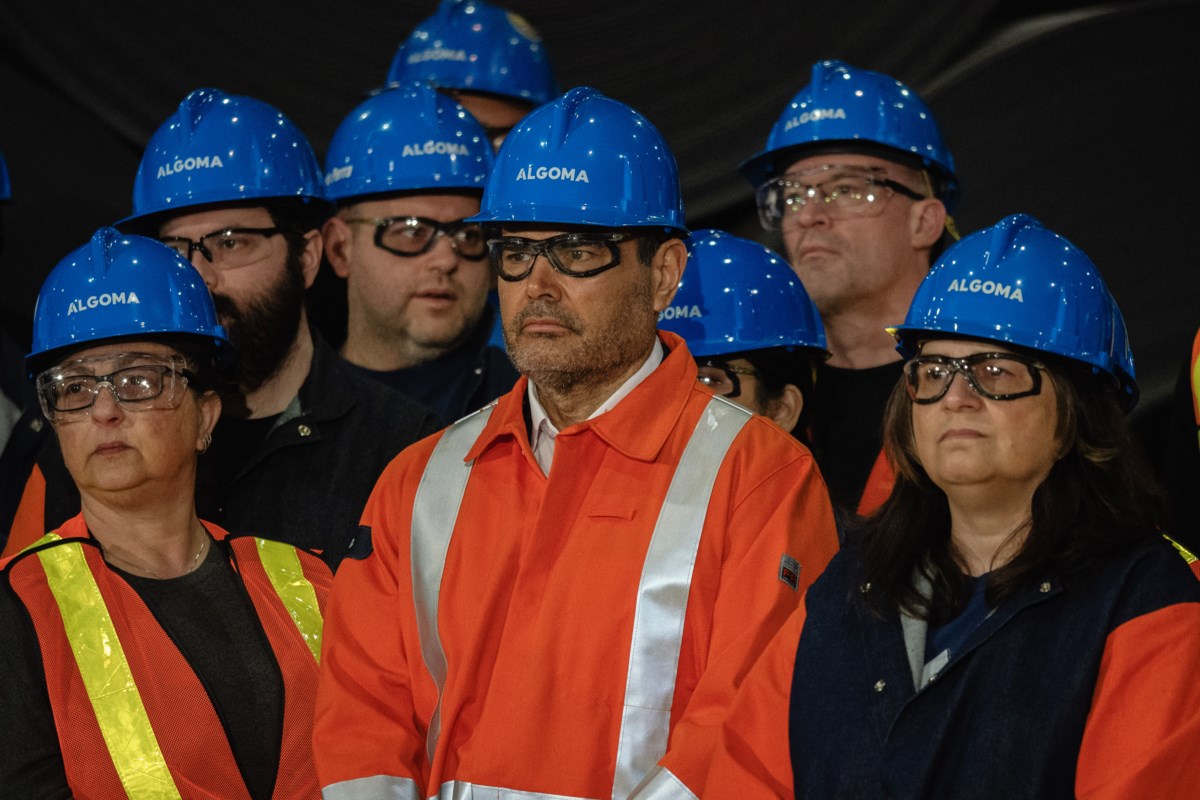
To be clear, Algoma Steel started prepping for a wave of layoffs long before Donald Trump unleashed his punishing tariffs. The trade war just kicked the plan into warp speed — and wiped out a few hundred more jobs than initially anticipated.
That context is important, especially as politicians continue to trade jabs (and more jabs) over who deserves blame for this week’s devastating news.
Who knew the plant was on the verge of slashing its workforce? Everybody did. Algoma Steel made no secret of the fact that its $900-million transition from blast furnace to electric arc production would gradually eliminate close to 1,000 jobs.
Then along came President Trump and his 50 per cent tariffs — and gradually became immediately. (And 1,000 expected job losses became 1,300.)
Simply put, Algoma Steel insists it had no other choice but to accelerate its move to electric arc furnaces (EAF). That means shutting down the blast furnace and coke-making operations in early 2026, “one year earlier than we had anticipated or planned.”
Ironically enough, Trump’s tariffs may prove to be the most resounding validation of Algoma’s embrace of green steelmaking. Had the company not committed to that massive change back in 2021, every last person at the plant might have received pink slips this week.
To use the words of CEO Michael Garcia: “Make no mistake, Algoma Steel would have experienced an even darker day – months ago, most likely its last.”
Twice over the past year, Garcia sat down for an in-depth interview with Village Media’s podcast (now called Closer Look). You can find those conversations HERE and HERE, as well as select snippets in the video clip above.
In the first interview, recorded in early March, Trump had just introduced a 25 per cent tariff on Canadian steel imports. Garcia talked about how the company was navigating the change, but also about the ongoing shift to electric arc production — and the job losses that would inevitably follow.
“That’s one of the most sobering parts of this transformation,” Garcia told the podcast. “An electric arc furnace requires much less staffing than a blast furnace and a coke oven…It’s going to be a big change in the employment of our company. We’ve tried to be open with our employees from the very beginning, helping them understand what this means, what the journey looks like, some idea of the timeframe that these moves will be made in.”
When he said those words, Algoma Steel employed around 2,750 people. Garcia said that number would be trimmed by a “little more than 1,000” over the next few years as the furnaces came online, lowering the total workforce to approximately 1,700.
But by July, when Garcia spoke to the podcast again, the landscape had drastically changed. Trump had introduced a 50 per cent tariff the previous month, a move that essentially blocked Algoma from accessing more than half of its traditional customer base.
“That has been very challenging for us,” Garcia said. “We’ve had to lay off around 200 of our employees, around 10 per cent of our professional and technical staff.”
Asked if the company might not survive, Garcia was honest. He said it all depends on how long Trump’s tariff stays in place.
“If it’s a 50 per cent tariff, I don’t know,” he told the podcast. “We’re going to try our best to continue to be here. It would take some extreme measures, but we won’t know exactly what that will take until we know the tariff.”
As we now know, that 50 per cent tariff is still on the books.
All told, layoff notices were issued to 1,050 employees on Monday. Add the approximately 200 layoffs Garcia told us about in July — as well as a handful of others who were trimmed before the end of October — and Algoma Steel is losing close to 1,300 positions.
What Garcia told our podcast in July still applies today, five months later.
“Everybody’s nervous, everybody is uncertain about what the future is going to bring,” he said. “But we’re focusing on what we can control, and I think that’s the number one thing we’re trying to do: focus on what we can control.”