
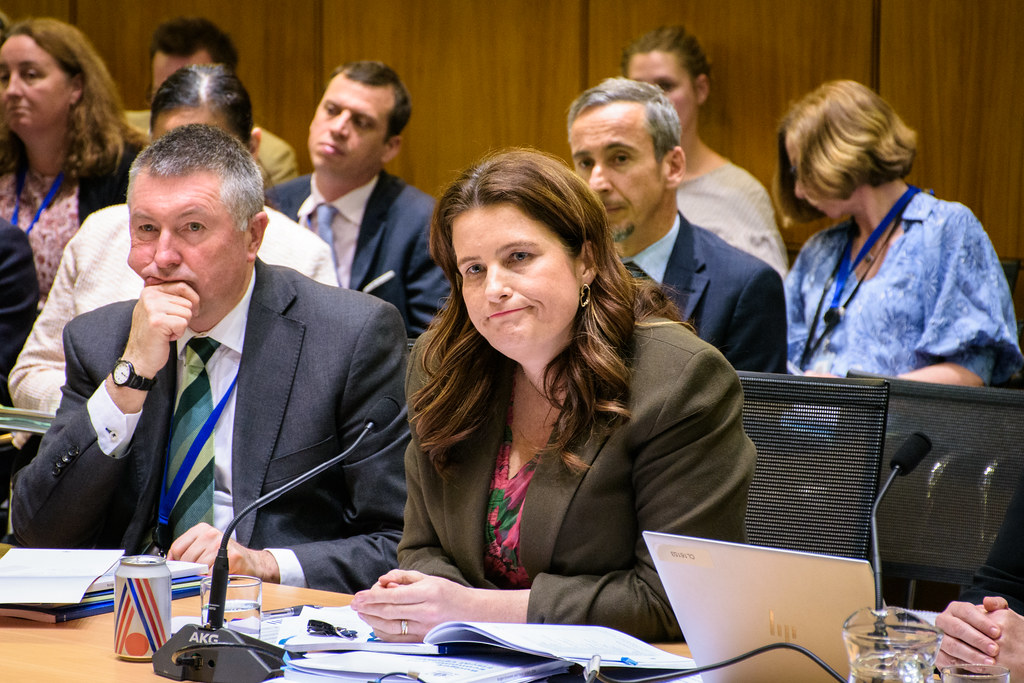
Analysis: Finance Minister Nicola Willis effectively confirmed Tuesday that New Zealand will not meet its 2030 climate target under the Paris Agreement under the current Government’s policies.
In comments to the Finance and Expenditure Committee and to reporters afterwards, Willis ruled out paying other countries to reduce emissions to help achieve the target, going a step further than other ministers have gone in the past. Instead, she said, the Government planned to meet the target solely through reducing climate pollution at home – or not meet it at all.
However, the coalition has systematically dismantled almost all significant climate policies left to it by the previous Labour government. A Newsroom analysis shows extremely steep emissions reductions would be needed to meet the target at home – exceeding the one-off Covid-19 emissions dip not just next year, but for every year thereafter to 2030. There are no signs the Government is planning policy that would achieve this outcome.
New Zealand’s commitments under the Paris Agreement for the 2021 to 2030 period have always assumed some reliance on so-called offshore mitigation – paying other countries to reduce emissions that we count on our ledger, in the form of aid payments, buying carbon credits or some other financial mechanism.
When the nationally determined contribution, or Paris target, was first set in 2015 under John Key’s National government, Cabinet documents indicated an intention to purchase more than 200 million carbon credits, costing New Zealand up to $14 billion.
By 2021, domestic action had narrowed the gap between the target and emissions projections, such that only 50 million credits would be needed (though higher carbon prices meant the bill could run close to $7 billion). At that time, the Labour government strengthened the target to bring it in line with international partners, raising the gap back up to around 100 million credits – though with an intention to reduce the gap through more climate policy.
When Labour left office, the gap had fallen to 71.5 million tonnes. However, actions under the coalition Government have pushed projections of future climate pollution upwards, widening the gap to 84 million tonnes in the latest projections.
Over that period, the time to implement policies at home to reduce emissions has also narrowed, since the target must be achieved by 2030. With nearly five years of emissions already locked in, significantly steeper cuts would be needed to meet the same goal domestically.
Despite this challenging picture, ministers have repeatedly raised doubts about the Government’s commitment to meet the target with the help of offshore mitigation. Last year, Agriculture and Trade Minister Todd McClay said New Zealand didn’t “have to go and buy credits overseas to meet our obligations and we’re working very hard to make sure we don’t”.
Climate Change Minister Simon Watts walked those comments back somewhat, saying, “all options are being considered”. He accompanied Prime Minister Christopher Luxon on a trade mission to South East Asia last year, where memorandums of understanding were signed with Singapore, Thailand and the Philippines to pave the way for possible purchases of credits.
In an interview with Newsroom in November, Watts reiterated that offshore mitigation was still on the table.
“For me as a minister, I have to create as many options as possible to ensure that we credibly can meet our targets. That’s what I’m doing. When do you pull the trigger on those is a timing conversation and a judgment, and right here, right now, we’re focusing on getting the domestic stuff done and dusted and get that banked,” he said.
Willis’ comments on Tuesday appeared to contradict him, as she ruled out offshore purchasing. Her office declined to comment when Newsroom asked for confirmation that this was her intention.
Asked directly whether, if domestic action didn’t meet the Paris target, the Government would buy credits from overseas, she responded: “Look, the Prime Minister, me, the climate change minister, have said again and again that we do not think it’s in New Zealanders’ best interest to send checks for billions of dollars offshore. New Zealanders who are struggling to put food on the table are not going to thank us for having a performative awards ceremony after we write billion-dollar cheques to other countries to meet a Paris target that James Shaw set. No, that’s not our priority.”
Putting aside that the Government is not on track to achieve John Key’s Paris target without offshore purchasing either, this effectively signals New Zealand will not meet its Paris target at all. The necessary cuts cannot be achieved domestically without widespread economic transformation that would be far more disruptive and costly to the country than offshore purchasing.
Meeting the target at home, under Newsroom’s analysis, would require carbon dioxide emissions reaching net zero by the end of the decade and methane from livestock and waste falling by 30 percent. This would be more ambitious than virtually any climate plan proposed anywhere in the world and is not at all reflected in the Government’s stated climate policies.
Emissions would need to fall 12 percent every year through to 2030. That’s more than double the one-off decline from 2019 to 2020 and roughly equivalent to the single-year fall during the GFC. In other words, the Government’s climate policies would need to produce the emissions declines of five GFCs.
The effects would be significant for the economy – likely resulting in the rapid ‘degrowth’ a small number of left-wing climate activists have long called for and conflicting with Willis’ intended agenda of economic growth.
There is no viable path to meeting the Paris target domestically that this Government would undertake.
Watts, in a statement to Newsroom, did not dispute that the Government has now ruled out offshore mitigation. He said the Government was focused on domestic emissions reductions and was making “meaningful progress”, citing the build-out in renewable electricity and not-yet-commercialised agtech.
“2030 is 48 months away, and I am optimistic about how we are tracking. Economic growth and climate action are two sides of the same coin, and we continue to prioritise action that delivers both.”
Green Party co-leader and climate spokesperson Chlöe Swarbrick told Newsroom the country was yet again left with “irreconcilable statements and irreconcilable facts”.
“Minister Willis said at the committee they were committed to meeting that nationally determined contribution. The Prime Minister has said similarly when I have asked him in the chamber and so has Simon Watts in many hearings.
“It is an immutable fact; if the Government is committing us to meeting our nationally determined contribution, that we are going to have to act domestically and/or internationally. For the minister to then say we’re just not going to send billions of dollars offshore, this comes back to the fundamental point which is, well, then show us the money. Be transparent about how you intend to meet that nationally determined contribution.”
Swarbrick said the Government “has knowingly and explicitly signed us up to breach the Paris Agreement, whilst also telling everybody that they’re committed to it – including the entire international community, just a week or two ago [at the COP30 climate summit]. I don’t know what else to call that, other than lies.”
Christina Hood, an independent climate policy expert and former head of climate at the International Energy Agency, also said the Government was breaching the Paris Agreement.
“Our obligation is to align policies and actions to have a realistic prospect of meeting the target throughout the implementation period. It’s not something that only kicks in after 2030.”