
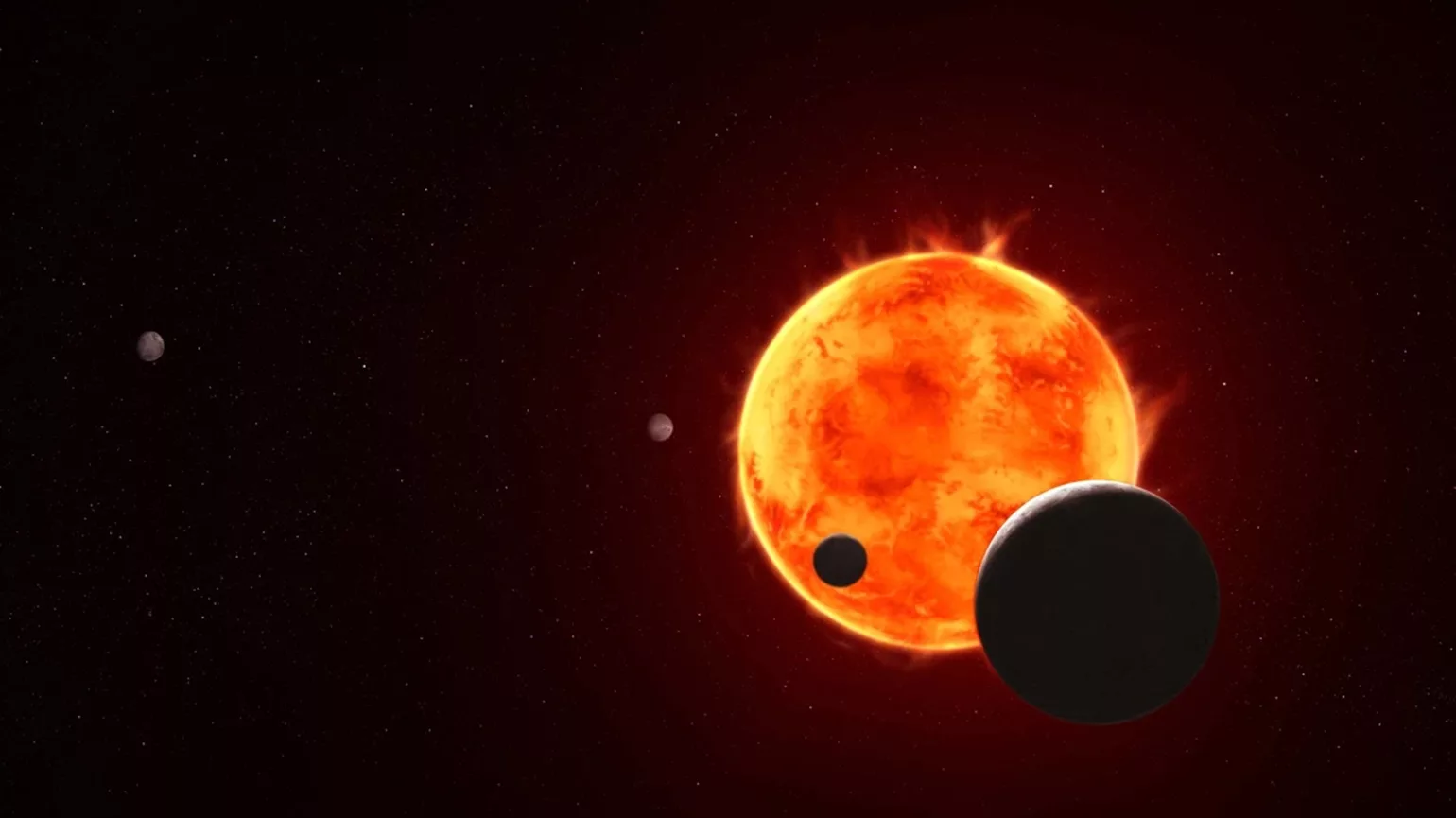
The James Webb Space Telescope (JWST) has begun a new phase in the search for life beyond Earth. It has turned its golden mirrors toward the compact TRAPPIST-1 system.
JWST has started to study small exoplanets that orbit M dwarf stars using spectroscopy. However, the findings from the telescope are complicated. Spectral features may originate from the planets, their host stars, or even the instruments that detect them. To navigate this complex situation, astronomers rely on Bayesian reasoning. In this approach, the least likely explanations must provide the strongest evidence.
Two recent papers in the Astrophysical Journal Letters detail the first wave of JWST observations of TRAPPIST-1, a star system just 39 light-years away. With seven tightly packed worlds orbiting an ultracool red dwarf, the system resembles a miniature solar system, so compact that all its planets could fit within Mercury’s orbit. Here, “years” last mere Earth days, and the possibility of habitability hangs tantalizingly close.
The spotlight falls on TRAPPIST-1e, a rocky world often hailed as one of the most Earth-like exoplanets discovered. Researchers pointed JWST’s powerful Near-Infrared Spectrograph at the planet as it crossed in front of its star four times. If the planet has an atmosphere, some of the starlight should filter through it, leaving chemical fingerprints behind. The readings suggested a faint trace of methane, a gas often tied to life on Earth. But the signal is still too weak to be certain.
“The basic thesis for TRAPPIST-1e is this: If it has an atmosphere, it’s habitable,” said Ranjan, assistant professor at LPL. “But right now, the first-order question must be, ‘Does an atmosphere even exist?’”
The caution stems from TRAPPIST-1 itself. Unlike our bright yellow sun, it is an ultracool red dwarf, small, dim, and peculiar enough to mimic atmospheric signals.
“While the sun is a bright, yellow dwarf star, TRAPPIST-1 is an ultracool red dwarf, meaning it is significantly smaller, cooler, and dimmer than our sun,” Ranjan explained. “Cool enough, in fact, to allow for gas molecules in its atmosphere. We reported hints of methane, but the question is, ‘is the methane attributable to molecules in the atmosphere of the planet or in the host star?’”
Simulations presented scenarios in which TRAPPIST-1e might resemble Titan, Saturn’s methane-rich moon. Yet even that possibility proved unlikely.
“Based on our most recent work, we suggest that the previously reported tentative hint of an atmosphere is more likely to be ‘noise’ from the host star,” Ranjan said.
“However, this does not mean that TRAPPIST-1e does not have an atmosphere – we just need more data.”
The challenge is partly historical. JWST was conceived long before Earth-sized exoplanets were even known.
“It was designed long before we knew such worlds existed, and we are fortunate that it can study them at all,” Ranjan noted. “There’s only a handful of Earth-sized planets in existence for which it could potentially ever measure any kind of detailed atmosphere composition.”
The search for clarity may soon gain reinforcements. NASA’s Pandora mission, slated for launch in 2026, will specialize in disentangling planetary atmospheres from stellar interference. Led by Daniel Apai of the University of Arizona’s Steward Observatory, Pandora will monitor stars before, during, and after planetary transits, thereby sharpening the contrast between the star and the planet.
Meanwhile, JWST continues its patient vigil. A new technique, “dual transit,” is being tested, observing TRAPPIST-1e alongside TRAPPIST-1b, the innermost and airless planet.
“These observations will allow us to separate what the star is doing from what is going on in the planet’s atmosphere, should it have one,” Ranjan said.
For now, TRAPPIST-1e remains a world suspended between signal and silence. The whispers of methane may be planetary breath, or stellar illusion. The only certainty is that the cosmos rarely gives up its secrets easily.
Journal Reference:
Sukrit Ranjan, Nicholas F. Wogan, Ana Glidden, Jingyu Wang, Kevin B. Stevenson, Nikole Lewis, Tommi Koskinen, Sara Seager, Hannah R. Wakeford, and Roeland P. van der Marel. The Photochemical Plausibility of Warm Exo-Titans Orbiting M Dwarf Stars. The Astrophysical Journal Letters. DOI: 10.3847/2041-8213/ae1026