

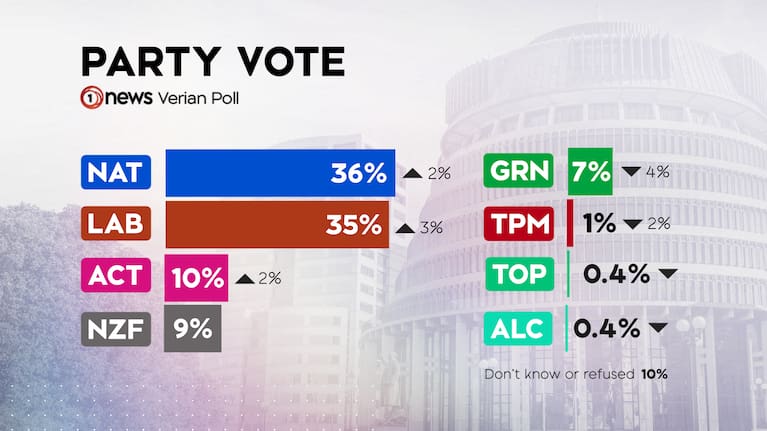
Te Pāti Māori’s support has dropped to 1% in the latest 1News Verian poll following weeks of negative publicity over disputes within the party.
Today’s result marks a major fall off for Te Pāti Māori, which recorded 7% in the poll just a year ago following the hīkoi that saw tens of thousands make their way to Parliament.
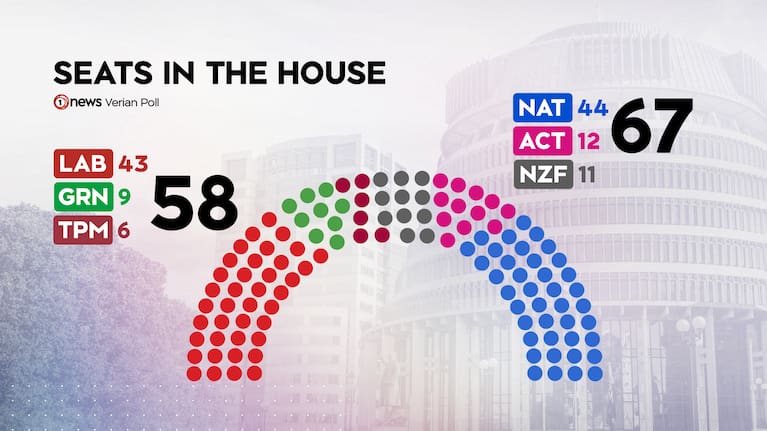
If an election were to be held today, the poll indicates it would be good news for the right bloc of National, ACT and New Zealand First, which forms the current government coalition. They would have 67 seats, easily enough to form the next government.

The left bloc of Labour, the Greens and Te Pāti Māori would have 58 seats – a decrease of 2 seats on the last poll in October, and short of the majority needed to form a coalition.
The seat calculation has Te Pāti Māori keeping the same number of MPs based on it holding on to its six electorates.
It comes alongside a new ASB economic forecast which suggests signs of recovery incoming. (Source: 1News)
But with such a steep drop in support, they may not retain all six.
The results are according to the Verian poll of 1007 eligible voters taken between November 29 and December 3.
They come after Te Pāti Māori threw out two of its MPs amid accusations of a “dictatorial” style by its leadership. The dispute took a new twist in court last week when a judge ruled MP Mariameno Kapa-Kingi should be reinstated as a party member.
National and Labour rise
National is up 2% to 36% in the poll, the party’s best result since April.
Labour too is rising, up by 3% to 35%, nipping at National’s heels. That is Labour’s best result since April 2023.
ACT is also up, climbing 2% to 10%. New Zealand First, meanwhile, is steady on 9% – the third time in a row it has been on that result.
The Greens are the biggest fallers, tumbling from 11% to 7%. The sharp 4% drop gives the party its worst result since May 2023, when it also recorded 7%.
Te Pāti Māori has crashed to 1%, down by 2% – its poorest result in five years.
The party’s final result is actually just 0.6%, but numbers across the board are rounded up and down depending on which side of 0.5% that they fall.
The last time Te Pāti Māori recorded a result of 0.6% was October 2020 in the final 1News poll before that year’s election.
A total of 10% of voters didn’t know or refused to answer which party they support.
Labour leader Chris Hipkins welcomed his party’s increase in support but said: “Te Pāti Māori clearly have lost a lot of the support that they were previously attracting. They’ve been in absolute shambles, and voters are deserting them.”
Hipkins said he would set out closer to the election whether he was ruling them out as a potential coalition partner.
“At this point it’s not even clear whether there will be a Māori Party left to work with.”
ACT leader David Seymour said: “Well, they don’t have a purpose. The ACT Party’s done more for Māori through charter schools than Te Pati Māori’s done in its entire existence.”
Te Pāti Māori and New Zealand First declined to comment on the poll results, while National’s leader, Prime Minister Christopher Luxon, said he was pleased with his party’s performance.
“I know it’s been a very tough and difficult time, and there’s a lot more for us to be doing, so it’s encouraging to see that’s there’s been some progress,” he said.
Te Pāti Māori leadership
Voters were also asked about their views on the current co-leaders of Te Pāti Māori.
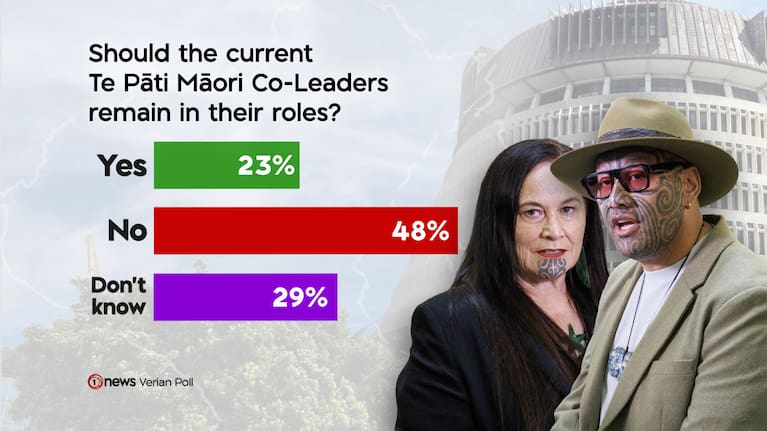
Just 23% said that Rawiri Waititi and Debbie Ngarewa-Packer should remain the co-leaders, while 48% said the party should choose new co-leaders.
A further 29% didn’t know or preferred not to say.
Among Māori, 45% believe the co-leaders need to be replaced, with 33% saying they should remain.
1News Verian Poll: Nearly half of voters say Te Pāti Māori leaders should go – Watch on TVNZ+
Rankings for the top job
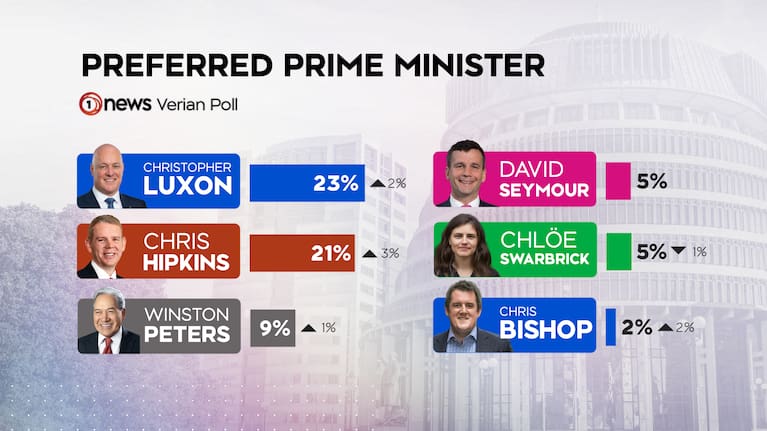
In the preferred prime minister stakes, National’s Luxon has risen by 2% and is now on 23%, his best result since May.
Labour’s Hipkins is also on the rise, going up by 3% to 21%.
New Zealand First’s Winston Peters is up for the fourth straight poll in a row, climbing 1% to 9%.
The Greens’ Chlöe Swarbrick is down 1% to 5%, while ACT’s David Seymour is steady on 5%.
National’s senior MP Chris Bishop also features, on 2%.
He’s the first non-party leader to go above the 1% mark since Jacinda Ardern in August 2023, six months after she resigned.
Rounding out the honourable mentions on 1% are NZ First deputy leader Shane Jones, Education Minister Erica Stanford and senior Labour MP Kieran McAnulty, while Finance Minister Nicola Willis is a re-entrant – on 1% for the first time since May.
Exclusive: 1News Verian Poll shows new face in preferred PM ranks – Watch on TVNZ+
Economic outlook
The public’s view of the state of the economy is starting to turn around, the poll suggests.
Economic optimism is up by 6% to 42%, while pessimism has fallen – going down 9% to 30%.
The result comes ahead of next week’s GDP results which are likely to be positive following a worse than expected 0.9% drop last time around.
Full poll results
Party vote
National – 36% (up 2% since October)
Labour – 35% (up 3%)
ACT – 10% (up 2%)
New Zealand First – 9% (steady)
Greens – 7% (down 4%)
Te Pāti Māori – 1% (down 2%)
Don’t know / refused to say – 10% (down 1%)
Seats in the House
National – 44
Labour – 43
Act – 12
New Zealand First – 11
Greens – 9
Te Pāti Māori – 6
Total: 125
Preferred prime minister
Christopher Luxon – 23% (up 2%)
Chris Hipkins – 21% (up 3%)
Winston Peters – 9% (up 1%)
David Seymour – 5% (steady)
Chlöe Swarbrick – 5% (down 1%)
Chris Bishop – 2% (up 2%)
See the full poll results here and the Te Pāti Māori leadership results here
Between November 29 and December 3 2025, 1007 eligible voters were polled by mobile phone (500) and online, using online panels (507). The maximum sampling error is approximately ±3.1%-points at the 95% confidence level. Party support percentages have been rounded up or down to whole numbers, except those less than 4.5%, which are reported to one decimal place. The data has been weighted to align with Stats NZ population counts for age, gender, region, ethnic identification and education level. The sample for mobile phones is selected by random dialling using probability sampling, and the online sample is collected using an online panel. Undecided voters, non-voters and those who refused to answer are excluded from the data on party support. The results are a snapshot in time of party support, and not a prediction.