
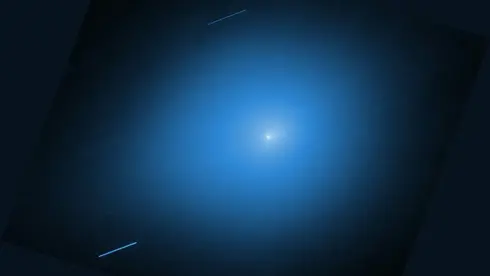
Space agencies have released some of the clearest images yet of the interstellar comet 3I/ATLAS as it makes its final pass through the inner solar system before heading back into deep space.
The comet, discovered in late June and confirmed in July as only the third known interstellar object, has spent recent months racing through the solar system at an estimated 130,000 mph (210,000 km/h). After close approaches to Mars and the sun in October, it will make its nearest pass to Earth on Dec. 19, at a distance of roughly 170 million miles (270 million kilometers), nearly twice the gap between Earth and the sun.
2 View gallery
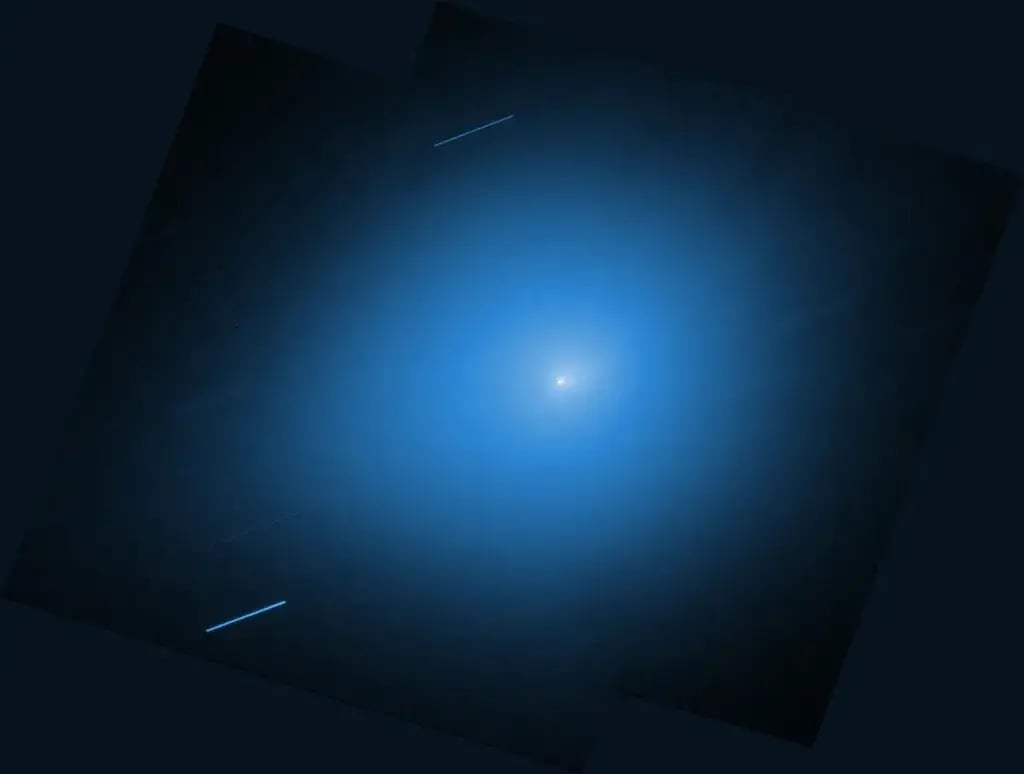
The second Hubble Space Telescope view of comet 3I/ATLAS
(Photo: NASA/Atlas)
Ahead of that flyby, spacecraft operated by NASA and the European Space Agency have been collecting images and measurements. Both released new photographs this week, showing the comet bright and active after its recent encounter with the sun, spewing gas and dust as its surface ices sublimate.
On Thursday, NASA published a new Hubble Space Telescope image capturing the comet’s nucleus and coma as a bright white glow against a background of streaked stars — the result of Hubble tracking the fast-moving object. The image was taken Nov. 30 at a distance of 178 million miles (286 million kilometers). Hubble’s first observation in July revealed little more than a faint blur but allowed astronomers to estimate the comet’s size as between 1,400 feet (440 meters) and 3.5 miles (5.6 kilometers) across, likely making it the largest interstellar object ever detected.
NASA has not yet released full data from the latest image, including details of the coma’s composition.
2 View gallery
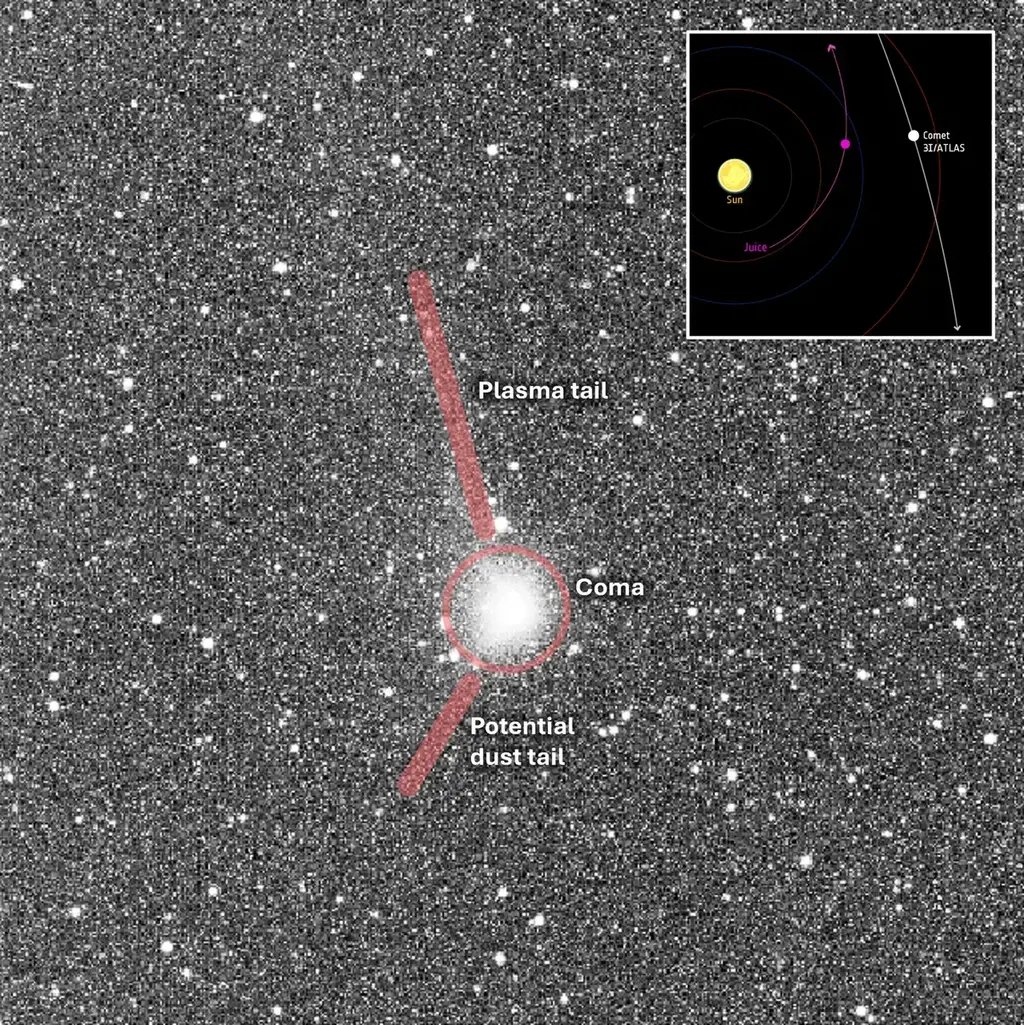
A new image of comet 3I/ATLAS, taken from the ESA’s Jupiter Icy Moons Explorer
(Photo: ESA/Juice/NavCam)
ESA also shared a new view Thursday, captured Nov. 2 by the Jupiter Icy Moons Explorer (Juice) spacecraft as it travels toward Jupiter to study its icy moons. From about 41 million miles (66 million kilometers) away, Juice imaged a highly active comet with a glowing coma and what appears to be both a plasma tail and a faint dust tail. ESA said Juice observed the comet over two days with five instruments, but the complete data will not reach Earth until late February 2026. The orbiter is currently relying on a smaller antenna because its main dish is being used as a heat shield during a close solar pass.
A dozen spacecraft across the solar system — from Mars rovers to asteroid probes — have now observed 3I/ATLAS, even though many were not originally designed to track comets. Scientists expect additional observations soon, including from the James Webb Space Telescope as the comet approaches its closest point to Earth.
Researchers say each dataset is valuable for understanding an object arriving from outside the solar system, offering a rare window into material formed around a distant star.