
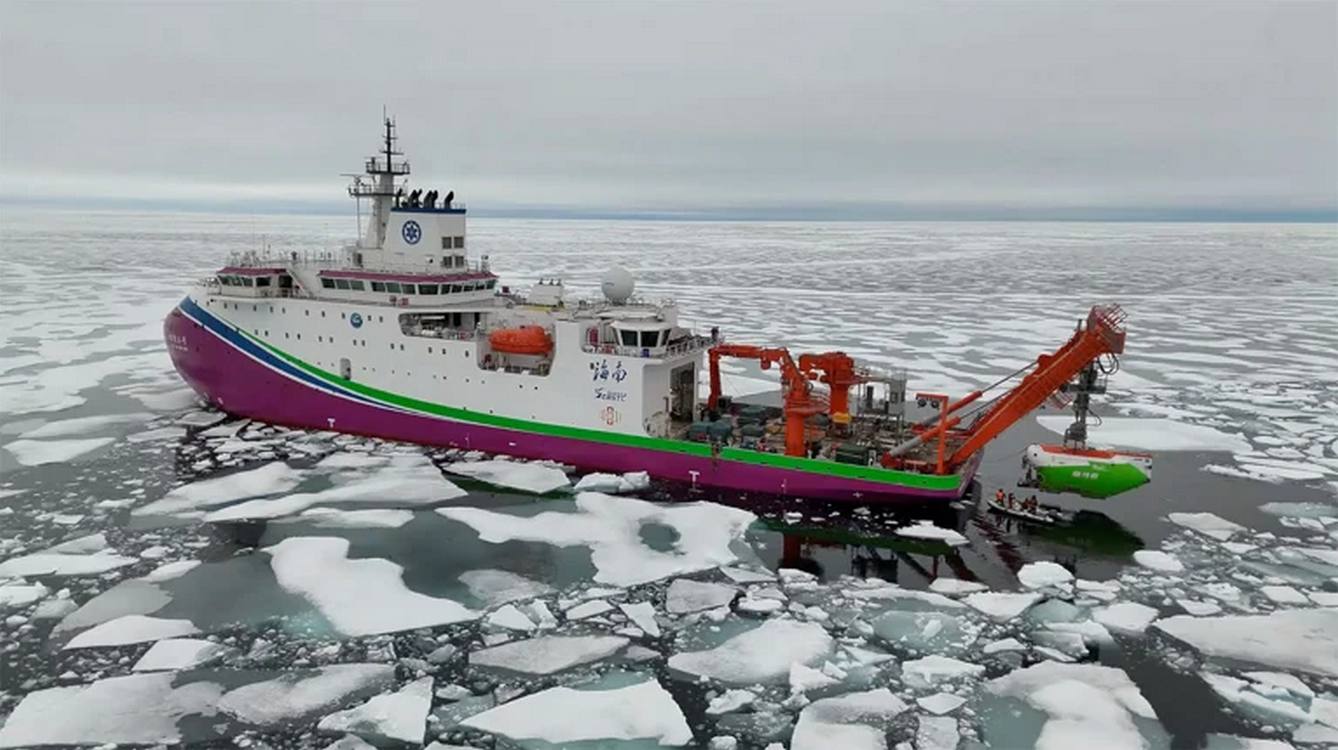
 The submersible Fendouzhe being deployed off a Chinese icebreaker in the Arctic Ocean. Credit: Courtesy of the Fendouzhe Research Team
One of the most remote and unexplored parts of the planet has been visited by a submersible crewed by Chinese geophysicists and marine scientists for the first time ever.
Having been researched from the surface by Russian scientists, and the western side with robotic submersibles by a US-German team in 2001, no one has ever explored the eastern side of the undersea mountain chain called the Gakkel Ridge.
Stretching from Greenland to Siberia, this underwater ridge sits along a volcanic fault line where repeat volcanic eruptions create new sections of sea floor crust that spread away from the ridge slower than the growth of human fingernails.
On the western side of this ridge, which is easier to reach as it remains under open water, surveys found that it hosted ecosystems clustered around hydrothermal vents—ejections of gas from the volcanic plumbing below that host a bizarre and rich array of life where there’s virtually no light.
These ecosystems are hypothesized as one of the best places to look for signs of alien lifeforms on ocean worlds like the frozen Jovian moon of Europa.
The eastern side, however, has never been reached with a dive vehicle. This year, an expedition organized by the Chinese Academy of Sciences and the Ministry of Natural Resources undertook a major endeavor to study the eastern side of the Gakkel Ridge.
It involved an icebreaker ship, as the eastern ridge is located where the sea ice can remain permanent, and a scientific submersible with room for 3 called Fendouzhe. Together the team completed more than 40 dives, including one deeper than 14,000 feet (5,277 meters).
“It’s the last piece of the puzzle,” says Xiaoxia Huang, a marine geophysicist at the Institute of Deep-Sea Science and Engineering in Sanya, China, and the expedition’s chief scientist, in an interview with Nature.
DEEP SEA DIVES: Bizarre Deep-Sea Creature – a ‘Death Ball’ Sponge – Discovered in One of the Most Remote Corners of the Planet
The dive was anything but straightforward. Floating sea ice meant that depending on how far Fendouzhe traveled, it might not be able to surface again. The research icebreaker vessel had to transport it to open areas, and at certain dive depths, the submersible had to use sonar to scan for holes in the ice to make sure it had an escape route. On one occasion the icebreaker had to clear ice to make an opening for the submersible to come up again.
“To be honest, I was never afraid,” Huang said. “It’s really a privilege to have such an opportunity” to study the deep sea in person.
THE FAR CORNERS OF THE WORLD: Potential New Source for Drugs to Fight Antibiotic-Resistant Bacteria Found Deep in Arctic Ocean
They targeted geologically interesting areas such as seamounts and cliff faces, while studying a variety of fish and deep sea species, which Huang said were “fascinating” to observe—living as they were in the dark, the cold, the pressure and the rocks.
The samples of the rocks, animals, and water recovered by Fendouzhe are awaiting analysis, and the team were tight-lipped about whether they encountered parallel regions of hydrothermal vents as were discovered on the western ridge.
SHARE This Cutting Edge Scientific Exploration With Your Friends…