
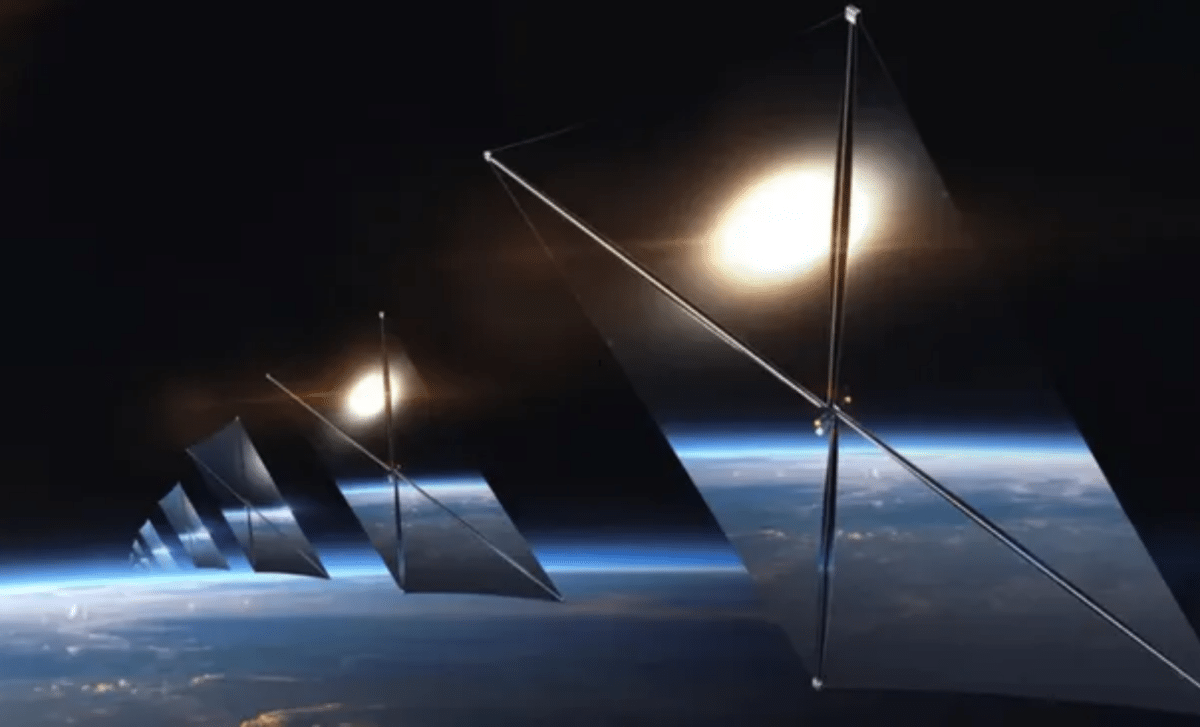
In an ambitious bid to extend daylight beyond the sunset, a California-based startup, Reflect Orbital, is planning to deploy thousands of satellites into low-Earth orbit to redirect sunlight to Earth’s nighttime side. This project, still in its early stages, promises to harness solar energy during the dark hours, with potential applications ranging from powering solar arrays to providing extra light for search and rescue missions. But the idea has raised concerns within the scientific community, with experts warning of its unforeseen impacts on both astronomy and the environment.
A New Frontier: Space Mirrors as Artificial Sunlight
Reflect Orbital’s vision for space mirrors is ambitious and futuristic. The company plans to launch a constellation of satellites equipped with large, reflective panels designed to capture sunlight and beam it down to Earth at night. These mirrors will be strategically positioned to shine light over specific regions, creating a controlled beam of illumination for purposes ranging from boosting solar energy collection to helping with emergency response in dark or remote areas. Reflect Orbital hopes to begin deploying these satellites as soon as 2026, with the goal of having thousands in orbit by 2030. The technology promises to offer “sunlight after dark,” but at what cost?
While the company argues that this project could be a groundbreaking solution to harness solar energy more effectively, experts in the field of astronomy have expressed concerns about the impact this technology could have on sky observations and wildlife. The project raises the question: Can the benefits of artificial sunlight outweigh the potential harm to ecosystems and scientific research?
The Impact on Astronomy: “Catastrophic” Consequences
One of the most vocal critics of this plan is the astronomical community, who are concerned about the potentially devastating impact on stargazing and celestial research. “The central goal of this project is to light up the sky and extend daylight, and obviously, from an astronomical perspective, that’s pretty catastrophic,” Robert Massey, Deputy Executive Director at the U.K.’s Royal Astronomical Society, told Space.com. Astronomers rely on the dark night sky to conduct their research and observe celestial phenomena. If space mirrors flood the night with artificial sunlight, it could severely compromise the ability to observe stars, planets, and other cosmic events, disrupting critical studies in the field.
Astronomers also worry about the broader impact of this technology. With satellites passing overhead and reflecting sunlight, they could turn the night sky into an unrecognizable spectacle of bright, moving lights. Even though the company assures that each satellite would only briefly illuminate specific patches of land, the cumulative effect could be far more invasive. As John Berentine, an astronomer at the Silverado Hills Observatory in Arizona, pointed out,
“The reflectors will be directing their light [even after they pass their target] because obviously they can’t shut that off. The beam reflected by these satellites is very intense, four times brighter than the full moon.”
Disruption to Wildlife and Ecosystems
Beyond the impact on astronomy, the project also raises serious environmental concerns. Wildlife, particularly nocturnal animals, depends on the natural cycle of day and night for their survival. The introduction of artificial sunlight could disrupt these natural rhythms, causing confusion among animals and potentially leading to dangerous consequences. For example, birds that navigate using the stars could become disoriented, increasing the risk of accidents and fatalities. Likewise, the interruption of natural darkness could affect ecosystems, as many species rely on the cover of night for feeding, mating, and migration.
According to Berentine, the light from these space mirrors could not only affect the directly illuminated area but also the surrounding environment.
“The beam reflected by these satellites is very intense… they will be flying multiple satellites in a formation. That will have an effect on wildlife in the directly illuminated area, but also, through atmospheric scattering, on the surrounding areas as well.”
This means that even regions far from the beam’s center could experience light pollution, disrupting ecosystems on a much larger scale.
The Promise vs. The Reality: Solar Energy Gains
Reflect Orbital’s primary claim for its space mirror project is the potential to increase solar power production, especially during nighttime hours. By reflecting sunlight onto solar arrays, the satellites could help to generate energy when the sun is not shining. This concept, while innovative, faces criticism regarding its practical feasibility. Experts like Samantha Lawler, an astronomer at the University of Regina, argue that the amount of energy collected would likely be minimal.
“When you do the calculation, it’s milliwatts,” she states. “You’d need hundreds or thousands of mirrors pointed at the same spot on the ground to even activate a solar panel.”
Moreover, there are concerns that the energy generated may not justify the technological and environmental costs. Aaron Boley, an astronomer at the University of British Columbia, suggests that adding more solar panels to rooftops would be a more efficient and sustainable approach. Given the scale of the project, it remains unclear whether the benefits in terms of energy production would truly outweigh the environmental risks and astronomical consequences.
Light Pollution and Its Global Impact
One of the most immediate concerns surrounding the project is the risk of exacerbating light pollution. Light pollution is already a significant issue in urban areas, where artificial lights obscure the night sky, making it difficult for both professional and amateur astronomers to observe celestial bodies. The introduction of space mirrors could dramatically increase light pollution on a global scale. As Massey warned,
“Our service is highly localized… Each reflection covers a defined 5-kilometer area for a finite period of time rather than providing continuous or widespread illumination.”
However, the fact that these beams will be moving and changing direction could lead to unpredictable patterns of light, further contributing to global light pollution.