

A Nasa astronomer has uncovered what he describes as the first scientifically-grounded explanation for the Star of Bethlehem, which guided the Three Wise Men to the birth of Jesus more than 2,000 years ago.
Mark Matney’s research, published in the Journal of the British Astronomical Association, has identified a celestial object which was observed by Chinese court astronomers in 5BC as the same one that illuminated the birthplace of the Son of God.
Ancient records from China, maintained for astrological purposes, describe a brilliant comet that remained visible for over 70 days from the spring of that year.
The biblical account, recounted in the Gospel of Matthew, describes the star initially appearing “in the east” before travelling ahead of the Magi on their route from Jerusalem to Bethlehem, ultimately “standing over” where the infant Jesus could be found.
Scholars generally date the Nativity between 6BC and 5BC, given that King Herod died no earlier than late 5BC.
Mr Matney employed a novel analytical technique to model how this comet would have appeared to move across the sky from ground level.
By calculating various orbital paths that matched the Chinese observations, he discovered trajectories bringing the object close enough to Earth that its eastward movement would have effectively counterbalanced our planet’s rotation for several hours.
Satellite engineers today recognise this effect as “temporary geosynchronous motion”.
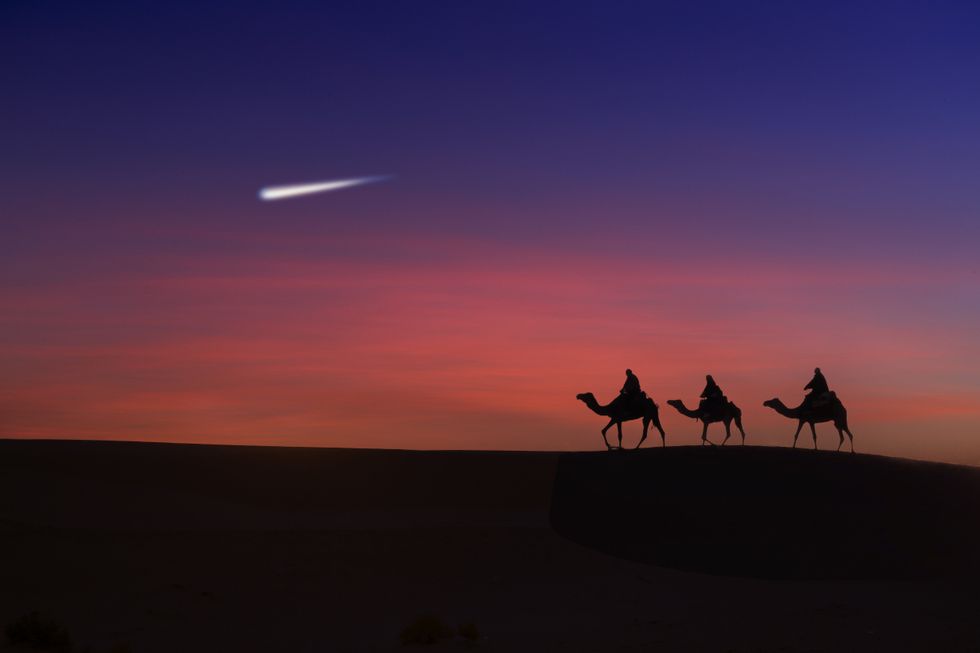
A Nasa astronomer has proposed a new theory behind the appearance of the Star of Bethlehem
|
GETTY
From the perspective of those on the ground, the comet would have seemed to halt almost directly above them before continuing on its course.
One orbital reconstruction places this event on a June morning in 5BC, with the comet’s position aligning with the Jerusalem-Bethlehem road while ascending in the sky.
“This is the first astronomical candidate for the Star ever identified that could have had apparent motion corresponding to the description in Matthew, where the Star ‘went before’ the Magi on their journey to Bethlehem until it ‘stood over’ where the child Jesus was,” Mr Matney wrote in his study.
For this phenomenon to occur, the comet would have needed to pass remarkably close to our planet, between 236,000 and 249,000 miles or approximately the same distance as the Moon.
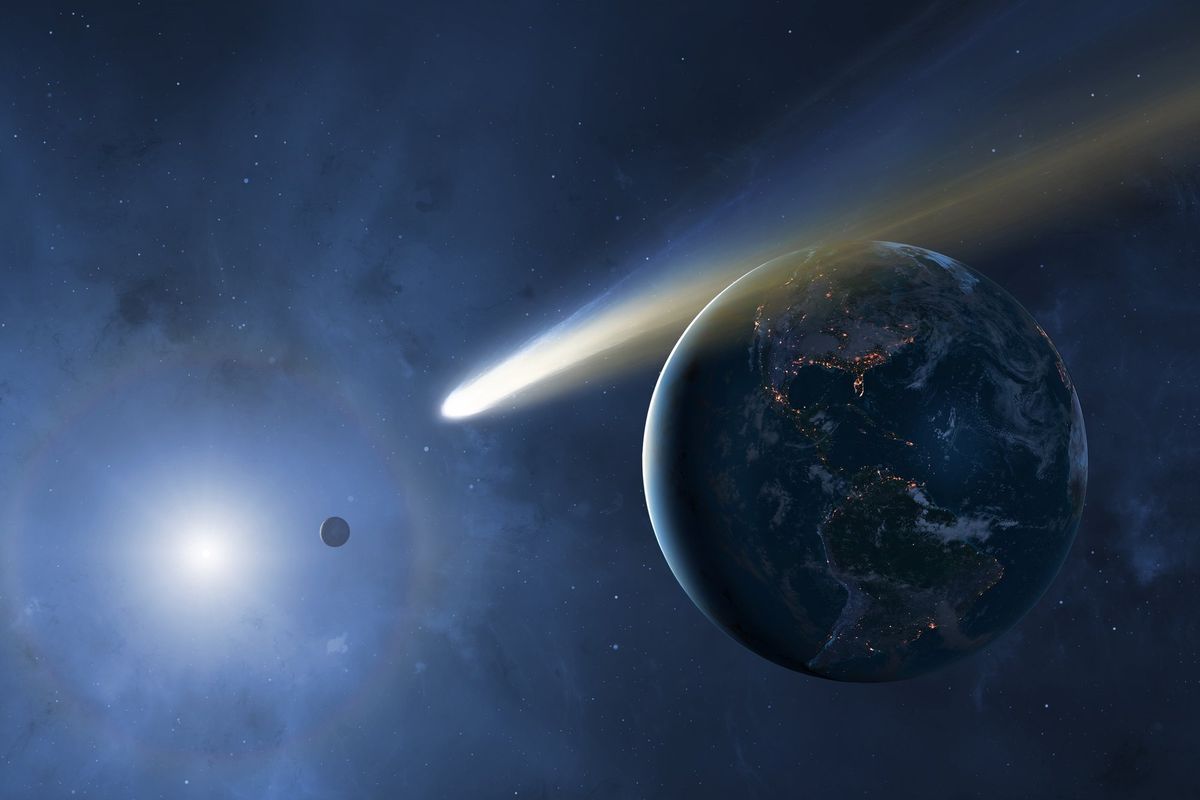
The researcher suggested the star may have been a comet observed by Chinese astronomers at around the same time
|
GETTY
The astronomer pointed to the Siding Spring comet, which came within 87,000 miles of Mars in 2014, as evidence that such near approaches do happen.
“While rare, such close approaches are possible,” he wrote.
At such proximity, the object would have been “extraordinarily bright” and “easily have been visible in the daytime,” according to Mr Matney.
His calculations indicate the Wise Men may have observed it during mid-morning hours.
“As the Magi travelled south, it would have been an unmistakable object in the southern sky, rising higher and higher,” he said.
A comet remaining visible for months aligns with the account in Matthew’s Gospel that the star had been observed over an extended period.
Comets held profound significance in the ancient world, interpreted in Greco-Roman and Eastern astrological traditions as portents of royal births, changes in power, and divine intervention.
For a group of elite astrologers, a striking comet would have provided ample motivation for an expedition.

The nature of the celestial phenomenon that guided the three Magi has been debated for centuries
|
GETTY
Mr Matney’s theory is not the first to claim to solve the centuries-old puzzle, as at least 400 scholarly investigations have attempted to identify the true nature of the star.
The 17th-century German astronomer Johannes Kepler proposed a conjunction of Jupiter and Saturn in 7BC was responsible.
Some researchers have suggested a supernova, the massive explosion created by a dying star, bursting into view, could have been the source.
Other scholars and believers regard the Star of Bethlehem as either a miraculous event or a symbolic narrative rather than a rational astronomical phenomenon.