
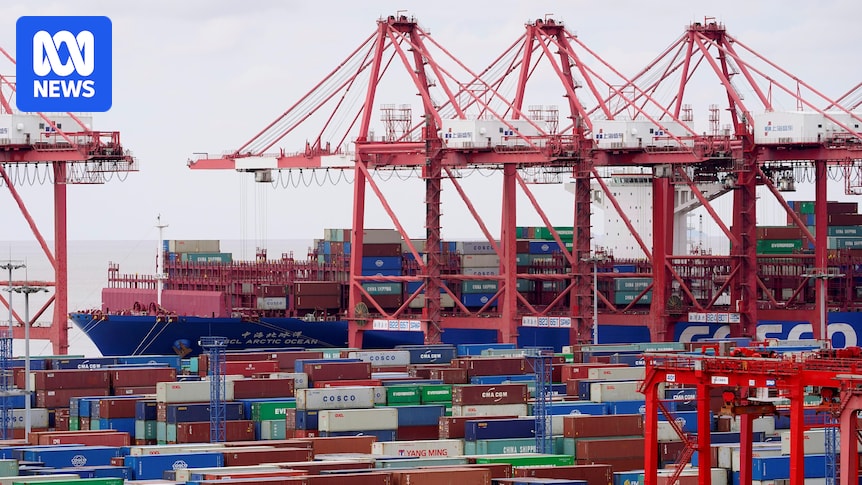
China’s trade surplus has topped $US1 trillion ($1.5 trillion) for the first time as manufacturers seeking to avoid President Donald Trump’s tariffs shipped more to non-US markets, with exports to Europe, Australia and South-East Asia surging.
Shipments to the United States dropped by close to one-third when comparing November data to the same month last year.
“The tariff cuts agreed under the US-China trade truce didn’t help to lift shipments to the US last month, but overall export growth rebounded nonetheless,” Zichun Huang, China economist at Capital Economics, said.
“We expect China’s exports will remain resilient, with the country continuing to gain global market share next year.
“The role of trade rerouting in offsetting the drag from US tariffs still appears to be increasing,” she added.
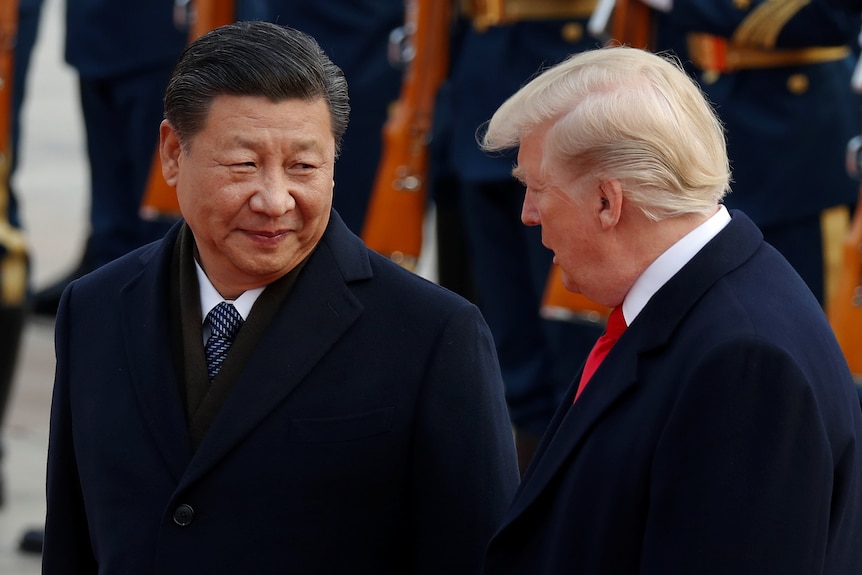
Xi Jinping and Donald Trump agreed to scale back some of their tariffs at an October meeting. (Reuters: Damir Sagolj)
Chinese exports overall grew 5.9 per cent year-on-year in November, customs data showed, a reversal from October’s 1.1 per cent contraction, and beating a 3.8 per cent forecast in a Reuters poll.
Imports were up 1.9 per cent, compared with a 1 per cent uptick in October.
Economists had expected a 3 per cent increase.
China’s trade surplus was $US111.68 billion in November, the highest since June and up from $US90.07 billion recorded the previous month.
That was above a forecast of $US100.2 billion.
It meant the trade surplus for a single year passed $US1 trillion for the first time, with a month of data still to come.
China has stepped up efforts to diversify its export markets since Mr Trump won the November 2024 US election, pursuing closer trade ties with South-East Asia and the European Union.
It has also leveraged Chinese firms’ global footprint to establish new production hubs for low-tariff access.
Chinese shipments to the US dropped 29 per cent year-on-year in November, while exports to the European Union grew by an annual 14.8 per cent.
Shipments to Australia surged 35.8 per cent, and the fast-growing South-East Asian economies took in 8.2 per cent more goods over the same period.
Tumbling exports to the US came despite news that the world’s two biggest economies had agreed to scale back some of their tariffs and a raft of other measures after Mr Trump and Chinese President Xi Jinping met in South Korea on October 30.
The average US tariff on Chinese goods stands at 47.5 per cent, well above the 40 per cent threshold that economists say erodes Chinese exporters’ profit margins.
“Electronic machinery and semiconductors seem to be key [to higher exports],” Dan Wang, China director at Eurasia Group, said.
“There is a shortage in lower-grade chips and other electronics, which meant prices jumped, and Chinese companies going global have been importing all kinds of machinery and other inputs from China.”
Efforts to wean economy off reliance on exports
China’s yuan firmed on Monday, off the back of the stronger-than-expected export data, with investors also awaiting policy signals from key year-end meetings.
The Politburo, a top decision-making body of the ruling Communist Party, pledged on Monday to take steps to expand domestic demand, a shift analysts say is crucial for weaning the $US19 trillion economy away from reliance on exports.
Trump to reduce tariffs on Beijing amid resumed US nuclear weapons testing
Top officials are also expected to convene for the annual Central Economic Work Conference in the coming days to set key targets and outline policy priorities for next year.
Economists estimate that diminished access to the US market since Mr Trump returned to the White House has reduced China’s export growth by roughly 2 percentage points, equivalent to around 0.3 per cent of GDP.
October’s unexpected downturn, following an 8.3 per cent surge the month prior, signalled that Chinese exporters’ tactic of front-loading US-bound shipments to beat Mr Trump’s tariffs had run its course.
Although Chinese factory owners reported an improvement in new export orders in November, they were still in contraction, underscoring continued uncertainty for manufacturers as they struggle to replace demand in the absence of US buyers.
An official survey tracking broader factory activity showed that the sector contracted for an eighth consecutive month.
Domestic demand still soft
China’s rare earth exports jumped 26.5 per cent month-on-month in November, the first full month after Mr Xi and Mr Trump agreed to speed up shipment of the critical minerals from the world’s largest refiner.
The nation’s soybean imports are also poised for their best-ever year, as Chinese buyers, who had shunned US purchases for the majority of this year, stepped up purchases from American growers in addition to large purchases from Latin America.
Overall, China’s domestic demand remains soft due to a prolonged property downturn.
That weakness was seen in a decline in imports of unwrought copper, a key material in construction and manufacturing.
“China’s pivot to establishing domestic demand as a key driver of growth will take time, but it’s essential for China to move into the next phase in its economic development,” said Lynn Song, ING’s chief economist for Greater China.
Reuters