

The same pigment that gives your favorite denim its iconic hue could soon power electric vehicles and energy storage systems.
Indigo, the pigment used for centuries, has been repurposed by researchers from Concordia University in Canada, proving it can do far more than just color fabric.
Interestingly, the dye can be used to perform certain chemical reactions in solid-state batteries. It could lead to batteries that hold more energy, cycle more reliably, and perform brilliantly even in the chill of winter.
“We were excited to see that a natural molecule could guide the battery chemistry instead of disrupting it. Indigo helps the battery operate in a very steady, predictable way. That is important if we want greener materials to play a role in future energy systems,” said Xia Li, the study’s lead author and associate professor in the Department of Chemical and Materials Engineering.
Overcoming organic material limitations
Solid-state batteries use solid materials rather than liquids for lithium-ion movement, resulting in enhanced safety and greater energy storage capacity.
Organic materials are key to next-generation batteries (including organic, lithium-ion, and solid-state) because they provide major advantages over typical inorganic metals in sustainability, cost, and flexible design.
However, the main difficulty lies in integrating organic materials, which typically interact poorly with the solid components. Usually, these materials cause instability with excessive interaction.
Contrary to standard practice, this study found that a carefully controlled reaction between indigo and the electrolyte can benefit the battery.
It stores and releases lithium, simultaneously activating the solid electrolyte to store energy too.
This unique cooperation between the indigo dye and the solid electrolyte is key to the battery’s performance, enhancing overall capacity beyond the storage potential of either component alone.
Furthermore, this combination also provides another benefit: stable operation not only at room temperature but also in cold conditions, specifically down to minus ten degrees Celsius.
Use of natural molecules
For solid-state batteries based on organic materials, achieving high capacity and reliability in cold weather is a remarkable and uncommon feat.
“Our study represents one of the strongest performances reported for this battery type,” said Qihang Yu, the first author of the study.
“It suggests that natural molecules like indigo can help overcome long-standing compatibility challenges and support more accessible and sustainable battery technologies,” Yu added in the press release.
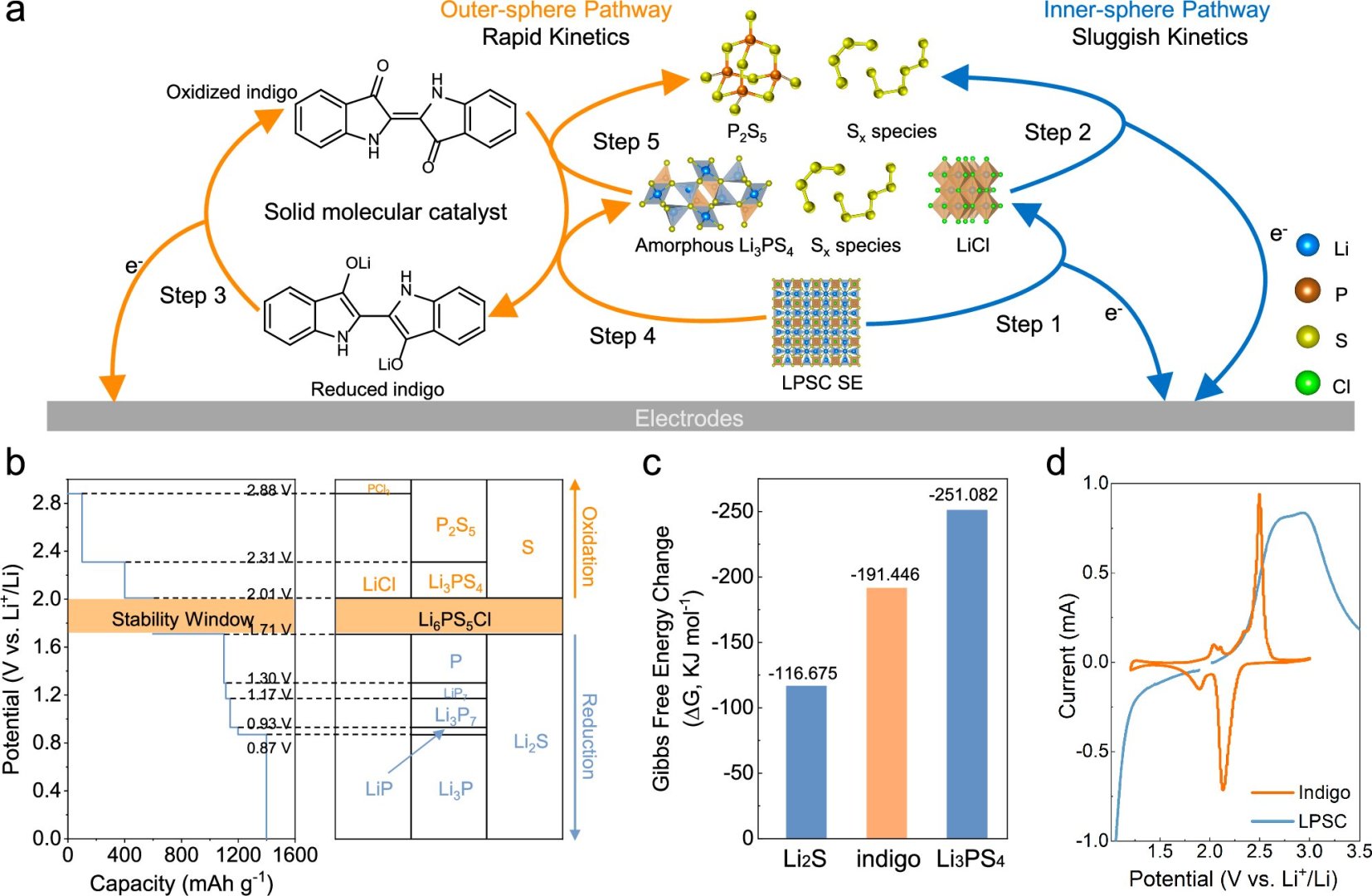 Working mechanism of indigo natural dye as both the active material and the molecular catalyst in sulfide-based ASSBs
A sustainable, high-performing battery is crucial for homes to electrify our commutes today.
Moreover, the use of organic materials from easily processed sources can simplify the supply chain, reduce price volatility, and ultimately lower the potential manufacturing costs of batteries.
The research team’s immediate objective is to transition this promising technology toward real-world use. This involves refining the battery’s internal reactions to maintain stability while storing more energy within a compact volume.
Successfully optimizing the battery’s energy density is the final step that will bridge the gap, bringing these highly sustainable, organic-based solid-state batteries much closer to practical, commercial application.