
Unlock the Editor’s Digest for free
Roula Khalaf, Editor of the FT, selects her favourite stories in this weekly newsletter.
An investigation into Britain’s top IRA spy has criticised a “significant failure” by MI5 to share information and said intelligence services had “time and again” refused to act upon tips that could have saved lives.
The nine-year Operation Kenova investigation found that MI5, the domestic UK intelligence agency, had more detailed information about the handling of Stakeknife — widely accepted to have been top IRA inquisitor Freddie Scappaticci — than it had previously disclosed.
That included two occasions when MI5 — which the report said was “closely involved with his handling” — knew Stakeknife’s military handlers had flown him by military plane out of Northern Ireland on holiday when he was wanted by police on murder and other charges.
The final report, published on Tuesday, detailed “state failures to act legitimately with empathy and care”. Prosecution files submitted to the Public Prosecution Service for Northern Ireland implicated Stakeknife in 14 murders and the abduction of a further 15 people.
 Freddie Scappaticci at the 1987 funeral of IRA man Larry Marley © Pacemaker Press
In a statement alongside the report, Kenova said it had identified 3,517 intelligence reports from Stakeknife — but “time and again the reports were not acted upon, with the protection of the agent apparently more important than protecting those who could and should have been saved”.
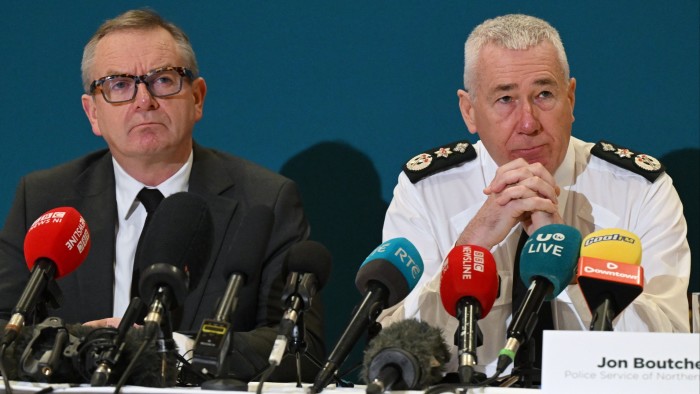
Jon Boutcher, chief constable of the Police Service of Northern Ireland, who previously led Kenova, said the repeated withholding of information by security forces meant “murders that could and should have been prevented were allowed to take place and those responsible were not brought to justice”.
He told a news conference: “Instead, they were left free to kill again.”
Claire Hanna, an MP who heads the small nationalist Social Democratic and Labour party, said Kenova “lays bare the bandit-style operations run by MI5, the FRU [the army’s military intelligence Force Research Unit] and [police] Special Branch and their disregard for the basic human rights of ordinary citizens”.
Last year’s interim Operation Kenova report found more lives were lost than were saved as a result of Stakeknife’s actions during Northern Ireland’s Troubles conflict.
The report failed to name Stakeknife after the UK government cited its “neither confirm nor deny” policy for not confirming his identity.
However, it is widely accepted to be Scappaticci, a notorious former senior member of the IRA’s “nutting squad” tasked with dispatching informants with a bullet to the head, who died in 2023.
Stakeknife had a career as a British spy from the late 1970s to the early 1990s and was feted as “our most important secret . . . a golden egg” of military intelligence by General Sir John Wilsey, who was in charge of the British army in Northern Ireland from 1990-93.
The report found a special military unit known as the “rat hole” was set up to help manage Stakeknife, whose handlers “routinely massaged his ego” and told if he stopped providing intelligence “the loss would be felt around the world”. An MI5 officer was assigned to the rat hole unit.
He was also given a special phone line he could call at any time, was paid “tens of thousands of pounds” and given help to purchase a property.
Kenova uncovered material from MI5 that it had not received before its interim report.
“While the information in the additional files would not have altered prosecutorial decisions, further investigative opportunities were undoubtedly lost,” Sir Iain Livingstone, the head of Kenova, said.
“The very fact that material owned and held by MI5 was not timeously disclosed understandably undermined the confidence of communities that state authorities had co-operated fully with Kenova. It was a significant failure on the part of MI5.”
 MI5 chief Sir Ken McCallum apologised for the delay in handing over information © Jonathan Brady/PA Wire
The report also found that MI5 retrieved a file from a secure safe used by Kenova during its investigation at MI5’s headquarters. Kenova changed the lock after the incident, which it said had eroded trust between investigators and the agency.
MI5 director-general Sir Ken McCallum apologised for the delay in handing over information but said the agency had never “deliberately withheld” anything.
Livingstone called on the UK government to name Stakeknife now “in the national interest” and said the “neither confirm nor deny” policy “cannot be used to protect agents who commit grotesque serious crime, leaving victims and families ignored and their demands for information and answers dismissed”.
Sinn Féin’s North Belfast MP John Finucane said the final report provided “further confirmation of collusion, criminality and cover-up by the British state”.
Hilary Benn, the UK’s Northern Ireland secretary, said the government’s “first duty is of course to protect national security and identifying agents risks jeopardising this”.