
Paul LynchBBC Shared Data Unit
 Getty Images

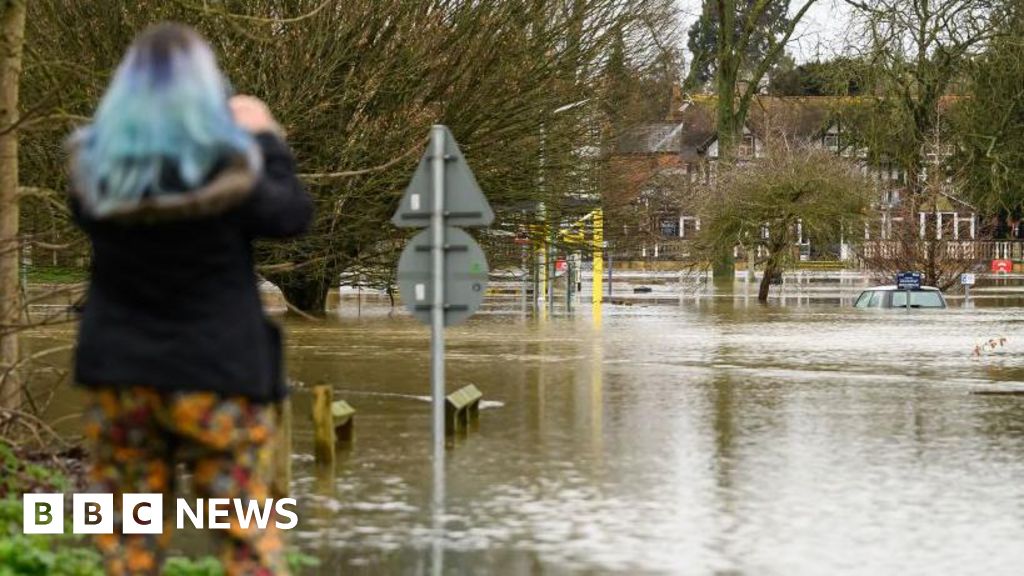
Parts of Wallingford in Oxfordshire were submerged in the aftermath of Storm Henk last year
Thousands of flood defences meant to protect multiple homes or businesses in England were below the required condition when winter began, a new analysis has found.
The 6,498 “high consequence” defences were among about 8,500 that were not fully working as intended due to erosion, damage or being overgrown.
Exclusive figures obtained by the BBC show that, as of 20 October, almost 9% of the 98,000 defences inspected by the Environment Agency were below condition.
While the Department for the Environment, Farming and Rural Affairs says record levels of investment have improved the defence network since 2024, stark disparities remain regionally.
More than 40% of flood defences were below the standard in North Tyneside, Brentwood in Essex and Hart in Hampshire – the highest proportions in the country.
A fifth of all the defences along the Thames corridor, passing Oxfordshire, parts of Surrey and Greater London, were also failing to meet the required condition due to a mix of record rainfall and tidal storm surges.
Storm Bram brought strong winds and heavy rain to the UK on Tuesday, with dozens of flood warnings in place.
Flooding was reported on riverside streets in York, part of the M66 in Greater Manchester and in Devon and Cornwall, where train services were disrupted.
Flood defences in England range from man-made walls, embankments and storm drains to natural areas of high ground.
The Environment Agency inspects almost all the defences intended to keep rivers from spilling into vulnerable towns and cities.
“Any flood defence that is not operating as close to 100% efficiency as possible is of a concern,” said Dave Throup, a former Environment Agency area manager for the Midlands.
“It’s difficult to say why that is happening. Is it a lack of money? Or is it the bashing that these flood defences have taken over the last three or four years as a result of many very large flood incidents? It’s very difficult to pull that apart.”
Data shows the scale of the challenge facing the government’s repair efforts, despite ministers pledging £2.65bn over two years to build and restore more than 1,000 flood defences across England.
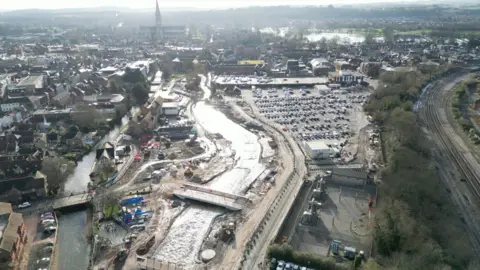
The £45m Salisbury River Park flood defence scheme, pictured under construction in 2024, aims to better protect more than 350 homes in the city
During its routine inspections, the Environment Agency gives flood defences a condition score out of five. This is then measured against a target score that reflects the required condition.
Defences can be marked down for having cracks and leaks. Sometimes they can be overgrown with vegetation or, in the case of drains and sluices, blocked.
The Environment Agency said a defence could still work correctly despite being in a poorer condition.
Floods minister Emma Hardy said the Labour government had inhereted flood defences in the “poorest condition on record” after “years of under-investment”.
She said: “Our immediate response was to redirect £108m into maintenance and repair works. But this is just the start.
“We’re investing at least £10.5bn – the largest programme ever – in flood defences until 2036. This will build new defences and repair assets across the country, protecting our communities for decades to come.”
The Environment Agency’s longer-term target is for just 2% of its high consequence defences to be below target condition. The current figure is near 9%.
In recent years, there have been several high-profile failures of flood protections.
More than 600 homes were evacuated in 2019 when the River Steeping burst its banks near Wainfleet, Lincolnshire. An official report found an embankment constructed in 1968 had collapsed, despite the Environment Agency being aware of its vulnerabilities.
However, the BBC found high consequence flood defences were about 45% more likely to be failing if they were maintained by a third-party other than the Environment Agency.
The agency only looks after a third of the defences it inspects regularly. A further third are maintained by private individuals, companies or charities and the remainder are mainly the responsibility of local councils.
‘We had no choice but to do something’

Earlier this year Katie Anderson led efforts to dig trenches at an estate in Leicestershire to avoid homes being flooded
In January, the complex responsibillities around flood protections nearly led to disaster at one Leicestershire neighbourhood.
Residents in the Grange Park estate in Loughborough say they were forced to dig their own flood defences when a privately owned pond that was meant to protect their homes overflowed.
The large hollow is designed to store floodwater, but residents there have raised concerns about its capacity during heavy storms. It completely filled in January, when the county was hit by unprecedented levels of rain and water began pouring towards front doors.
William H Davis Homes, which owned the pond at the time, said a blockage on a neighbouring parcel of land had been the cause – but concerned residents say they did not have the time to navigate a web of responsibility as the water crept onwards.
In near-freezing conditions, about 30 people dug trenches into the green area outside their homes to divert the flow of water.
Engineer Katie Anderson helped lead the effort.
“If everyone hadn’t pulled together, I don’t want to think what could’ve happened,” she said.
Confusion reigned over who they could turn to for help. Katie says calls to their water company Severn Trent, the borough council and the developer went nowhere and time was running out.
“They all said it wasn’t their problem,” she added.
The pond was only formally adopted by Charnwood Borough Council in October – but no upgrades have yet been made to increase its capacity.
A council spokesperson said initial investigations showed the drainage scheme was working “as intended”. An independent survey was under way and any recommendations from that would be considered, it added.
Katie, meanwhile, said she would be willing to take matters into her own hands again if floodwater threatened to reach her home.

Flood expert Professor Hannah Cloke OBE says more needs to be done to invest in catchment management across England
The Environment Agency said wetter winters were making the task of repairing flood defences more difficult than ever.
Six of the 10 wettest winter half-years (October to March) on record for England and Wales so far have been in the 21st Century.
Last winter, the UK was hit by six named storms. Among them, storms Bert and Connall caused severe flooding in England during November.
The Thames corridor saw some of the biggest impact from the past two winters. The Environment Agency says it has repaired many of the highest risk defences, but many remain below their required condition, the vast majority of which are maintained by third parties.
Prof Hannah Cloke OBE, a leading flood expert at the University of Reading, said the BBC’s findings had to be viewed in context as the data was “not perfect”.
“We’ve got some percentages here – but that doesn’t tell us exactly what would happen if each of those flood defences did fail,” she said, pointing to the fact a defence such as the Thames barrier was of greater importance than a parcel of natural high ground by a small brook.
Likewise, some defences may be in a good condition but may not have been designed effectively in the first place. Defences built five years ago were already being overtopped by floods, she said.
Prof Cloke said the government needed to invest in “catchment management” schemes that limit the speed of rainwater entering river systems.
These include tree planting or the digging of dips and hollows into the landscape, but are often hampered because a large proportion of river catchments are on private land.
“We can maintain our flood defences, we can try and protect property, but actually, if we can catch the rain where it falls that can really help in terms of making sure that we don’t have the floodwaters running downstream,” she added.
An Environment Agency spokesperson said: “Protecting communities in England from the devastating impact of flooding is a top priority – which is more important than ever as climate change brings more extreme weather.
“Each year, we complete up to 165,000 inspections of flood assets across the country and have recently redirected £108m into repairs and maintenance. This will help to ensure the strongest protection for nearby communities.”