
Dark matter, the invisible substance that makes up roughly 85 percent of the universe, is one of the biggest mysteries facing astrophysicists and cosmologists today.
In a bid to better understand this mysterious substance, a team of researchers with the LUX-ZEPLIN (LZ) dark matter experiment has investigated one of the prime dark matter candidates: weakly interacting massive particles (WIMPs).
The international team of researchers has just announced its latest results. During their investigation, they found a known milestone signal that behaves like dark matter at previously unobserved energy depths. This suggests that scientists are slowly but surely edging closer to discovering the true composition of dark matter.
Setting a new record for dark matter detection
LUX-ZEPLIN, one of the largest dark matter detectors in the world, is based at the Sanford Underground Research Facility (SURF) in Lead, South Dakota, nearly a mile underground in a former gold mine. At that depth, there is little interference from cosmic rays and background radiation.
WIMPS are a key candidate for dark matter. Scientists have hypothesized that these particles originated in the very early universe. To investigate the dark matter contender, researchers at LUX-ZEPLIN used a 10-tonne tank of liquid xenon. They captured potential WIMP activity by detecting how possible dark matter particles interact with xenon atoms.
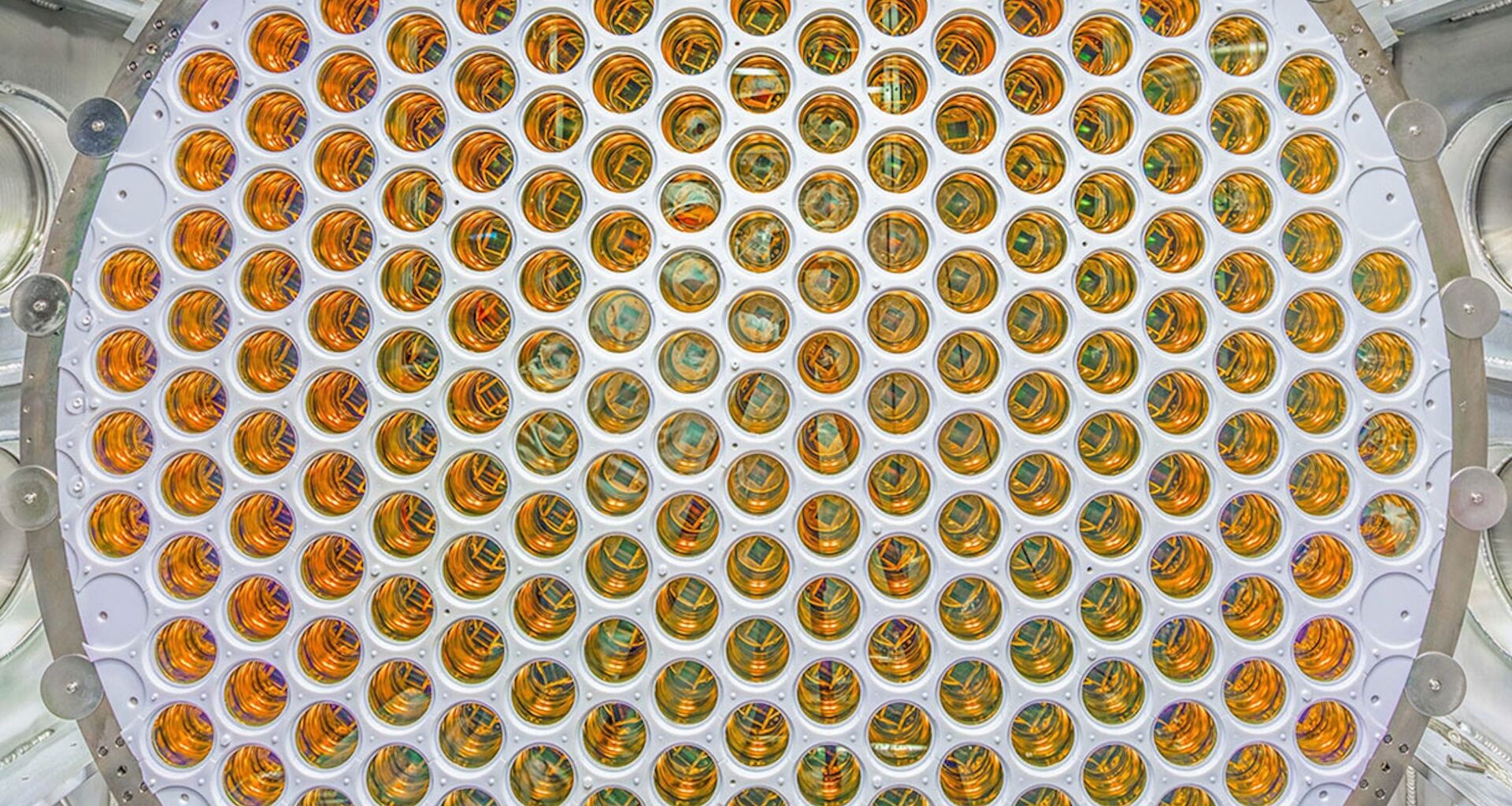
 The LUX-ZEPLIN central detector. Source: Matthew Kapust / Sanford Underground Research Facility
The team set out to explore whether WIMPs could have masses between five and ten GeV/c2 (gigaelectronvolts/c2). Previously, researchers had placed artificial limits on these energy signatures, meaning the new analysis charts previously unexplored terrain.
Within these low-mass regions, the team found boron-8 neutrino signals. These are tiny, ultra-fast particles that emanate from the Sun’s core. They interact with xenon atoms in a way that dark matter particles should. This means that LUX-ZEPLIN should also be able to detect dark matter.
Scientists are ‘ready to discover’ dark matter
Incredibly, the new results show that dark matter detection could happen at any moment. The LUX-ZEPLIN project aims to collect 1,000 days of data, meaning there will be plenty of opportunities to test the latest findings.
“These results are really exciting because we’ve opened a new window into the universe as the leading dark matter experiment for WIMP dark matter at these low masses,” Dr Jim Dobson from King’s College London, one of the scientists who took part in the investigation, explained in a press statement.
“Every time we open a new dataset, we can see dark matter, and observing this known neutrino signal means that we can have confidence that if a dark matter signal is there, we’re ready to discover it,” he continued.
The LUX-ZEPLIN project comprises 250 international scientists, engineers, and support staff.