
A day after Anant Ambani received the Global Humanitarian Award for wildlife conservation, a small group of surfers and tourists in Varkala found themselves fighting their own, quieter battle to protect the ocean.
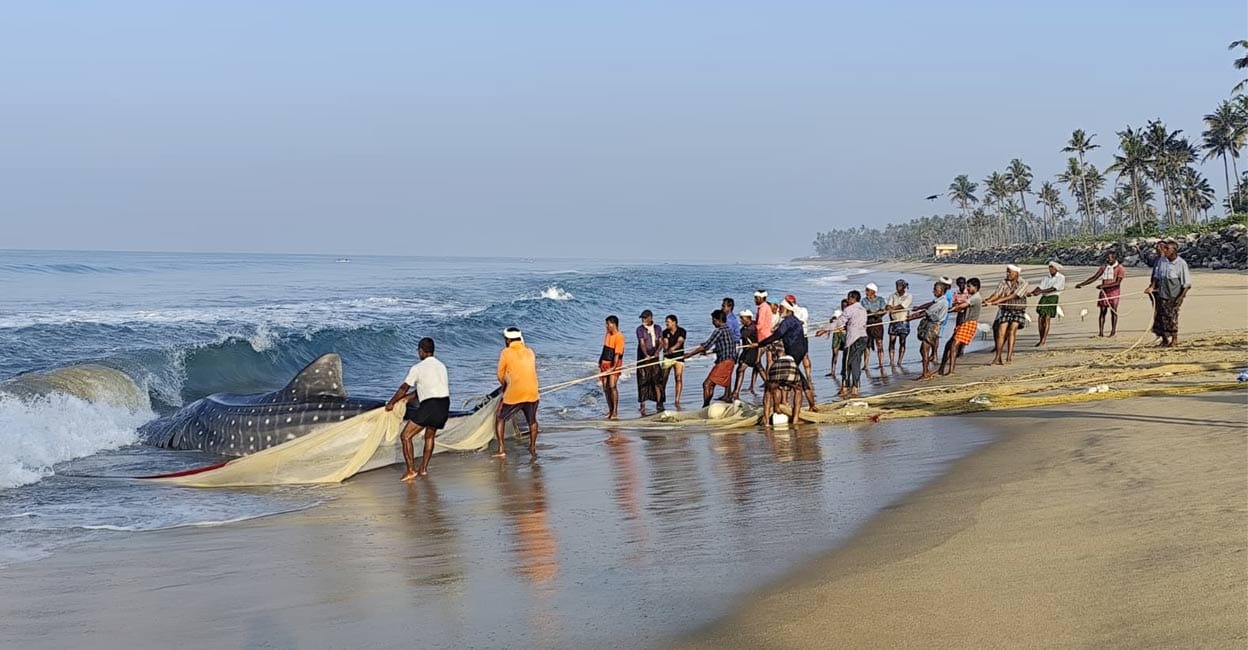
On December 9, Rakhul Shyamraj and fellow surfers from Soul & Surf arrived at Kappil beach, 8km from their Varkala retreat, for a routine session. The usual calm had been replaced by commotion. Fishermen were dragging a massive dark figure from the water. Up close, the white spots and broad fins made it unmistakable. A whale shark, ensnared in a seine net, lay nearly motionless on the sand.
“I was amazed when I saw it, but also heartbroken because it was dying,” Rakhul said.
The surfers rushed in, telling the fishermen that the whale shark, classified under Schedule I of the Wildlife (Protection) Act, 1972, is protected by law and cannot be captured. It is also listed as “endangered” on the IUCN Red List. According to Dr P Pugazhendi, IFS, the species faces its gravest risks from bycatch and vessel strikes, but “its biggest enemy is ignorance.”

Rakhul and two foreigners near the Whale Shark. Photo: Aswin Daniel/ Special Arrangement.
That ignorance played out on the beach. The fishermen were unaware of the legal and ecological significance of the animal. As its breathing grew laboured, they attempted to estimate its market value. They initially offered to sell it to the surfers for ₹50,000. To diffuse the situation, Rakhul verbally assured to pay ₹25,000 if they helped return the shark to the sea.
Under the harsh sun, surfers, foreign tourists, and a few fishermen began an improvised rescue effort. They kept the shark’s gills wet and pushed the 15-ft fish towards deeper water. They managed to eventually secure the help of two fishing boats to guide it seaward before the tide receded.
By the time the police and the Fire and Rescue Services arrived, the fishermen understood the seriousness of the matter, and the money talk evaporated. A quick online search by Rakhul showed them that the Wildlife Trust of India, in collaboration with the Forest Department, offers ₹25,000 to fishermen who assist in whale shark rescue operations.
Rakhul watches the shark return home. Photo: Aswin Daniel/ Photo: Special Arrangement.
The rescue was physically punishing. The shark’s rough, sandpaper-like skin cut through their hands, and its sheer weight posed a real danger. “Many of us were injured. If it had rolled on someone, they could have died,” Rakhul said. What troubled him more was the indifference of onlookers. “Some did not know how to swim, but largely it was a lack of awareness. Many believed whale sharks harm humans,” he said.
Dr Pugazhendi stressed that whale sharks are gentle filter feeders which consume plankton, krill, fish eggs, and small schooling fish. The Forest Department, he said, had been conducting awareness programmes along the coast, especially among fishing communities.
Rakhul noted that the challenge extends beyond marine species to everyday attitudes. “We treat the ocean like a dustbin. The phrase ‘kadalil kondu poyi kala’ (throw it into the sea) shows how normalised this behaviour has become,” he said.
Rakhul rushed in to help the whale shark. Photo: Aswin Daniel/ Special Arrangement.
For the surfing community, he said, the ocean is more than a workplace. “We work with nature. Many of us choose this life because we want to protect it,” he added.
As the rescued whale shark finally regained momentum and disappeared into deeper waters, relief gave way to a sobering sight: a plastic wrapper clinging on one of its fins. It was a reminder that while one life had been saved, the larger struggle for marine conservation continues.