
When Geordie Beamish fell in the heats of the 3000m steeplechase at this year’s World Athletics Championships and a rival stood on his head, it seemed as if that would be that for the then 28-year-old. Before the September championships in Tokyo, the New Zealander’s best time in 2025 was
only 31st in the world, so he hadn’t been given much of a chance, even before being forced to eat his opponent’s spikes. Incredibly, he didn’t just get up from the fall, but went on to finish second, qualifying for the final.
That alone would have made for a pretty decent Hollywood ending had he not, two days later, produced one of the most incredible runs by a New Zealander since Kiwi in the 1983 Melbourne Cup. In sixth place coming around the last bend in the final, he produced a phenomenal burst of speed to blow past the pack until the only person between him and the gold medal was Soufiane El Bakkali, the seemingly unbeatable Moroccan who had won the event at the last two Olympics and last two World Championships. Beamish steamed past him metres from the line to win New Zealand’s first ever track gold at a world athletics championships.
Geordie Beamish stuns “unbeatable” Moroccan Soufiane El Bakkali at the World Athletics Championships. Photo / Getty Images
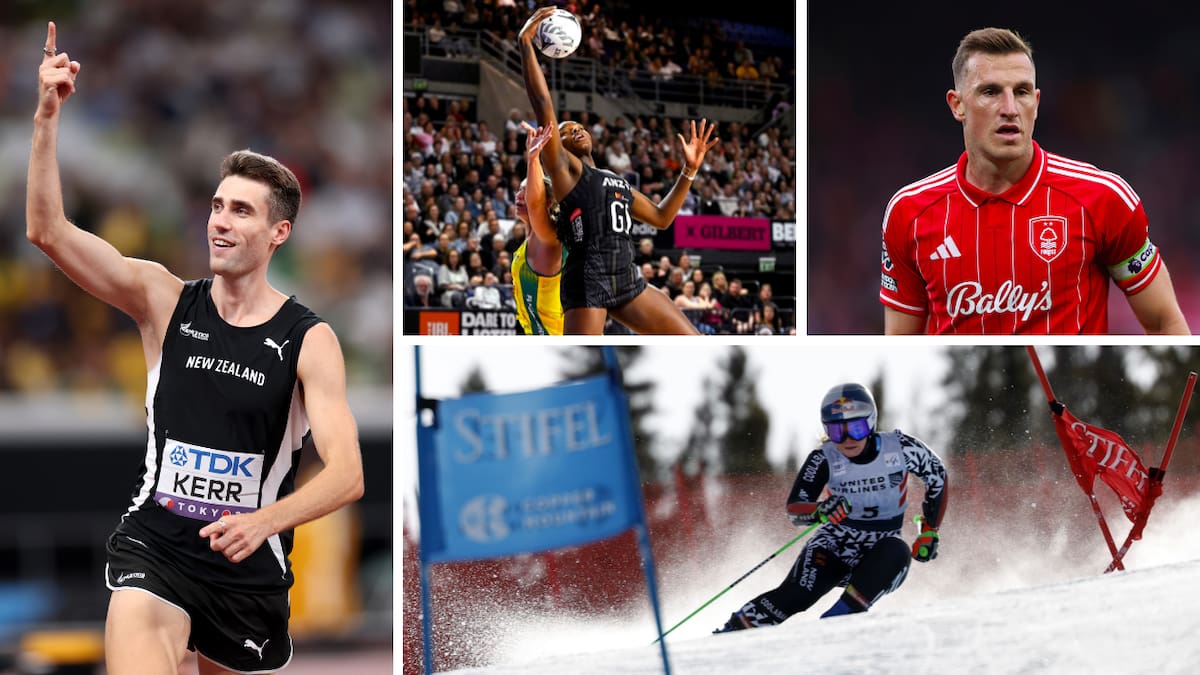
It was to be New Zealand’s greatest ever world championships: Hamish Kerr won gold in the high jump to go with his gold at last year’s Olympics and Maddi Wesche took bronze in the shot put. It was nearly even better: Wesche was leading her event for five of the six rounds and nearly took back the lead in round six with a monster throw, only for it to be ruled foul. Nevertheless, New Zealand finished fifth-equal on the medal table ahead of Great Britain, China and Australia.
Rugby
Until the unexpected glory of the World Athletics Championships, it had seemed our biggest chance for global success this year might be at the Women’s Rugby World Cup, where the Black Ferns were seeking to turn around a relatively poor spell of form in their otherwise illustrious history. In the years since the emotional high of their World Cup triumph at Eden Park three years ago, they had lost games against France, Ireland, Canada and England (who they hadn’t beaten since that ridiculously entertaining 2022 final).
But when the Ferns lit up the tournament with their attacking play in the pool games, destroying Ireland 40-0 then scoring 46 points against South Africa in their quarterfinal, it seemed they might once more be the irresistible force of old. But their vaunted attack was almost completely shut down by Canada in the semifinal and another painful chapter was written in the book of New Zealand teams at Rugby World Cups.
The All Blacks’ loss to South Africa in Wellington was their biggest-ever defeat. Photo / Getty Images
The All Blacks, who had written most of those stories, briefly became the world’s No 1 ranked team in a season when it would be hard to argue they deserved it. They were erratic, disjointed and generally representative of the malaise of the sport as a whole: beaten by Argentina, flayed by South Africa, comeback win against Ireland, scraped home against Scotland, flayed by England. Scott Robertson, seen by so many for so long as the All Blacks’ saviour, now in his second season as coach, looks like just another guy trying to survive the most unforgiving job in the country.
Football
With the Black Ferns, All Blacks and rugby as a whole mired in mediocrity – a term also applicable to the Warriors in league – New Zealanders should give thanks for football, which provided plenty of highlights for both the patriot and lover of a good underdog story.
It was such a good year for football that the All Whites’ third successful qualification for the Fifa World Cup was only the sport’s fourth best story. The best, or at least the most likely to be turned into a movie starring Dwayne “The Rock” Johnson, was that of the journeymen of Auckland City who took leave from their day jobs as labourers and office workers to go forth as lambs to the slaughter at the hands of the filthy rich superstars at the Fifa Club World Cup.
Bayern Munich smashed them 10-0 in their first pool game; Portuguese giants Benfica thrashed them 6-0 in their second. In their final game, against Argentina’s great Boca Juniors, they went behind to an early goal and it seemed another hiding was imminent, but then the bald dome of Christian Gray (The Rock) rose from among a mass of bodies, nodded in a corner, then sat for the next 40 minutes like a block of cement in front of his own goal, rebuffing the inevitable Boca onslaught and helping his team to a never-to-be-forgotten draw. They were knocked out, of course, but it was the most glorious knockout ever.
Auckland City’s Christian Gray scores against Boca Juniors at Fifa’s Club World Cup. Photo / Getty Images
Had it not been for Auckland City, the A-League triumphs of Auckland FC would have been the football story of the year. In the professional team’s debut year, it finished top of the round-robin league season, its success bringing big crowds to football in this country on a regular basis for the first time since the Wellington Phoenix had that good season.
Arguably the greatest fairytale of all was that of All Whites’ striker Chris Wood, who, aged 33, scored an astonishing 20 goals for his English Premier League side Nottingham Forest. Before the season, the Premier League’s official statistics partner predicted Forest would finish 17th. In the end, Wood’s goals helped them to seventh, qualifying them for European competition for the first time in 30 years. Only international superstars Erling Haaland, Mohamed Salah and Alexander Isak scored more goals than he did. His fellow players voted him into the Professional Footballers Association’s “Premier League team of the year”. Haaland didn’t make it.
Netball
Although football had a banner year, netball had one best forgotten – which is a shame, because were it not for the lingering mystery of what happened to Silver Ferns’ coach Dame Noeline Taurua, the story would have centred on the team’s phenomenal comeback in the four-match Constellation Cup series with Australia. After getting thrashed in the first two games, the apparently down-and-out Ferns under an interim coach won the next two matches, forcing a dramatic extra-time decider, which they lost by just one goal.
But hanging over it all was the fact that, earlier in the year, several unidentified players had expressed “concern” about the Ferns’ team environment, saying they felt unsafe. Eventually, a meeting was held, after which Taurua was stood down. Six weeks later, she was reinstated, having agreed with Netball NZ to “implement enhancements” that would support “wellbeing and performance” and strengthen “the player voice”.
While the focus was on coach Noeline Taurua’s suspension, Grace Nweke starred in the fourth Constellation Cup game against Australia. Photo / Getty Images
At press time, months after Taurua was first stood down and more than a month after she was reinstated, no one outside Netball NZ appears sure exactly what happened or how it was resolved. As a case study in communication failure in sport in this country, it has no peer. The comment from Netball New Zealand’s chief executive Jennie Wyllie to RNZ’s Dana Johannsen was a paradigmatic example of how empty words can be: “We had issues in the environment, and it was something that we couldn’t walk past.”
Cricket
On the cricket pitch, the White Ferns’ season centred on the ODI World Cup in India in October, and by that measure, it’s hard to see it as anything other than a disappointment. The team played seven games and won only one, against a poor Bangladesh side, although two games against lower-ranked opponents were washed out.
Maddy Green, left, and Polly Inglis of the White Ferns during game two of the Women’s ODI series, which resulted in a another loss. Photo / Getty Images
For the Black Caps, the highlight was reaching the final of the ICC Champions Trophy, then whitewashing England and the West Indies in consecutive ODI series. At press time, they were the second-ranked ODI side in the world. In tests, however, they were ranked fifth, after a year in which they again hardly played any. By the time they played their first test of the year, against Zimbabwe on July 30, they’d played 25 one-day or T20 internationals. After that two-match series, they didn’t play another test until December 2.
Motorsport
For Liam Lawson and Kiwi motorsport fans, the year promised so much. For the first time since the glory years of Bruce McLaren, Denny Hulme and Chris Amon, New Zealand had a driver in a competitive F1 car in more than a temporary role. So it was disappointing when Lawson was sacked after two races as teammate to world champion Max Verstappen with Red Bull Racing and sent back to its feeder team, Racing Bulls, alongside French rookie Isack Hadjar. He had his moments, including two Grand Prix where he finished fifth and sixth, but was outperformed by Hadjar, who finished the season by being promoted to Lawson’s old role alongside Verstappen. Still, Lawson retained his seat for next year. Alongside Scott Dixon and Scott McLaughlin in the US IndyCar Series and Shane van Gisbergen in Nascar he’s part of a golden generation of New Zealand drivers.
Rough year: Liam Lawson. Photo / Getty Images
Snowsports
On the piste, Zoi Sadowski-Synnott claimed four World Cup podiums including three golds, and a gold and bronze at the X Games, and became the first Kiwi female to win the overall Snowboard Slopestyle World Cup. Skier Alice Robinson was not to be overshadowed, securing New Zealand’s first alpine ski world championships medal with silver in the giant slalom in Austria in February, and finishing the year with consecutive wins to lead the World Cup giant slalom standings. Both, along with freestyle skier Luca Harrington. are tipped to figure prominently at February’s Winter Olympics in Italy.
Zoi Sadowski-Synnott winning the Big Air final at Aspen in February. Photo / Getty Images
Golf
And finally, no review of any year in New Zealand sport is complete without mention of Lydia Ko. It was always unlikely Ko’s 2025 could top 2024, when she won an Olympic gold medal, her third major and entered golf’s Hall of Fame. Nevertheless, she added another title to her name and finished the year ranked sixth in the world.
She is approaching 30, the age she has always maintained she will retire by. It has always felt far too young; now it feels far too close. She is a genuine all-time great in a truly global sport. Our top male, Ryan Fox, will never reach such heights, but he did enjoy a breakthrough year with two wins on the US PGA tour, where he earnt US$4m (NZ$6.9m) in 2025.
Left, Lydia Ko and Ryan Fox, right.SaveShare this article
Reminder, this is a Premium article and requires a subscription to read.
Copy LinkEmailFacebookTwitter/XLinkedInReddit
Tags:
- % chance
- 2025
- 28yearold
- 3000m
- 31st
- athletics
- beamish
- been
- before
- being
- best
- championships
- Diamonds
- didnt
- even
- fall
- fell
- final
- finish
- forced
- from
- geordie
- given
- hadnt
- head
- heats
- in
- incredibly
- Just
- much
- New Zealand
- NewZealand
- NZ
- only
- opponents
- our
- qualifying
- reviewed
- rival
- rough
- second
- seemed
- September
- spikes
- sporting
- Sports
- steeplechase
- stood
- that
- the
- then
- this
- time
- Tokyo
- went
- when
- world
- would
- year
- years
- zealanders