
 24/7 Wall St
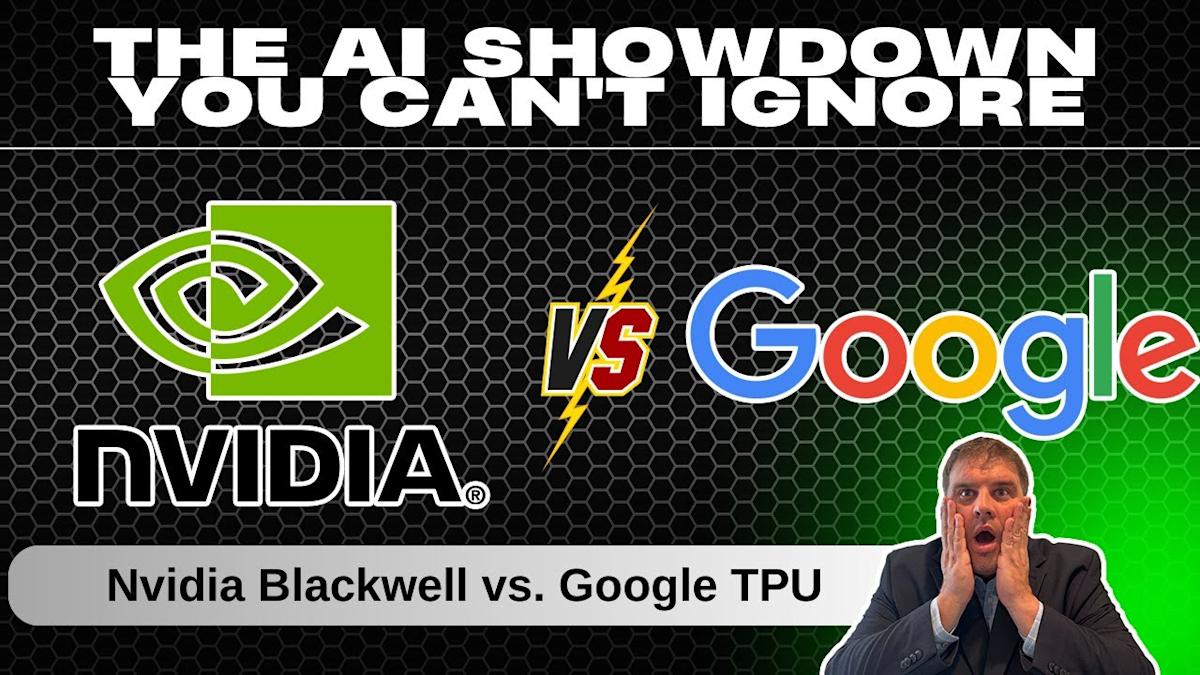
Google’s custom TPU chips are emerging as a serious challenger to NVIDIA’s GPUs, driven by potentially lower total cost of ownership through cheaper pricing and higher energy efficiency.
Investor sentiment has shifted sharply, with companies tied to the TPU supply chain—such as Broadcom, Celestica, and TTM Technologies—far outperforming those more dependent on NVIDIA as expectations for massive TPU deployments grow.
Controlling energy use and cost per token are key variables to giving companies competitive advantages when it comes to the future of the AI hardware landscape.
If you’re thinking about retiring or know someone who is, there are three quick questions causing many Americans to realize they can retire earlier than expected. take 5 minutes to learn more here
During a recent episode of The AI Investor Podcast, 24/7 Wall St. analysts Eric Bleeker and Austin Smith broke down the competitive dynamic between Google (NASDAQ: GOOGL)’s custom TPU chips and NVIDIA (NASDAQ: NVDA)’s GPUs, which currently dominate AI compute.
As application-specific chips, TPUs are more energy-efficient and potentially cheaper than NVIDIA’s more general-purpose hardware. This could set the stage for a major shift, especially as Google considers selling TPUs externally, including to Meta (NASDAQ: META), transforming what was once an internal tool into a large commercial business. As one example of TPU’s spreading influence, in their latest conference call Broadcom (NASDAQ: AVGO) announced their agreement to sell TPU chips to Anthropic has now reached $21 billion by the end of 2026. With Wall Street forecasting $86 billion in sales next year for Broadcom, you can see how much influence the deal has on their top and bottom lines.
A core theme in this debate is the total cost of ownership—the combination of chip price, energy usage, and performance—which remains difficult to measure but is crucial to determining whether TPUs can truly undercut NVIDIA. Recent reports from Semi Analysis claim TPUs already offer lower total cost of ownership than NVIDIA’s current generation, which caused significant pressure on NVIDIA shares in recent weeks.
As a result, stocks tied to Google’s TPU ecosystem—Broadcom, Celestica (NYSE: CLS), and TTM Technologies (NASDAQ: TTMI)—have surged far more than companies tied primarily to NVIDIA’s ecosystem.
But as The AI Investor Podcast hosts remind their audience, NVIDIA is unlikely to be displaced and should continue performing strongly.
If the video embed isn’t working, you can access the full video at the following URL: https://247wallst.com/investing/2025/12/14/the-ai-showdown-you-cant-ignore-in-2026-the-full-nvidia-blackwell-vs-google-tpu-battle-explained
This conversation was from our most recent episode of The AI Investor Podcast. It’s free to subscribe in your favorite podcast player and every episode we give updates and recommendations in a $500,000 portfolio filled with our top AI stock ideas.
We’ve recommended TPU stand-out stocks like Lumentum (NASDAQ: LITE), which is up 286% since we first called it, and Broadcom. Our multiple Broadcom recommendations are up 100% and 98%, respectively.
You can listen to our most recent episode in either Apple Podcasts or Spotify below:
Austin: There’s a Goliath versus Goliath battle teeing up here, and I find this one fascinating. I’m talking about Google’s TPUs versus NVIDIA’s Blackwell. What’s interesting to me about this one is that Google’s had their TPU, which is an ASIC chip for a long time, and this is a purpose-built chip. ASICs are application-specific integrated circuits and they are custom designed for one more narrow specific task.
So they’re not as flexible as GPUs, which is what NVIDIA is selling to power this AI revolution. But they have the downstream benefit of being generally a lot more energy efficient at that task because they’re application-specific. You’re just removing a lot of the excess capacity and power demand.
So Google’s TPU is something that they’ve had in-house to train YouTube for a long time. The biggest story right now is that Google is going to be selling this to potentially Meta Platforms to build their TPU chips. That’s interesting because this is like the investment thesis that’s been out there for years that people kind of forgot about and rediscover every couple years.
It’s the “Macy’s real-estate thesis,” right? The real estate that Macy’s owns is more valuable than the market cap of the company. It feels like that around every few years, people rediscover it. People have been talking about Google’s TPU as a business line for a long time, and it’s surprising to me that it ended up sort of getting rediscovered now when Google is one of the most covered companies on Earth.
But let’s talk about what people are saying about these chips and what you’re seeing. And then we can talk a little bit about the investment implications.
Eric Bleeker: Yeah, I think that was a good tee-up on what TPUs are. You go from CPUs to GPUs to TPUs in terms of kind of from being general to more specific. But yeah, this has become the biggest story in investing spheres. You’re not going to open up probably CNBC and see a headline about TPUs, but if you’re talking with people that are in the investing space, this has been the hot core of what’s being discussed and moving market cap in a way that might surprise you as we get into how much this NVIDIA vs TPU debate has shaped performance across the entire AI sector.
The background is NVIDIA right now, they’re charging 70% margins. So if you’re a company that, you think about Meta, it’s a $200 billion top-line business spending a hundred billion in capital expenditures. This is now 50% of your revenue, in terms of cost, is just buying compute. So if you’ve got a company that you’re paying that a hundred billion to, that’s commanding 70% margins, you can see you’re really incentivized to find a way either around that company, or to reduce that cost structure.
And with TPUs, Google’s looking at more of a 40-50% kind of margin on that cost structure to a company like Broadcom and some of the other partners. So if you can have that margin, and you can get a lot of traction, you have what might be a massive competitive advantage, right? Suddenly we’re talking about AI compute being a $500 billion-plus maybe up into a trillion-dollar annual industry. If your margin profile is 20 points better, you’re going to be kind of the lowest-cost producer of “tokens,” and you’re going to be able to win in this market.
Austin: One of the things we’ve talked about is ultimately if you really get the AI industry down to its most fundamental level, it is who can effectively capture and control the most electrons in the most efficient way. And that’s sort of the argument people are now making around TPUs, that they are so affordable; that margin conversation you’re talking about is one of the driving factors. If Google’s custom chips have a 40-50% margin, you can buy more effective compute per dollar.
Now, I want to be clear and clarify a little bit, and maybe the answer is both: when you say 40-50% margin, do you mean that as, is that on the sale of the chips (in which case the buyers can buy more compute more effectively than from NVIDIA, even though NVIDIA’s chips are more powerful and broader-based)? Or do you mean a 40-50% savings on energy consumption, after you’ve bought them, because my understanding of the TPU advantage, aside from being more affordable initially, is that they are also significantly more efficient per kilowatt, even if they’re not as powerful chips. So is that margin on initial acquisition, or on long-term utilization, or both?
Eric Bleeker: Well, you’re asking the trillion-dollar question right now, Austin, because I’m specifically referring to margins for companies involved here, NVIDIA versus something like Broadcom or Marvell Technology or other compute-infrastructure companies. But your question gets to the core of what you’re ultimately getting at: total cost of ownership.
And that’s been the big debate these past few weeks, because total cost of ownership includes cost of chips, energy cost, and relative performance. It’s a very tough thing to really get at, and a lot of the information is proprietary. But what happened was a firm named Semi Analysis published some research.
Austin: Semi Analysis?
Eric Bleeker: I have read it once or twice. But this company is driving the narrative in the markets.
Austin: I think Semi Analysis has to send you a thank-you basket at this point. I don’t know how many members you’ve sent their way.
Eric Bleeker: I think we’ve sent them some traffic. But yeah, they say that essentially the total cost of ownership for TPUs was better than for the current generation of NVIDIA. Now, Austin, I will say, what’s happened from all this debate: if you look at two baskets. Basket #1 is companies with broad exposure to Google and this TPU infrastructure: that would be Google itself; Broadcom; TTM Technologies; Celestica; and Marvell. If you look at this category, since last November to today, it would be at 265 (index value), outperforming dramatically.
If you look at companies more exposed to NVIDIA and companies tied to other kinds of AI-compute cycles like Oracle, Advanced Micro Devices, Microsoft, NVIDIA itself, or others like CoreWeave (not publicly traded), that basket is only at 134. So 34% gain vs 164% gain.
So, Austin, right now the market is really pricing in massive gains for this TPU-related complex. And the reason is a few things. Number one: Google’s model (Gemini) looks very strong.
Austin: Fantastic rollout. Changed a lot. People who were previously using older models, I mean, every few months you see someone say, oh, this new model from some company is “breathlessly great,” and then we wait for the next big competitor (like Claude or others) to show up. I don’t know where we are in that circle. But no doubt that the recent version of Gemini seems to really impress people, not just with broad model performance but also video-generation capabilities.
Eric Bleeker: Yeah, they released Gemini, it’s moved to lead reports, as you noted. It’s very good in many categories like spatial awareness, and this is fueling narrative for all things Google-connected. But we also have Meta looking to go big into TPUs, and also firms like Anthropic (private) potentially ordering many TPUs.
As I believe you know earlier, there could be an order of a million TPUs just from them. But Austin, the key point here is that when estimates for TPU demand come up, companies in this TPU envelope can see incredible gains. So an incremental 1 million TPUs next year could add US$10 billion of revenue to Broadcom. Their estimates for next year are US$86 billion, so that’s a massive increase. TTM Technologies (NASDAQ: TTM), which builds the printed-circuit boards (backplanes) that wire together chips, memory, interconnects and TPU hardware, might see an additional $800 million from an extra 1 million TPUs (on top of their forecast total revenue of $2.9 billion). And Celestica could add US$500 million from that incremental 1 million TPUs (against total revenue of $16.2 billion).
With estimates now pointing to maybe 3 million TPUs in 2026, 5 million in 2027, and 7 million in 2028, anyone can do the math and see why companies in this TPU-cycle have seen such phenomenal gains, because it really is a fairly tight group of firms. As those estimates increase, some of these companies begin looking at doubling relative to Wall Street’s expectations.
So I’ll just end with a few key clarifications, because I know this is a broad discussion, but one thing is clear: NVIDIA is going to be just fine. We tend to get very zero sum in our analysis of companies. Nvidia is going to have strong leadership through its next cycle and TPUs are having a moment right now. But like you said, narratives flip and move. The narrative is at peak Google right now but it’s not pure gravy for Google because if they do want to go out and sell TPUs, they are reducing a key competitive advantage for their own cloud hosting. So, there is a little bit of a tough decision for Google to make here. But overall, Austin, I just wanted everyone out there to understand the companies aligned with this TPU complex, why they’re seeing such strong gains, we own some of them in the portfolio, and to say, I don’t have a zero-sum mindset on this and I think Google is going to be just fine.
You may think retirement is about picking the best stocks or ETFs, but you’d be wrong. Even great investments can be a liability in retirement. It’s a simple difference between accumulating vs distributing, and it makes all the difference.
The good news? After answering three quick questions many Americans are reworking their portfolios and finding they can retire earlier than expected. If you’re thinking about retiring or know someone who is, take 5 minutes to learn more here.