
By Chris Trotter*
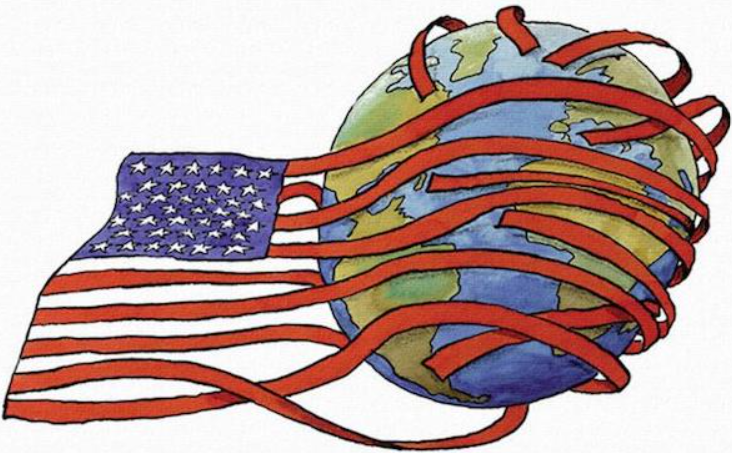
Rory Stewart, the former Conservative Party cabinet minister, last week offered the world a truly disturbing image. He and Alastair Campbell, co-host of the podcast “The Rest is Politics, were examining the “National Security Strategy of the United States of America November 2025” (NSS25) and Stewart, clearly as stunned as many other political commentators around the planet, observed that it was as if the United States had “ripped off its mask”.
What NSS25 confirms, according to Stewart, is that all the accusations levelled against the United States by its critics over the last 100 years were nothing less than the truth; the USA is indeed a ruthless, violent, and exploitative regime; which bears no resemblance to the wholly benign entity, the “indispensable nation”, the “shining city set upon a hill”, that America’s defenders have presented.
Campbell, Tony Blair’s indispensable spin-doctor, did not dispute his Tory co-host’s analysis. He, too, seemed utterly flabbergasted by NSS25.
This was hardly surprising, since, as he read the document, Campbell could hardly have avoided the bitter conclusion that all the people who warned Blair and his government back in 2003 had got it right. “Sexed-up” dossiers notwithstanding, by joining the US attack on Iraq the United Kingdom was participating in an act of naked aggression – a clear breach of international law.
According to the geopolitical logic of NSS25, however, the US was perfectly justified in imposing its will on Iraq in 2003. What’s more, the US is now ready to impose it again upon any nation, or combination of nations, foolish enough to stand in its way. As the document insists over and over again, the United States is the mightiest nation on Planet Earth, and as far as the administration of President Donald Trump is concerned, might is always right.
How should New Zealand respond to this new – unmasked – United States? Where should we stand in this radically changed geopolitical environment? Should we be moving closer to the Americans, or distancing ourselves from them? Whichever option we choose, the diplomatic, economic and military consequences will not be trivial.
Given the temperament and ideological positioning of both New Zealand’s foreign minister, Winston Peters, and its defence minister, Judith Collins, this country’s initial response to NSS25 is likely to be one of cautious support. Both politicians will find much to applaud in the Strategy’s clear determination to gird-up America’s loins for the looming struggle with the Peoples Republic of China. Whether this initial enthusiasm survives their encounter with the brutal policies the US intends to adopt to retain/regain its global hegemony is much less certain.
NSS25 makes it clear that the US is currently too closely involved and dependent upon the Chinese economy to risk an immediate challenge. Instead, the document indicates a measured disengagement from China’s increasingly unchallengeable spheres of influence in East and South Asia, to be offset by the rapid and ruthless assertion of US power in the Western Hemisphere.
From the Arctic to the Antarctic, from Greenland to Terra del Fuego the hemisphere is to become America’s natural resource base and cheap labour reservoir.
If the nations of Central and South America fail to make the necessary ideological adjustments – i.e. refuse to get rid of their socialist governments – then American intervention can be anticipated. In a naked and unilateral reassertion of the 1823 “Monroe Doctrine”, any and all “foreign” powers currently engaging in resource extraction and/or significant industrial development in the Western Hemisphere will be expected to vacate the markets they have developed in favour of American investors. What punitive tariffs cannot achieve, American aircraft carriers will secure.
That this strategy amounts to a great deal more than a bombastic declaration of predatory intentions is attested to by the current massive build-up of military resources off the coast of Venezuela. The message could not be clearer to the socialist regime presided over by Nicolás Maduro: “Get out now, or we will take you out.” And, lest anyone should be in any doubt about America’s ruthless words being backed by ruthless deeds, more than a dozen vessels alleged to be transporting narcotics to the United States have already been blown out of the water – along with their defenceless crews.
The impact of such aggressive power projection on the formulation of New Zealand foreign affairs and defence policies can only be considerable. Washington will expect Wellington to back without reservation every one of its reconditioned imperial ambitions. Such residual support for the United Nations, and for the international conventions ratified by its member states since 1945, as remains in New Zealand society will be disregarded. Those elements of New Zealand society unwilling to accept the effective re-colonisation of the Western Hemisphere (and South Pacific?) should expect to be disciplined.
But Māori won’t be alone in registering the cultural impact of this resurgent American imperialism. That part of the New Zealand population that looks to the British Isles and Europe for cultural inspiration and solace will have to adapt to a world in which the USA has emboldened and empowered the Russian Federation as a counterweight to expanding Chinese influence on the Eurasian landmass.
In effect, the geopolitical breakthrough effected by Richard Nixon’s and Henry Kissinger’s opening to Beijing in the early 1970s is about to be reversed. It is difficult to see how Ukraine – or even Nato – will be able to accommodate the Trump Administration’s opening to Moscow. Not when the American Right’s detestation of Europe is so openly on display.
One has only to parse the following extraordinary passage from NSS25 to realise just how little the United States now cares for the rest of the world’s good opinion:
“As Alexander Hamilton argued in our republic’s earliest days, the United States must never be dependent on any outside power for core components—from raw materials to parts to finished products— necessary to the nation’s defense or economy. We must re-secure our own independent and reliable access to the goods we need to defend ourselves and preserve our way of life. This will require expanding American access to critical minerals and materials while countering predatory economic practices. Moreover, the Intelligence Community will monitor key supply chains and technological advances around the world to ensure we understand and mitigate vulnerabilities and threats to American security and prosperity.”
Be warned China: when the USA no longer needs you, it will come for you.
Be warned New Zealand: An America made great again will have no need of allies – only vassals.
The mask is off.
*Chris Trotter has been writing and commenting professionally about New Zealand politics for more than 30 years. He writes a weekly column for interest.co.nz. His work may also be found at http://bowalleyroad.blogspot.com.