The Famous Project CIC Jules Verne Trophy record attempt – Day 15
by Agence TB Press 14 Dec 07:38 PST
14 December 2025
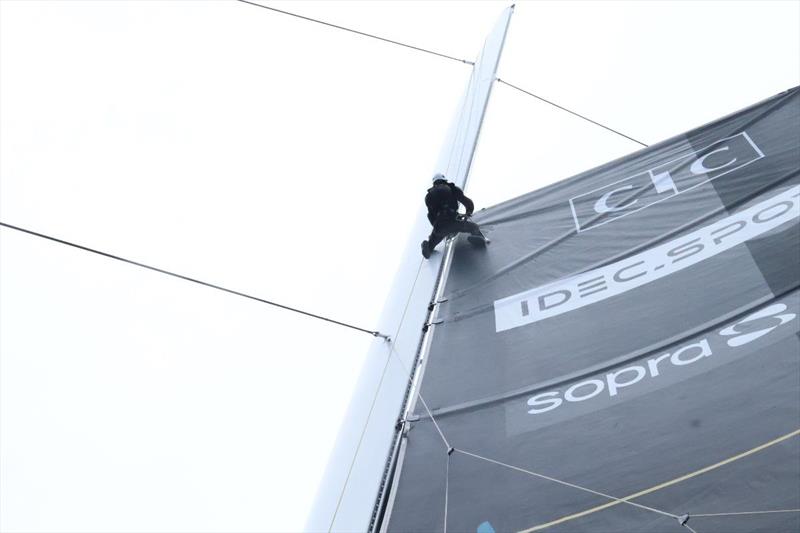
The Famous Project CIC, aboard the maxi trimaran IDEC SPORT, during their Jules Verne Trophy record attempt © The Famous Project CIC
A wounded IDEC SPORT maxi trimaran, mainsail blocked at the second reef. 16,800 miles (31,114 km) to go, handicapped, on the most hostile oceans on the planet. Cape Town straight ahead, its sirens calling for a stopover… so many axioms and possibilities that, for the past 36 hours since the hook broke, have been running through the hearts and minds of the eight women of The Famous Project CIC.
Stopping to repair and continuing to sail means losing the Jules Verne Trophy. Above all, it is a dream, a desire, a passion, that of becoming the first female crew to complete a non-stop, unassisted circumnavigation of the globe on a maxi multihul, that is dying. And on this fifteenth day of adventure, none of the eight women sailors is ready to give up on this project of a lifetime, this unprecedented nautical Holy Grail.
So, hook or no hook, reduced sail area or not, the decision was unanimous, amid tears, sighs and sisterhood, Alexia (Barrier), Dee (Caffari), Annemieke (Bes), Rebecca (Gmür Hornell), Deborah (Blair), Molly (LaPointe), Támara (Echegoyen), and Stacey (Jackson), looking each other in the eye, irrevocably chose to continue their adventure. They will see it through to the end! The long road continues, despite the uncertainties, the unknowns, and the doubts. The Famous Project CIC will keep its promises. “Because a dream is a lie if it doesn’t come true” (Bruce Springsteen – The River).
Stubborn mainsail hook
For six hours last Friday, the entire crew of The Famous Project CIC worked together on the deck of the Maxi trimaran, which was moving slowly in the heart of the South Atlantic. The cause was a stubborn hook, stuck and blocked, preventing the mainsail from being raised to the second reef. A hook is a kind of clasp that takes the tension of a sail’s luff and sends it to the top of the mast. The sail is hoisted and locked at the top with this hook. Disassembly, inspection, repair, reassembly… at the cost of several climbs outside but also inside the boat’s wing mast, each crew member patiently and diligently took their turn in these repair attempts: “Bex, first,” explains Alexia, “An incredible willpower. Raw talent. She climbed inside the mast, more than fifteen meters high, in rough seas, to check the part to which the hook is attached. We could hear her on the VHF. With every jolt, a groan. It’s violent up there. And we, down below, felt bad for her. Molly, always ready to tinker. Debs and Annemieke, searching, rummaging, finding the right equipment. Stacey, with her ideas, her experience, her insight. Meanwhile, Tamara was at the helm. Dee listened, coordinated, and kept an eye on the big picture. And I was in constant contact with the team on shore to receive, cross-check, and relay information.”
So why and how should we continue on our way?
But it was a wasted effort! The mainsail remained stubbornly stuck at the second reef. With the J3 (staysail) at the bow, the maxi trimaran was perfectly rigged for the conditions at the time, with the arrival of this large southern depression and its winds of nearly 40 knots. Heading due east, the maxi trimaran regained a steady pace and the crew postponed their hopes of possible repairs until they reached South Africa. Insidiously, however, the idea of a pit stop, or even abandoning the race, began to creep into their minds.
“We thought it was a deal-breaker and started to get used to the idea of having to stop,” Alexia continues. “I asked Christian Dumard (shore-based router) to calculate routes at 70% of our potential, to assess our ability to sail at a reasonable speed. We had to accept sailing in our current configuration, with the enormous constraint of having to stop the boat for several hours each time we changed reefs. We are at the gateway to the Southern Ocean and we decided it was worth continuing. We shared these perspectives with each other, and off we went again!”
The adventure of The Famous Project CIC continues. Alexia and her seven crew members will have to reinvent another way of sailing, sometimes under sail, with different angles to the wind, different ways of carrying their headsails—in short, other difficulties added to their titanic challenge around the world. Challenge accepted, which gives even more depth, spice, and merit to this circumnavigation of discoveries and unknowns.
Alexia Barrier…
“You may not believe me… but we almost decided to stop. We’ve been thinking about it for two days. Two days of thinking about nothing else. We’ve been evaluating. Analyzing. Turning the question over and over in our minds.
Because, in a great adventure, the most difficult decision to make… is not to set sail. It’s to give up.
The mechanical failure we’ve suffered is not trivial. It’s serious. But it doesn’t jeopardize our safety. It jeopardizes our speed. The record. The numbers.
It doesn’t jeopardize our story. Or our dream. Or our ambition to write a new chapter in our sport by becoming the first female crew to complete a non-stop, unassisted circumnavigation of the globe on a maxi multihull.
So yes… we’ll go slower. And yes… we’re competitors. So it stings a little. But what we are experiencing here is exceptional. Unique. We’re going slower… but we’re together.
Together to overcome our fears. Our doubts. Our anxieties. Together to progress. Together to experience the Southern Ocean. And that, frankly… is priceless.
In any case, not the price of a few knots stolen by a faulty mechanical part.
So we made the decision. The decision to continue. I talked a lot. With Christian Dumard. With Brian Thomson too. With the shore team. I felt the power of their support. Technical. Human.
And then there were the looks. My parents on WhatsApp. My eyes, which have been crying for the last two days, wondering if we were crazy… or just alive.
And then we looked ahead. With clarity. It’s not going to be easy. We’ll have to tinker again. Adapt. Compose.
But we are going. Because we’re still moving forward. Because the boat is moving forward. Because we’re covering miles. Because we’re on schedule for a huge adventure.
Because no one will remember a number… but everyone will remember an achievement. Because, no matter what happens, we are experiencing something that very few people will ever experience.
Because crossing the South at 30 knots in 40-knot winds is not something you can learn from a manual. Because rounding Cape Horn with an all-female crew on a trimaran is something you never forget.
Because, if one day we have to stop, we will know how to do so with a clear conscience.
But not now. Not here.”
Quick Links: