
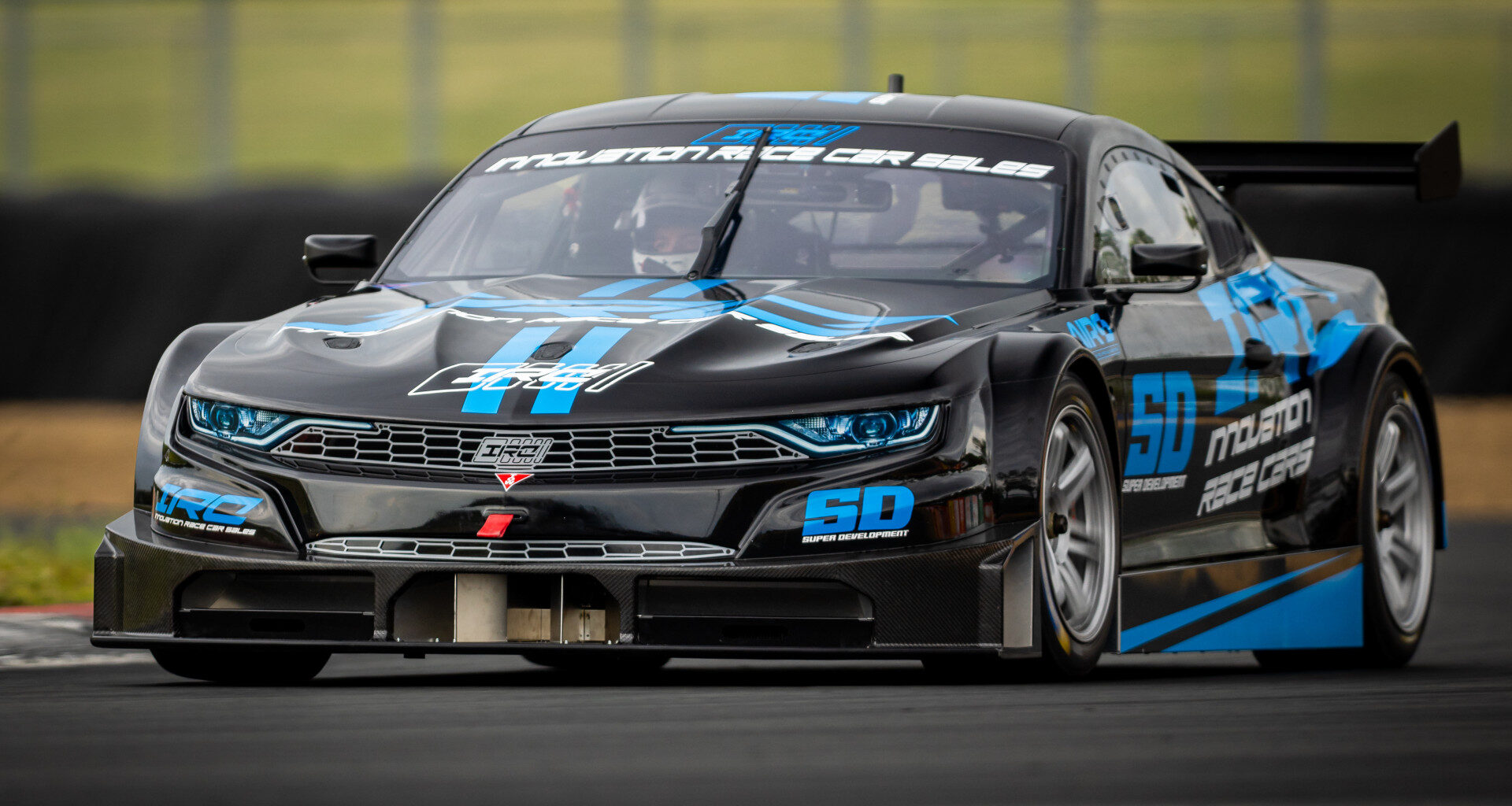
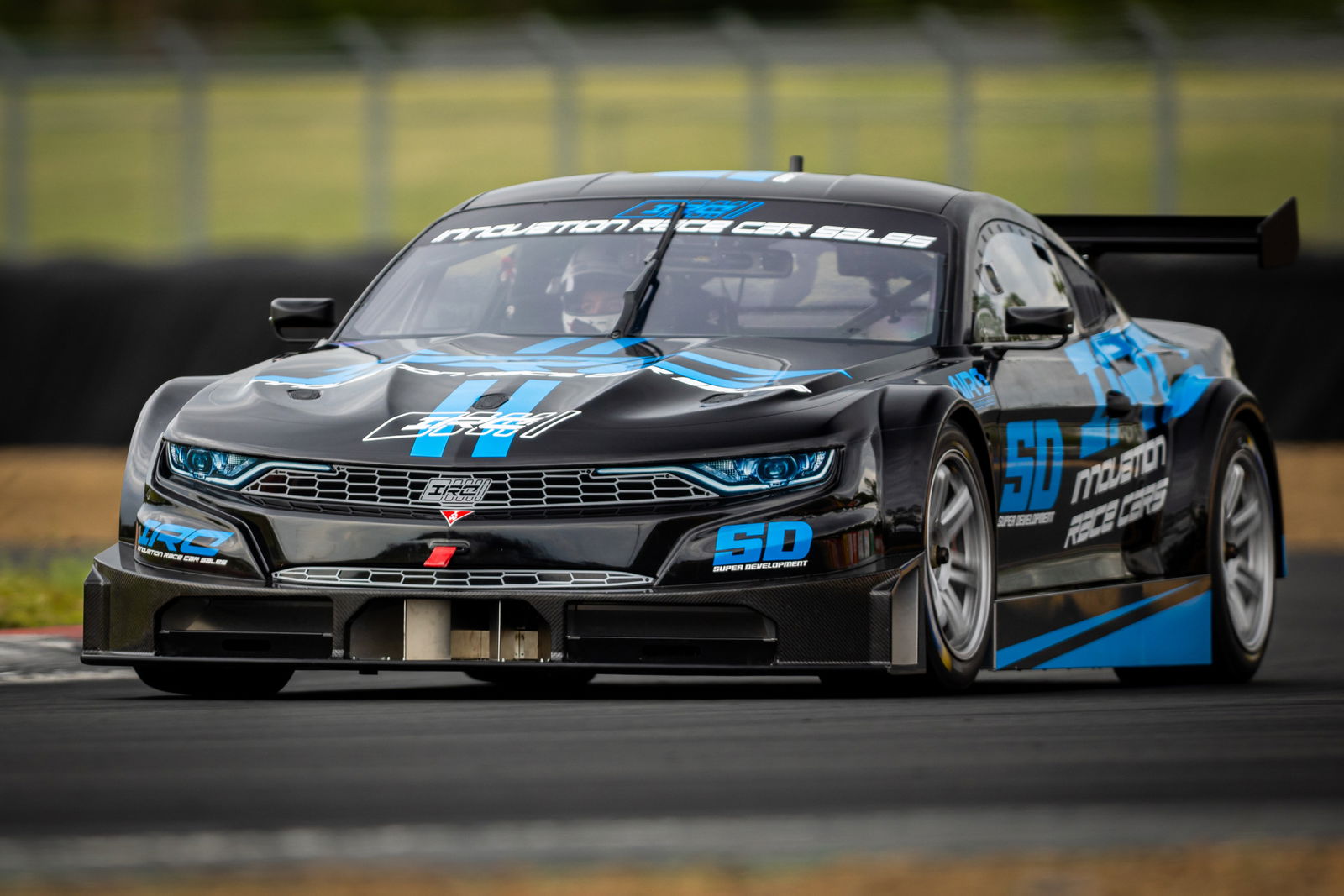
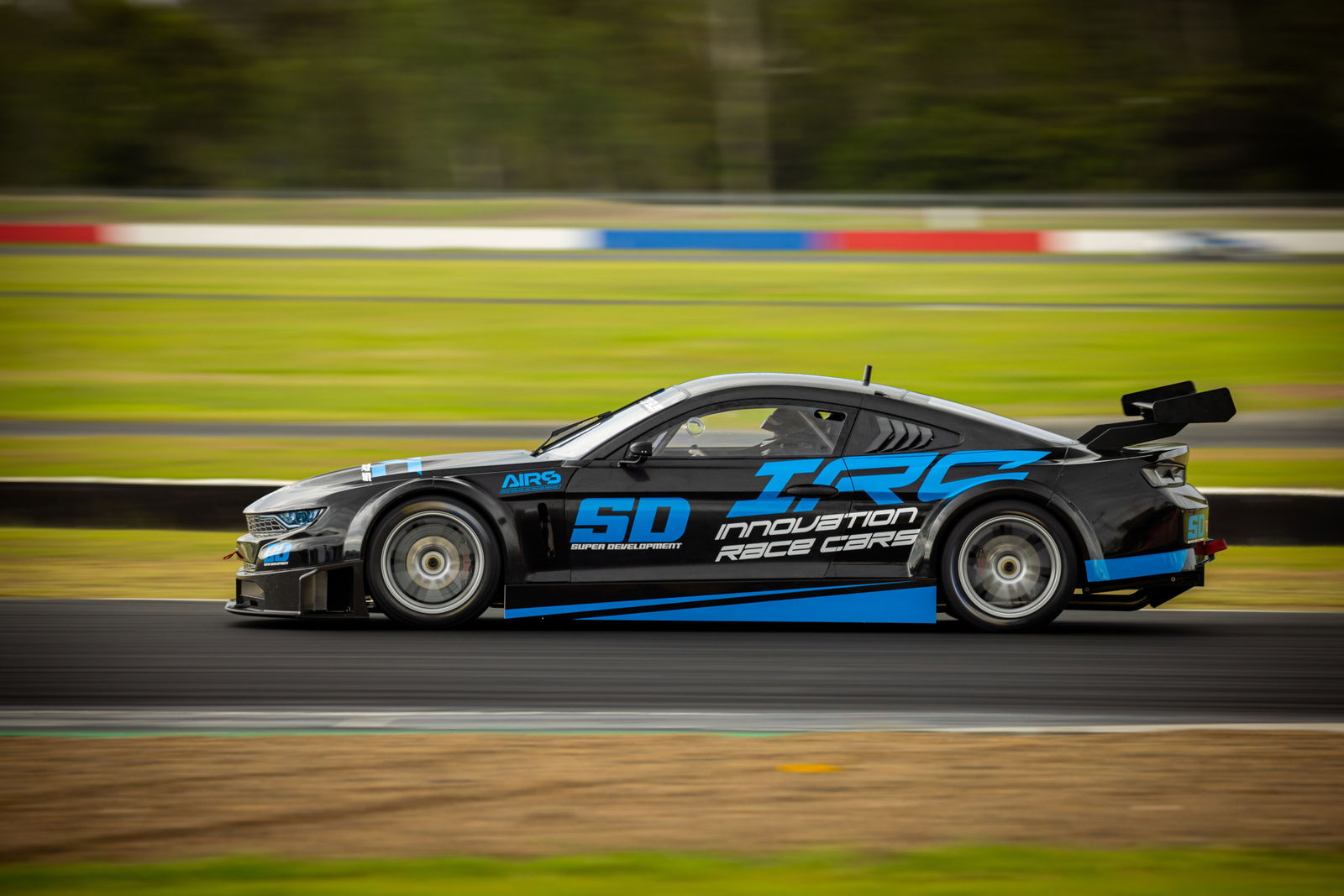
The new Super Development (SD) by Innovation Race Cars (IRC). Image: MTR Images
Dubbed ‘Super Development’, the car was presented this week alongside the regular IRC GT model at Queensland Raceway.
Aesthetically, both the IRC GT and IRC SD are almost identical, but under the skin is where they differ.
Anti-lock braking and traction control is disabled in the SD while the paddle-shifters are replaced by a sequential shifter.
The SD car is also right-hand drive and features less downforce than its GT counterpart, with a new front splitter and revised bottom-mounted rear wing as opposed to the original top-mounted, goose-neck.
Built by Pace Innovations, the SD is being billed as a low-cost stepping stone on the V8 racing ladder with Gen3 characteristics – costing roughly $370,000 to buy outright.
The SD and GT are both powered by a 6.2-litre, naturally aspirated, LS3 engine making 550hp.
Porsche Carrera Cup Australia winner Harri Jones, who drove with Team 18 in this year’s Enduro Cup, tested the car over two days at Queensland Raceway, hailing it a “rocket ship.”
“In terms of how it drives and how it feels, I think, in my opinion, it’s the closest thing to a Supercar I’ve ever driven,” Jones told Speedcafe.
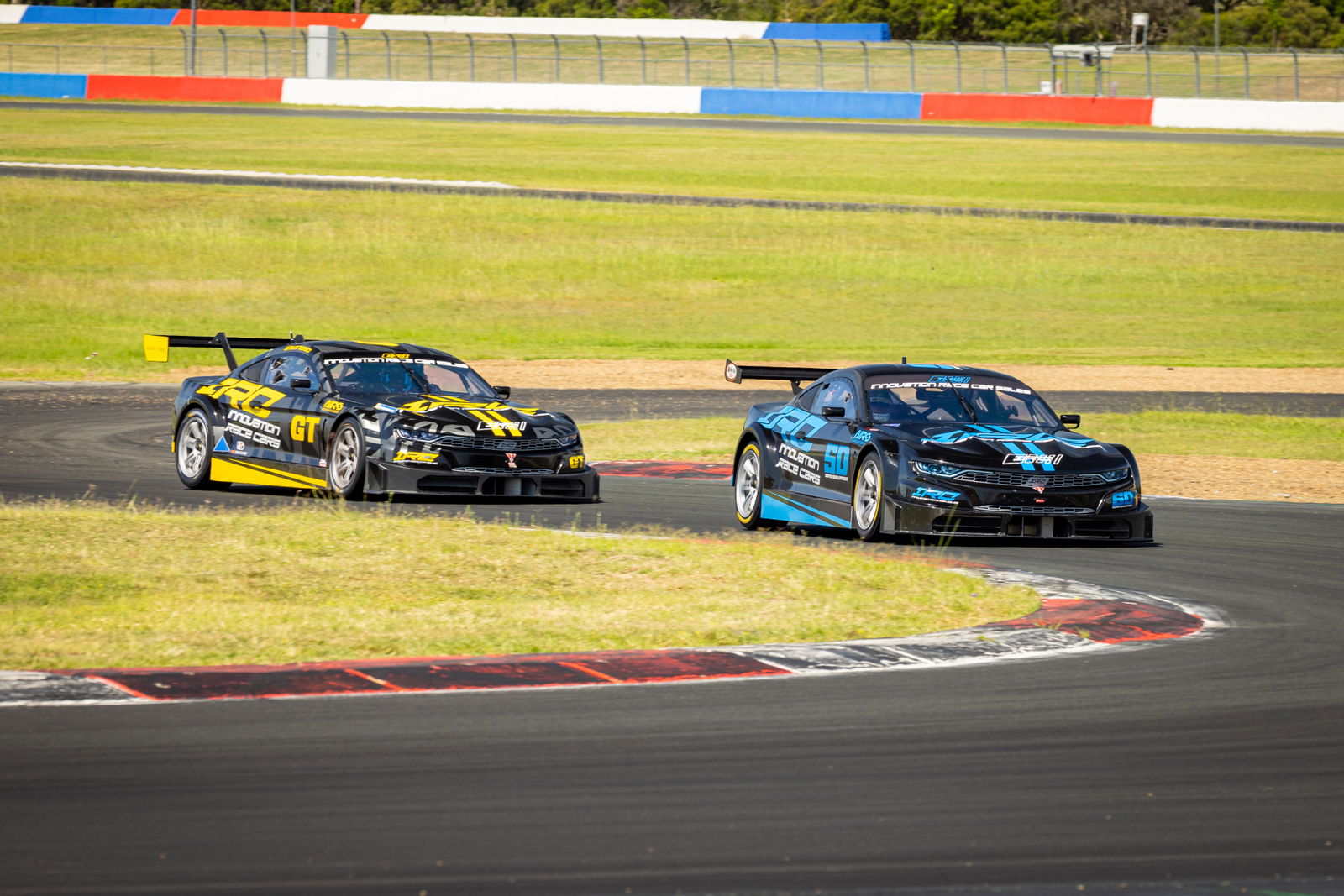
The new Super Development (SD) by Innovation Race Cars (IRC) ahead of the former GT model.
“Even the ergonomics in the cockpit, the way you have to drive the car, the way you have to turn the car, the lines you take, all of that is very similar.
“There are still a few more things in the development process that we’re gonna change just to make it even more similar.
“Straight out of the box, you couldn’t really ask for much more than what they’ve delivered.”
Although the shift mechanism is electronic with a pneumatic shift barrel actuator, Jones said the driving style is still akin to a Supercar with left-foot braking and heel-toe possible.
One key difference between the IRC and a Supercar is that the SD and GT both feature a limited-slip differential as opposed to a locked differential.
“It’s all manual. Basically, it’s exactly how you drive a Supercar, but it’s just a different system to change the gears,” he explained.
“Instead of me pushing on the gearbox, it’s a shift barrel that pushes on it.
“The good thing is, you can right foot brake. I did pretty much all of the testing as a right foot braker just to make sure it is exactly as it should be.
“I did a couple of sessions left for braking as well, just to make sure for anyone that wants to come in that it doesn’t matter what technique you’re using, you can do it either way.
“Obviously, if you’re developing for Gen3 Supercars, you’re going to want to right foot brake.”
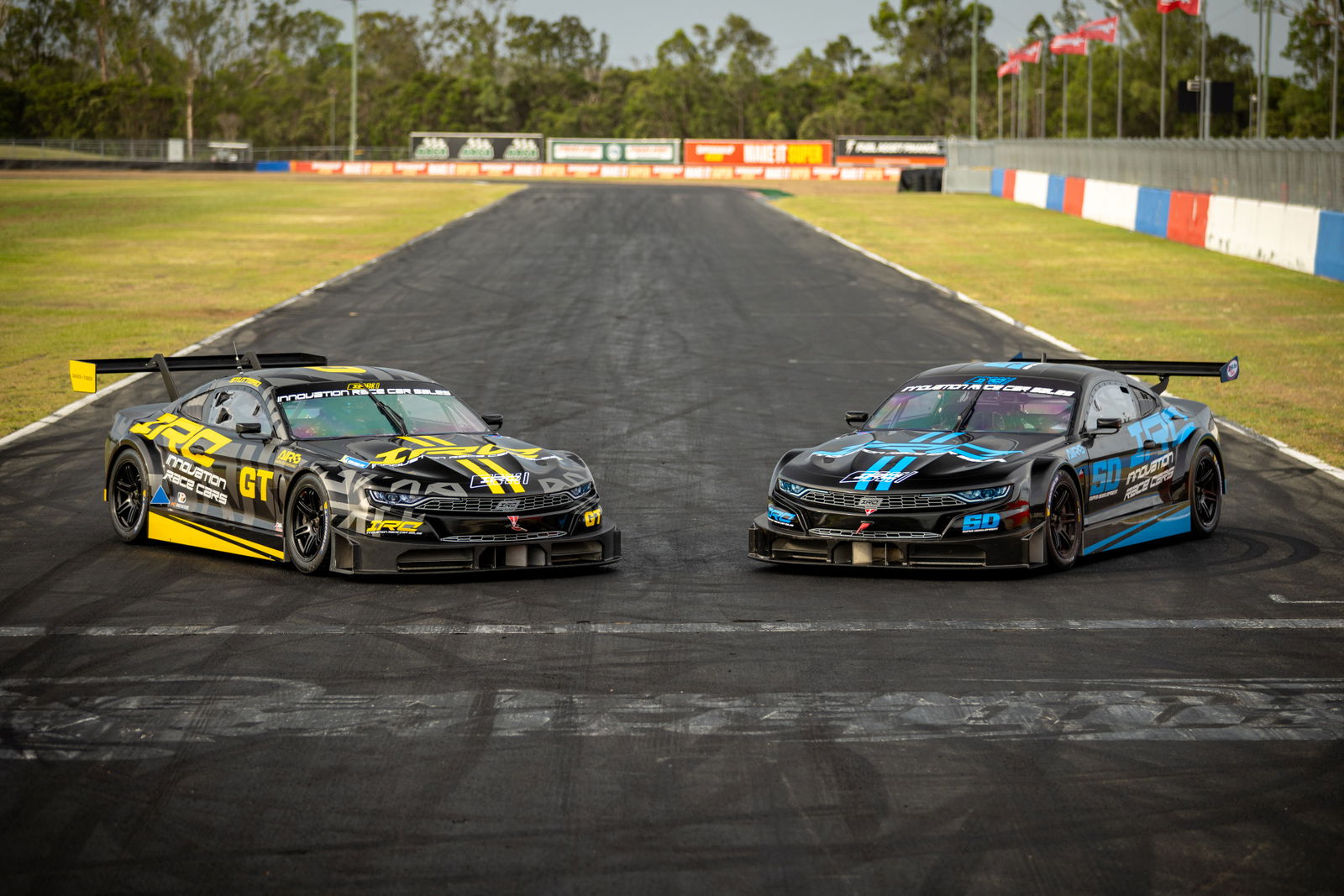
The new (right) Super Development (SD) by Innovation Race Cars (IRC) alongside the GT model (left).
Innovation Race Cars is the successor to MARC Cars Australia, which was started by Ryan McLeod.
‘MARC’ cars took philosophies from the Car of the Future (COTF) Supercars of the 2010s, building a series of V8-powered, cost-effective, hatchback and coupe racers based on the Ford Focus, Ford Mustang, Mazda 3, and BMW M235i.
Geoff Taunton took over MARC Cars Australia and established what is now known as Innovation Race Cars.
Now the Innovation Race Cars business is owned and operated by racer Danny Stutterd and his son James Stutterd.
Innovation Race Cars has its own series run within the AASA-affiliated (Australian Auto-Sport Alliance) Hi-Tec Oils SuperSeries.
Grids are modest, although two SD cars have already been committed to the 2026 series.
Jones said the SD could be seen as a stepping stone to Supercars – alongside Trans Am but below the Super2 Series.
Harri Jones drove the IRC SD at Queensland Raceway.
“I think the biggest point of difference that IRC has is how cost-effective it is,” Jones explained.
“Running under AASA, they’re very cheap events to attend and your entry fees are low, but then most of all, the cars are quite cheap.
“The running costs are cheaper than anything we’ve driven. I’ve got experience with Cup cars and Supercars and historic race cars and all sorts. They’ve got everything they need and nothing they don’t.
“The cars are built to be maintained by minimal crew. In terms of engineers, the category has shared access to very experienced engineers.
“Even small teams, you don’t need to rock up with a team of personnel just to run one car. You can actually do it pretty well bare bones.
“In terms of where it fits on the motorsport landscape, it is probably in line with Trans Am or even say Porsche Sprint Challenge or Mustang Cup or GR Cup. It’s probably a step below Super2.
“Super2 is always gonna have an important role in the Supercars platform and landscape because it is a Supercar, right? You can’t really forget that.
“Maybe it’s not a Gen3, but it still has the same bones. You’re still talking with Supercars teams, working with Supercars engineers.
“Right now, there’s a gaping big hole in the Australian landscape. There’s nothing really of much relevance to Supercars other than Super2.
“Trans Am and Sprint Challenge and other categories that are being used as a feeder series out of something like 86s or go-karts, it’s a compromise of some sort.
“The IRC car shares pretty well all of the same characteristics as a Supercar, just without the price tag.”
The six-round 2026 Australian IRC Racing Series begins at The Bend in March. The series will be split into an endurance and sprint format.
The first three rounds will be endurance rounds, each featuring two, 50-minute races. The sprint rounds will include four shorter races.

Image: MTR Images

Image: MTR Images

Image: MTR Images
