
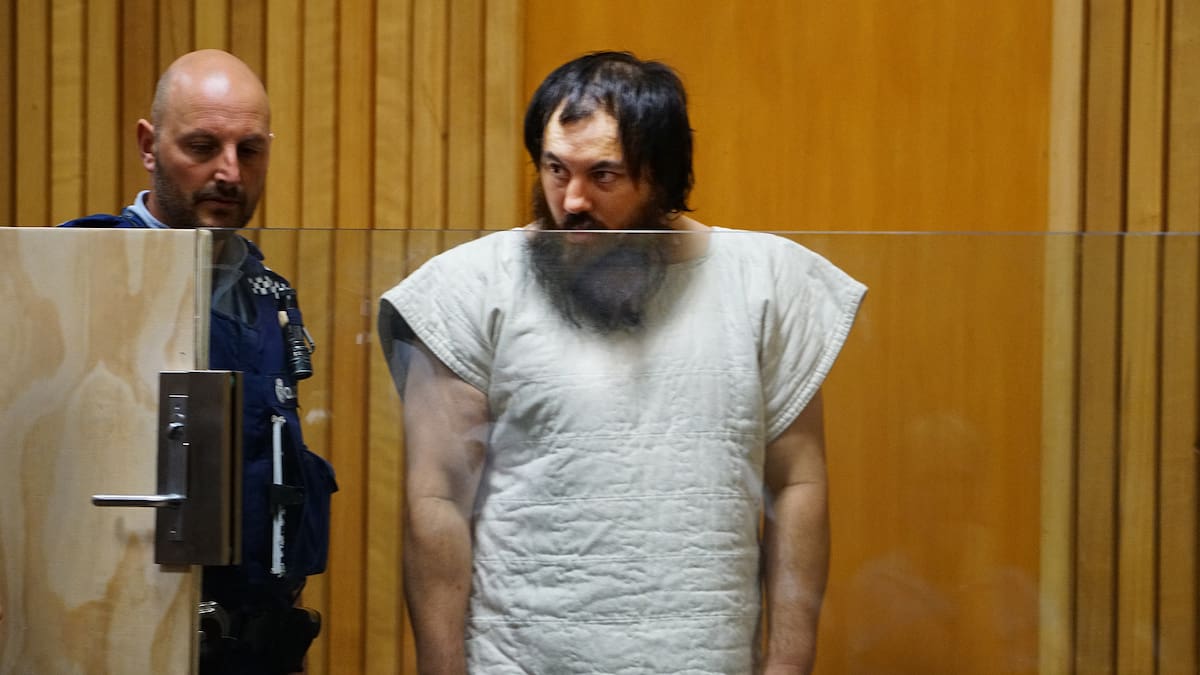
Being made a special patient was something Crown prosecutor Rebekah Hicklin, Dent’s counsel Elizabeth Hall, and even Dent himself agreed should happen.
But that wasn’t enough; the court also had to decide that such an order was necessary.
Justice McHerron said the category of special patient was reserved for those who required “extraordinary precautions” and required “ultimate care and treatment”.
The word “special,” he explained, referred to special procedures that applied in relation to the person’s treatment and management to safeguard the public.
It is a restrictive order, imposed for an indefinite term and remains in force until the Minister of Health directs that Dent should be discharged from it.
Lived an isolated existence with his animals
At the time of the killing, Dent was known to mental health services in Whanganui, receiving both inpatient and community treatment.
But he’d withdrawn from those services and lived an isolated existence, with mainly his animals for company.
The court heard it was the death of one of his animals, a cat, which triggered the tragic sequence of events.
Dent had buried his treasured pet in his backyard.
Next door, Raukawa was entertaining friends and family in her backyard.
Sometime in the afternoon, Dent, who was extremely upset, decided his neighbours were responsible for the cat’s death, despite no evidence to suggest that was the case.
Dent spoke to Raukawa, who denied it.
After returning home and grabbing two knives, he returned, first stabbing Raukawa and then her daughter Parepumai Raukawa in a shared driveway.
Seeing what was happening, Parepumai’s then partner Marama Wall and his friend Frederick Davy attempted to distract Dent, but were themselves stabbed.
Raukawa‘s friend and colleague Dalphina Taurerewa and Raukawa’s boarder Kahurangi Edwards were also stabbed.
Following Parepumai on to the street, Dent stabbed her saying, “You are all going to die”.
Raukawa died from her stab wounds, while the five others suffered varying degrees of injury.
They sought help from strangers at the scene and the nearby supermarket, who provided first aid.
The High Court has ordered that Jarrod Arnold Dent be made a special patient.
Acts of heroism required quick thinking and bravery
Justice McHerron acknowledged the heroism of those involved and outlined the chaotic scenes that unfolded, as people realised what was happening.
One victim managed to distract Dent and draw him away as he was about to slit the throat of one of his victims.
Another removed his singlet, wrapping it around the neck of another victim to stem the bleeding.
At the same time, another ran to the supermarket to raise the alarm, despite being severely injured.
The judge praised not only those directly affected by the attack, many of whom had distracted Dent, preventing further injuries, but also courier drivers Shane Nesbit and Glen Campbell, as well as police and other first responders who shielded the victims and provided help.
“These acts of heroism required quick thinking, bravery and selflessness,” the judge said.
“Without these acts of bravery and selflessness, I have no doubt more people would have died or would have had worse injuries from Mr Dent’s attack,” he said.
Meanwhile, Dent returned to his flat and called his mother and the police, who arrested him shortly after.
He was originally remanded in custody before being transferred to a forensic psychiatric ward, where he has been since, appearing by audio-visual link, as he did for his trial and the hearing.
Jarrod Arnold Dent appeared by audio-visual link for a disposition hearing in the High Court at Whanganui on Monday. Photo / Bevan Conley
A significant danger to the safety of the community
In weighing up whether to make the order, the judge referred to Dent’s risk of serious and unprovoked violence, describing Dent’s behaviour as at “the most serious end of the scale”.
Justice McHerron said that risk was ongoing and Dent had the potential to deteriorate quickly, posing a significant risk to any community-based service responsible for managing him.
Finally, Dent’s complex mental diagnosis, which treating clinicians couldn’t agree on, made it difficult for general mental health services to treat and monitor him.
“I readily accept that to keep the community safe from Mr Dent, and to keep him safe, a specialist approach to long-term treatment is required; the opinions of psychiatrists carry significant weight.
“I am clearly satisfied that Mr Dent remains a significant danger to the safety of the community,” Justice McHerron said, adding that this would continue until he has received considerably more treatment in a secure facility, if not indefinitely.
“If his release back into the community is ever contemplated, that will need to be very carefully managed, supported and monitored.”
Having considered all the evidence, including medical assessments and what was heard at Dent’s trial earlier this year, Justice McHerron said it was in the interests of the public, the victims and the offender that Dent should be detained in a hospital as a special patient.
Case’s unusual history
During the hearing, Justice McHerron outlined the case’s unusual history.
Following the incident in 2019, the original trial was delayed because of the Covid pandemic.
In 2021, Dent was found unfit to stand trial, only to be declared well enough three years later.
In August this year, a jury found Dent killed Miriama Raukawa and wounded five others, but was not guilty by reason of insanity.
“The jury accepted Mr Dent was insane at the time and so not criminally responsible,” the judge said.
This meant he had a disease of the mind and was incapable of understanding the nature and quality of his actions, Justice McHerron told the court.
That meant it was for the judge to decide what was the best pathway under the Criminal Procedure (Mentally Impaired Persons) Act, to keep both Dent and the community safe.
The hearing finished with Justice McHerron ordering that Dent be detained in hospital as a special patient under the Mental Health Act.
Catherine Hutton is an Open Justice reporter, based in Wellington. She has worked as a journalist at the Waikato Times and RNZ. Most recently she was working as a media adviser at the Ministry of Justice.