
Great mash-up of the indigenous and the exotic there. But while the red blooms have fallen, the jacarandas are also having a spectacular year. There are trees smothered in purple haze all around my part of town.
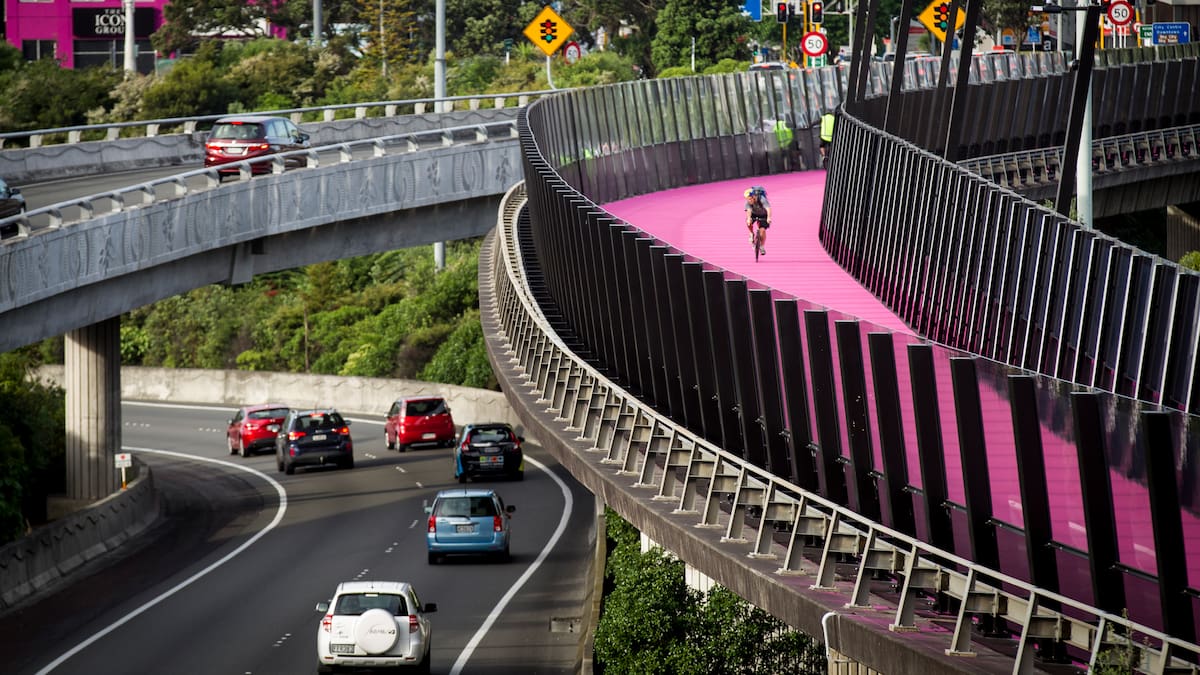
Apologies, but it’s my last weekly column for the Herald, so of course I’m going to write about the joy of cycling in the city, and of course I’m going to slip in some climate-change stuff. And yes, I will have some things to say about Wayne Brown too.
Bicycles give you the freedom that car ads promise.
I didn’t dream that up – the credit goes to the Canadian advertising guy turned cycling advocate Tom Flood – but I think it’s brilliant and true.
The reason it’s true is the physical reality of cycling: you’re in the world, not shut away from it. And as I may have mentioned once or twice, cycling’s good for all the things: reducing emissions, easing road congestion, improving public health, shopping, seeing people, having fun.
And boosting children’s independence. If social media is bad for kids, what better way to embrace the idea than buying them bikes and sending them off to ride?
Oh wait. We don’t have enough safe cycleways.
Well, we do have a lot. We need more, no disputing that, and especially we need a cycling connection over the harbour and safe routes to Cornwall Park.
But there are bike lanes all through Māngere and in some other suburbs, on very long stretches around the harbours, through joined-up parks and on more city streets than ever before.
Triple Teez forever! Māngere cyclists (from left) Ioaba Parai, Maliu Mafi and Manu Ioane making a T sign to represent the Triple Teez bike hub, where they learned how to ride. Photo / Auckland Transport
The Herald office is just off Victoria St West, so my route into town takes me through Victoria Park, along the 30km/h streets of the Wynyard Quarter, along the waterfront, over the bridge and along Quay St.
It’s green and gorgeous all the way and it’s one of the things I will miss.
That route also begs a question: now there’s a pretty good network of cycleways in and around the central city, where’s the plan to expand it in other town centres and around schools?
And what about Waiheke? The island is so obviously a perfect place to ride e-bikes, for locals and visitors alike, you’d think they’d be the norm there by now.
But they’re not, and there’s only one reason why: New Zealand drivers. Even on narrow roads with no borders and gullies to the side, many Waihekeans drive as fast as they can. That’s people casually ruining their own slice of heaven.
Changing our driving culture needs commitment from both central and local government. The solutions don’t need to be expensive but they do need to be good. And safe for kids. That’s the test.
Brown has given precious little indication that he understands the purpose and value of cycling, or even that he grasps the need to moderate driving in the central city.
He was at it again in a council meeting this week, suggesting the wharf area around the Viaduct Events Centre in the Wynyard Quarter could be used for car parking.
This is a “solution” for which there is no problem.
Wynyard is a low-traffic zone and a model of how good urban planning and design can be. Many of the corporates in the office buildings there have incentivised their staff to use public transport and to walk or cycle – and it works.
It’s near the train and ferries and the end point for three frequent bus services: the City Link, Remuera route 75 and Ponsonby/St Lukes route 20. At the south end of the quarter, Fanshawe St carries all the bus services to the North Shore.
The linear park along Daldy St, connecting the waterfront to Victoria Park, is magnificently pedestrian-friendly. And the waterfront itself, which is fully pedestrianised, is a jewel in our urban crown, always busy, with attractions for people who want to spend a lot of money, a bit of money or nothing at all. Safe for kids, cool for everyone.
Its latest feature is the seawater pool at Karanga Plaza, known as Browny’s Pool, which has been wildly popular in the recent heat.
And it’s not just the pool. The plaza is popular (and features many pōhutukawa), the bridge is popular, the whole precinct is a charm.
Now “Browny” wants to put a carpark next to it.
I’m just going to say it. In my view, when it comes to things like this, he’s being idiotic.
And where does his deputy, Desley Simpson, stand on this? I asked her twice this week what she thought of the carpark suggestion and she declined both times to answer.
Karanga Plaza also has new changing sheds that are so lovely, they could just be my favourite thing about the whole city right now. It’s great the pool has this amenity, but honestly, even if that little gem of a building was nothing more than a piece of public art, we’d still all be the richer for it. Thank you, Pac Studio.
“Browny” told me a few months ago it’s a waste of money.
The changing sheds for “Brownie’s Pool”, Karanga Plaza in the Wynyard Quarter, designed by Pac Studio. Photo / Samuel Hartnett
Credit where it’s due. He has grasped the most important issue facing urban development. A well-planned compact city, with growth focused around town centres and good public transport, will do more to control household living costs, traffic congestion, road crashes and emissions than any other policy.
But that doesn’t make him an urbanist. Brown does not appear to grasp that we won’t achieve any of those objectives if he also privileges driving in places where cars don’t need to go.
The difficult truth is that a city safe for cycling is a city fit for every worthwhile purpose.
And, to be honest, I’m a bit sick of saying it, although I guess I should thank my rage readers: your clicks are important to us. Much deeper thanks to the readers who enjoy what I write. I get messages of appreciation every week and it means a lot.
But I’m not sick of riding around the city. Did I say it’s good fun? One reason for that: you can forget about the idiots. I recommend it, whoever your particular idiots happen to be.
Simon Wilson is retiring from the Herald this week, but says he will continue to write about urban affairs, social issues, the climate and politics on a freelance basis.